
AI in procurement is the use of machine learning, natural language processing, and generative models to run purchasing work, such as sourcing suppliers, drafting RFQs, reading quotes, analyzing spend, and reviewing contracts, with far less manual effort. It's the shift from software that follows fixed rules to software that reads a messy PDF, drafts a request, and flags an outlier.
This guide is the hub for everything Buyer24 publishes on the subject. It covers what AI in procurement actually is, the difference between generative and agentic AI, where AI fits across the sourcing lifecycle, the ROI and the risks, how roles change, and how to get started. Each section links to a deeper guide on its topic.
What is AI in procurement?
AI in procurement is the application of artificial intelligence, mainly machine learning and generative models, to the tasks that make up buying: understanding a need, finding and contacting suppliers, collecting and comparing quotes, analyzing spend, and managing contracts. In 2025, McKinsey found that about 40% of procurement functions had begun using generative AI (McKinsey, 2025), a fast move for a traditionally conservative function.
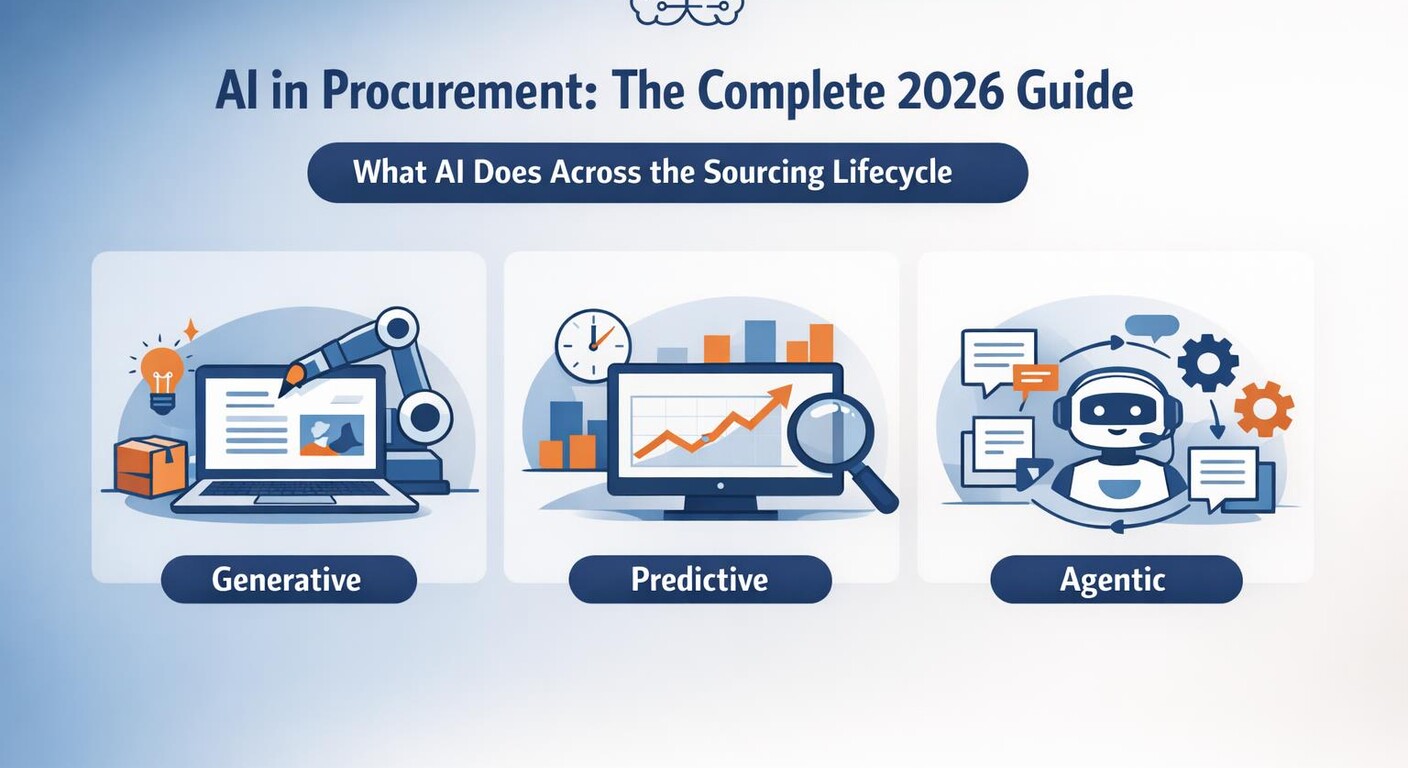
The category is broader than one tool. It spans predictive models that forecast demand or risk, generative models that draft and read language, and, increasingly, agentic systems that chain those steps together and act with light supervision.
It helps to say what AI in procurement is not. It isn't a replacement for the buyer, and it isn't a rules-based automation macro. Rules-based tools route an approval; AI reads the unstructured contract that triggered it. The two work together, but they aren't the same thing, which is a point we return to when discussing how AI is transforming procurement automation.
The recent change is in language: once software could reliably read a PDF quote or draft a tailored RFQ, the mechanical core of sourcing became automatable.
Why is AI in procurement a priority now?
AI in procurement is a priority now because procurement teams are being asked to manage more spend with fewer people, and AI is the only lever that scales without headcount. In 2026, the Hackett Group found procurement workloads rising 8% while budgets and headcount decline (Hackett Group, 2026 Procurement Key Issues Study).
The pressure shows up in the numbers. In 2025, McKinsey noted companies now manage 50% more spend per employee than five years ago (McKinsey, 2025). Meanwhile, in 2026 the Hackett Group reported 80% of procurement executives calling AI-enabled technology the most transformational trend of the next five years (Hackett Group, 2026), ahead of automation, skills, and ESG.
Market-research estimates put the broader procurement-software market at roughly $10.9 billion in 2026, growing to about $21.3 billion by 2033 (Grand View Research, 2025, a market-research estimate), with the AI-specific segment growing faster on most models. Treat those sizing figures as directional, since market-research firms scope the category differently and their forecasts diverge widely.
The consequence of sitting still is falling behind on cycle time and cost while competitors reallocate hours to strategy. For teams still early in the journey, our guide to digital transformation in procurement covers where to begin.
Where does AI fit across the procurement lifecycle?
AI fits at every stage of the source-to-award lifecycle, but it delivers the most where work is repetitive and text-heavy: intake, RFQ creation, quote handling, and spend analysis. The map below shows where AI does the heavy lifting and where a buyer still owns the outcome. For the sourcing process itself, independent of the technology, see our practitioner's guide to strategic sourcing.
| Lifecycle stage | What AI does | Buyer24 deep-dive |
|---|---|---|
| Intake & specification | Turns a vague need into a structured spec | Pre-procurement workflow |
| Sourcing & RFQ creation | Drafts requests, selects and contacts suppliers | RFQ automation |
| Quote collection & comparison | Extracts and normalizes quotes into a like-for-like view | Supplier quote management |
| Spend & category analysis | Classifies messy line items, surfaces tail spend | AI for tail spend |
| Contracting | Extracts clauses, summarizes obligations and renewals | (see risks and ROI below) |
The pattern holds across the row: AI handles the reading and reconciling, the buyer handles the deciding. The first payoff is usually in quote handling, because extracting prices from mismatched PDFs is the single most time-consuming manual step, and it's the one AI removes most cleanly.
The mistake teams make is trying to automate the whole lifecycle at once. Pick the stage with the most repetitive volume, prove it, then expand.
Generative, predictive, and agentic AI: what's the difference?
Generative AI creates and reads language, predictive AI forecasts from historical data, and agentic AI chains those abilities together to complete multi-step tasks with limited supervision. The distinction matters because each carries a different risk and readiness profile. In 2025, Deloitte found the top generative-AI investment priorities to be spend analytics (53.4%), RFP and RFQ generation (42.3%), and contract summarization (41.3%) (Deloitte, 2025 Global CPO Survey), all generative tasks.
- Predictive AI forecasts demand, price movements, or supplier risk from past data. It's the oldest and best-understood layer.
- Generative AI drafts RFQs, reads quotes and contracts, and summarizes. This is where most procurement value sits today, and we cover the concrete applications in our rundown of generative AI use cases in procurement.
- Agentic AI is the frontier: systems that source, negotiate, or reorder with a human setting the guardrails rather than approving each step.
The agentic trajectory is steep on paper, but adoption is the slowest of any business function, and where to place the human gate is a decision in its own right. We cover both in our guide to what to let an AI agent do in procurement.
What can AI automate, and what stays human?
AI can automate the mechanical, repetitive parts of procurement, such as structuring intake, drafting outreach, chasing responses, extracting and normalizing quotes, and assembling comparisons. Judgment stays human: final supplier selection, negotiation strategy, relationship calls, and risk tolerance. In 2025, BCG estimated that generative AI can streamline up to 30% of manual procurement work (BCG, 2025), which is the mechanical layer, not the decisions.
The table below maps the division of labor.
| Task | AI role | Human role |
|---|---|---|
| Intake structuring | Draft the spec | Review |
| Supplier shortlisting | Suggest candidates | Final selection |
| RFQ drafting and sending | Draft | Approve |
| Follow-up reminders | Automate | Oversee |
| Quote extraction and normalization | Do it | Spot-check |
| Comparison and outlier flags | Build the view | Interpret |
| Negotiation | Prepare data and options | Decide and execute |
| Award | Recommend nothing | Decide and own |
The common principle is accountability: a model can draft, extract, and flag, but someone signs the award and answers for it. That division is also why the "AI replaces buyers" framing misreads the shift, a point we unpack in how AI reshapes procurement roles.
How does AI change procurement roles and skills?
AI changes procurement roles by removing data entry and shifting the job toward supplier strategy, negotiation, and oversight of the models doing the grunt work. The buyer becomes an editor and decision-maker rather than a typist. This raises the skill bar. In February 2026, ManpowerGroup reported that AI skills had become the hardest capability to fill globally, with 72% of employers struggling to fill roles (ManpowerGroup, 2026 Global Talent Shortage Survey).
The gap between wanting AI skills and building them is stark. In 2025, BCG found that 89% of executives said their workforce needed better AI skills, but only 6% had begun meaningful upskilling (BCG, 2025), and procurement is no exception.
What does this mean day to day? Routine buyers move up the value chain toward category strategy and supplier relationships. Analysts spend less time cleaning spreadsheets and more time interpreting what the model surfaced. Managers add a new responsibility: governing how AI is used and checking its output.
The teams that adapt fastest treat AI as a tool their people learn, not a system that replaces them. For a practical change-management path, see how to introduce AI to your procurement team without the guesswork.
What are the risks of AI in procurement?
The main risks of AI in procurement are ungoverned use, unreliable output, and weak data foundations, each of which can turn a promising pilot into a liability. The first is data. In 2025, Gartner reported that 74% of procurement leaders say their data isn't AI-ready (Gartner, 2025), and a model trained or prompted on bad data produces confident, wrong answers. What that phrase actually means, and which records to fix first, is the subject of our guide to procurement data readiness.
The second is governance. In April 2026, a ProcureAbility report found that 54% of procurement and IT teams were not collaborating on AI governance (ProcureAbility, 2026, a procurement-advisory firm), leaving policy, access, and accountability unclear. The stakes are rising alongside adoption: in 2026, Stanford HAI's AI Index recorded 362 documented AI incidents in 2025, up from 233 the year before (Stanford HAI, 2026 AI Index), a 55% jump.
Ambition also outruns execution, especially on agents. Gartner predicts that more than 40% of agentic AI projects will be scrapped by 2027 (Gartner, Predicts 2026), citing legacy systems and unclear cost. That reinforces, rather than contradicts, Gartner's own placement of generative AI for procurement in the "trough of disillusionment" in 2025. For a full treatment, see the five risks of AI in procurement and how to eliminate each. The response is to scope narrowly, govern deliberately, and keep a human on every decision.
How does AI fit into your existing procurement stack?
AI usually enters procurement not as a rip-and-replace platform but as a layer on top of the tools you already run. In 2026, the Hackett Group found that 69% of procurement organizations access AI through capabilities embedded in their existing platforms (Hackett Group, 2026), rather than through a separate product.
That's a relief for anyone dreading another multi-year ERP project. The practical question isn't "which suite do we migrate to," it's "where does an AI capability slot into what we have."
Two patterns work. The first is enabling AI features inside an incumbent suite, which is fine for the workflows that suite already handles well. The second is adding a focused AI layer for the gap those suites leave open, typically supplier-facing sourcing and quote handling. We make that case in the AI layer your procurement stack is missing.
The third is integration. A tool that can't hand structured award data back to your ERP just moves the re-keying around. Buyer24 is built to run alongside SAP Ariba, Coupa, and Oracle rather than replace them, connecting through email and API so suppliers change nothing.
What ROI does AI in procurement deliver?
AI in procurement delivers ROI across three levers: hours saved, cycle time cut, and better decisions that lower total cost. The clearest outcome benchmark comes from BCG, which in 2025 found generative AI could reduce procurement costs by roughly 15% to 45% (BCG, 2025) depending on maturity and category.
Returns track maturity more than tool choice. In 2025, Deloitte found that "Digital Masters" earned about 3.2 times the ROI on generative AI compared with roughly 1.5 times for "Followers" (Deloitte, 2025 Global CPO Survey).
The table below frames where the value shows up. The illustrative figures reflect typical Buyer24 customer workflows and will vary by category and supplier mix.
| ROI lever | How to measure | Illustrative shift |
|---|---|---|
| Buyer hours per request | Time logged across all steps | 8–15 hrs → 1–2 hrs |
| Cycle time | Days from request to award | 2–4 weeks → 1–2 weeks |
| Cost reduction | Total cost per category | Up to 15–45% (BCG, 2025) |
| Efficiency headroom | Ops capacity from agentic automation | 25–40% potential (McKinsey, 2025) |
One caution: don't measure only unit-price savings. Faster cycles and more comparable quotes often deliver more value than shaving the last percent off a price. In 2025, McKinsey noted that e-sourcing can cut MRO costs up to 20%, yet only about a third of firms use it (McKinsey, 2025), which is pure unrealized ROI sitting in most catalogs.
How do you get started with AI in procurement?
Start with one narrow, high-frequency task, measure a manual baseline, and expand only once it works. Most efforts stall on scope rather than technology. In 2026, the Hackett Group found only 12% of procurement organizations running AI at large scale (Hackett Group, 2026), with most stuck in broad, unfocused pilots. EY's 2025 survey shows the same shape, with 80% of CPOs planning to deploy generative AI within three years but only 36% having meaningful implementations today (EY, 2025 Global CPO Survey Outlook, a ~75-CPO sample). The full six-stage sequence, with the gate between each stage, is in our AI transformation roadmap for procurement.
A short reconciliation, since the numbers can look contradictory: broad, casual use is already near-universal, with 94% of procurement teams using generative AI at least weekly (AI at Wharton, 2024). The gap is between trying it and depending on it. Bridging that gap looks like this:
- Pick one task you do dozens of times a week, such as quote normalization or RFQ drafting.
- Baseline it first: minutes per request, error rate, response rate. Without a baseline you can't prove a gain.
- Embed it where people already work, matching the 69% who deploy through existing tools rather than adding another login.
- Keep the buyer in the loop. The model reads and reconciles; the person decides and negotiates.
Then expand category by category. Each one benefits from the last, and skeptics become advocates once they see hours come back. For smaller teams, that math lands faster, which is why AI procurement for small business often returns value sooner than enterprise rollouts.
FAQ
What is AI in procurement?
AI in procurement is the use of machine learning and generative models to run purchasing tasks such as sourcing suppliers, drafting RFQs, reading quotes, analyzing spend, and reviewing contracts with less manual work. In 2025, McKinsey found about 40% of procurement functions had begun using generative AI. It augments buyers rather than replacing them.
Is generative AI the same as agentic AI in procurement?
No. Generative AI drafts and reads language, like writing an RFQ or extracting a quote. Agentic AI chains those steps to complete multi-step tasks with limited human supervision. Most procurement value today is generative; agentic use is early, and we cover where to place the human gate in our guide to agentic AI in procurement.
Does AI replace procurement jobs?
No, it shifts them. AI removes data entry and repetitive reconciliation, moving buyers toward supplier strategy, negotiation, and oversight of the models. The skill bar rises, though: in 2026, ManpowerGroup ranked AI skills the hardest capability to fill globally. The role becomes editor and decision-maker rather than typist.
What's the ROI of AI in procurement?
ROI comes from hours saved, shorter cycle times, and lower total cost. In 2025, BCG estimated generative AI could reduce procurement costs by roughly 15% to 45%, and Deloitte found mature "Digital Masters" earned about 3.2 times the ROI of laggards. Returns depend on disciplined deployment more than tool choice.
What are the biggest risks of AI in procurement?
The biggest risks are poor data, ungoverned use, and unreliable output. In 2025, Gartner found 74% of procurement leaders say their data isn't AI-ready, and in 2026 a ProcureAbility report found 54% of procurement and IT teams weren't collaborating on AI governance. Scope narrowly, govern deliberately, and keep a human on every decision.
Do I need to replace my ERP to use AI in procurement?
No. In 2026, the Hackett Group found 69% of procurement organizations access AI through capabilities embedded in their existing platforms or through a focused layer on top. A well-designed AI tool connects to your current ERP by email or API, so suppliers and internal users change little.
How should a procurement team start with AI?
Start with one high-frequency task, such as quote normalization or RFQ drafting, measure a manual baseline, and expand only once it works. Broad, unfocused pilots are why only 12% of organizations run AI at scale, per the Hackett Group in 2026. Narrow scope with a measured baseline beats a sweeping rollout.
Key takeaways
- AI in procurement uses machine learning and generative models to run sourcing, quoting, spend analysis, and contracting with less manual work; about 40% of functions have started (McKinsey, 2025).
- There are three layers: predictive (forecasting), generative (drafting and reading, where most value sits today), and agentic (multi-step action, still early).
- AI automates the mechanical work; judgment, negotiation, and the award stay human.
- ROI tracks maturity, not tools: BCG put cost reduction at 15–45% and Deloitte found Digital Masters earn ~3.2x the ROI of laggards (2025).
- The real risks are weak data, absent governance, and over-scoped pilots; only 12% of organizations run AI at large scale (Hackett Group, 2026).
- Start narrow: one high-frequency task, a measured baseline, embedded in existing tools, with the buyer in the loop.