Where AI Procurement Automation Stands in 2026
Artificial intelligence is already part of procurement work. If you're new to the topic, it helps to first understand what procurement automation is before layering AI on top of it. In the ProcureCon CPO Report 2025, 66% of chief procurement officers rated using AI in procurement and decision-making a high priority for the next 12 months, and 82% said they had already identified or prioritized AI use cases for their teams.
The returns are showing up in practice. In Deloitte's 2024 Global CPO survey, about half of the procurement leaders who had piloted or deployed AI reported a doubling of ROI compared to traditional methods, with some advanced implementations seeing returns of more than 5x. For a closer look at the numbers, see what ROI companies can expect from AI in procurement.
This post covers what AI in procurement looks like in practice and how an organization can start using it. It sits within our complete guide to AI in procurement.
Where AI is Making the Biggest Impact
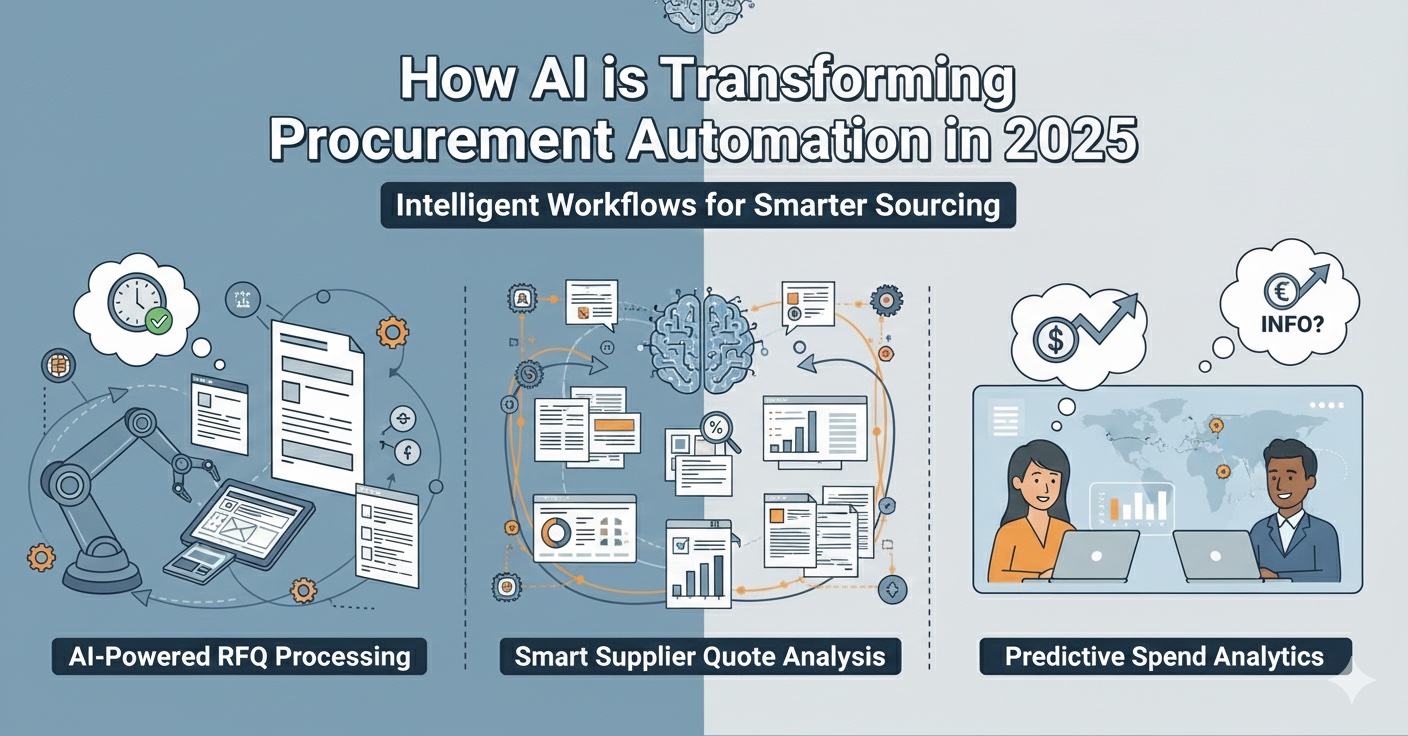
Automated RFQ Processing
One of the most immediate applications of AI is automating the Request for Quote process, as part of a broader shift toward automating the entire pre-procurement workflow. AI-powered systems can now:
- Automatically generate RFQs from purchase requisitions
- Invite and manage suppliers based on category expertise
- Collect and normalize bids regardless of format
- Recommend optimal awards based on pre-set rules and criteria
Autonomous sourcing platforms automate spot buys and tactical sourcing, and their early adopters include Coca-Cola, Mars, and Siemens. The vendor Keelvar reports teams reducing tactical workload by up to 90% and costs by up to 25%.
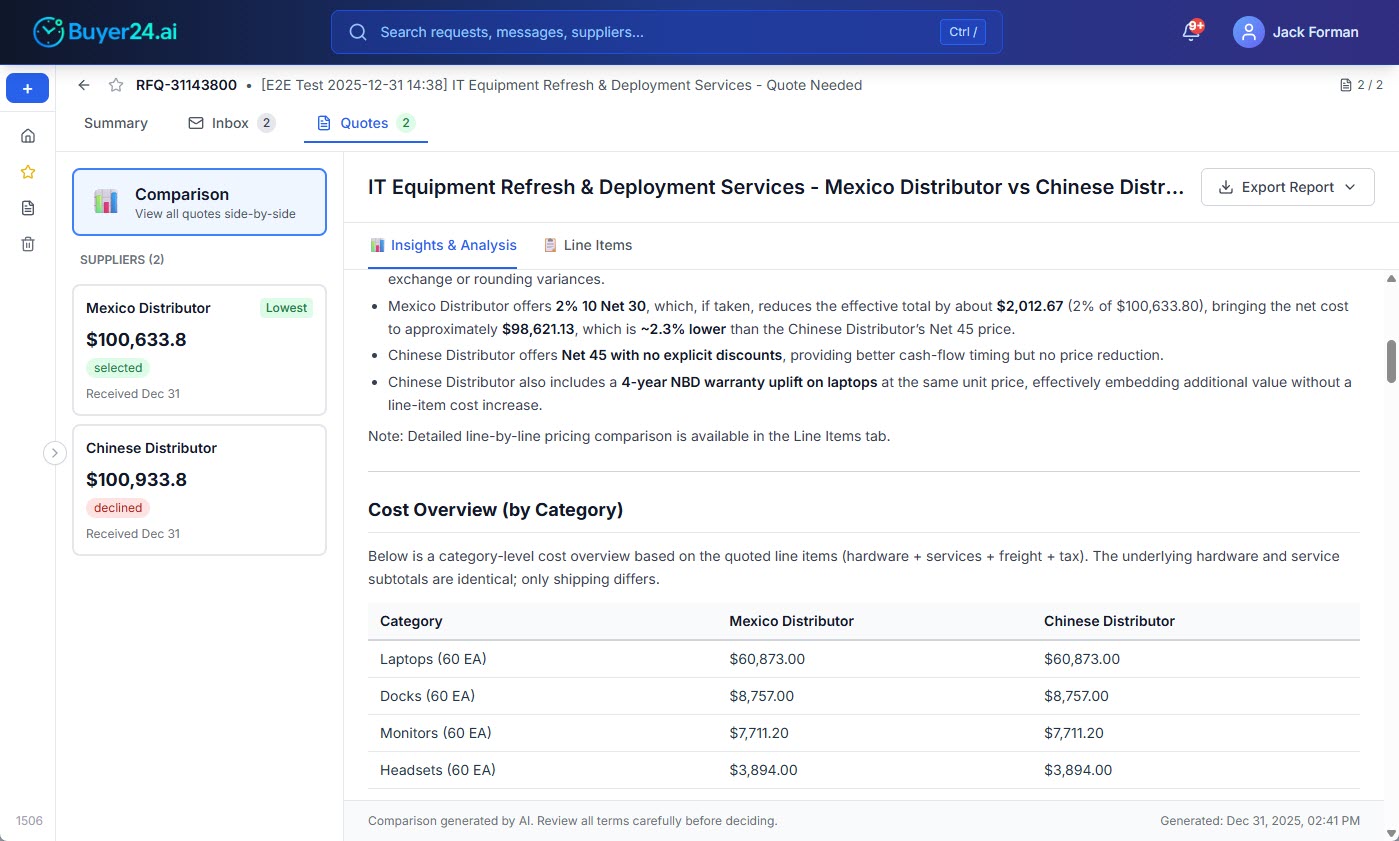
You don't need an enterprise budget to see these gains. In fact, why small teams adopt AI faster than large enterprises comes down to having fewer legacy systems and approval layers to work around. Tools like Buyer24 bring RFQ automation to organizations of any size. When supplier quotes arrive by email, in the email body or as PDF, Excel or Word attachments, the AI extracts pricing, quantities, and delivery terms automatically, and Buyer24 builds the comparison once two suppliers have quoted, so nobody retypes prices into a spreadsheet.
Intelligent Quote Analysis
AI excels at analyzing supplier responses faster and more comprehensively than manual review. Machine learning models can evaluate bids on more than cost, factoring in:
- Supplier reliability and past performance
- ESG compliance scores
- Total cost of ownership projections
- Delivery risk assessments
This multi-dimensional analysis is a big part of how AI improves procurement, because it improves the quality of decisions as well as their speed.
Buyer24 lines up each supplier's price for every line side by side, with quantities, units and currency as quoted. This kind of supplier quote comparison with AI replaces manual spreadsheet work with a side-by-side comparison, a recommendation and its trade-offs. You apply your own weighting, such as price, delivery speed, or supplier reliability, when you decide.
Automated Communication and Translation
Supplier communication is another area where AI has a large effect. AI can now:
- Translate messages automatically between the buyer's and each supplier's language
- Draft professional responses quickly and consistently
- Summarize long email threads into actionable insights
- Track conversations across multiple suppliers and requests
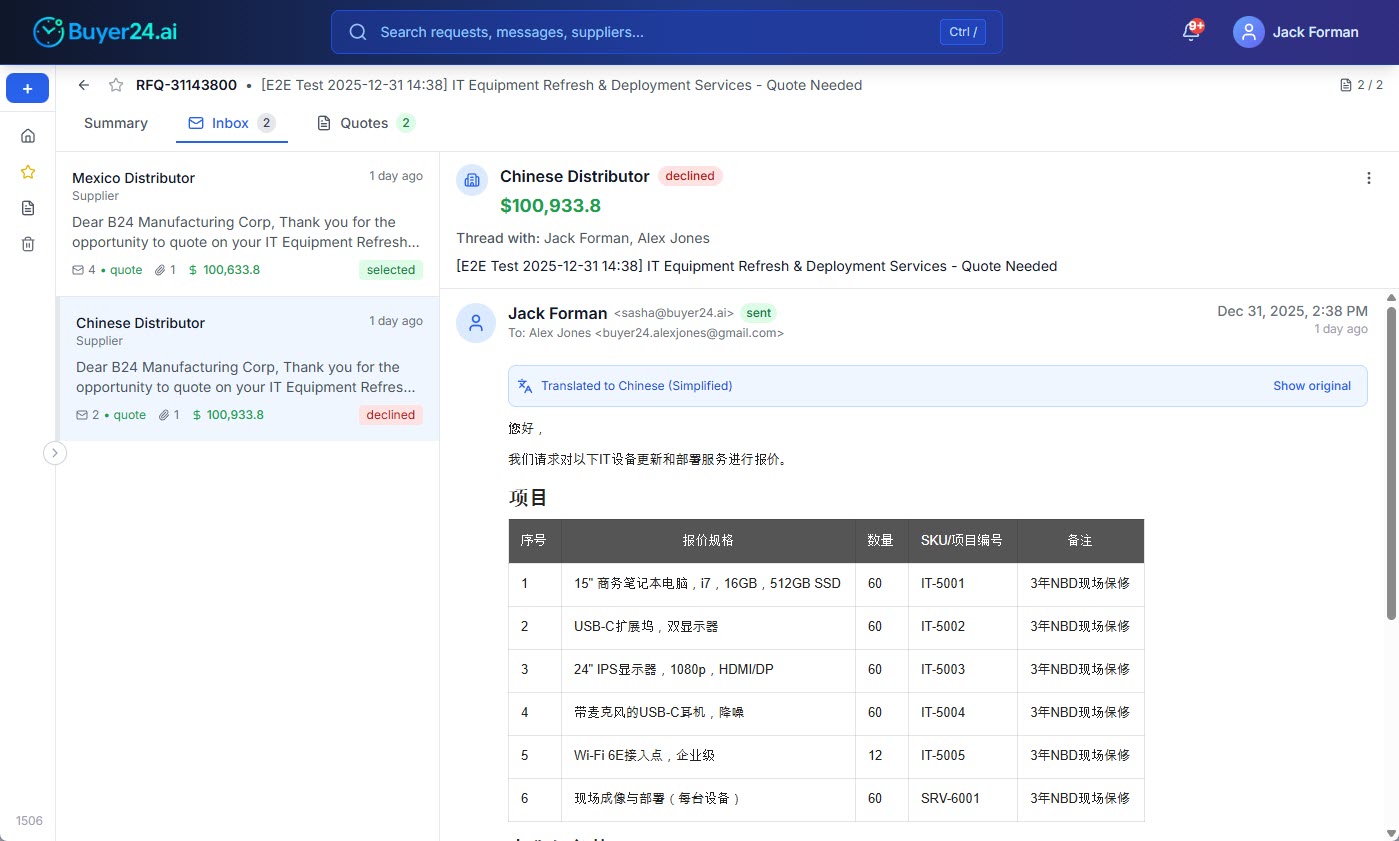
Translation, in particular, opens global sourcing opportunities that used to be out of reach. With Buyer24, RFQs and replies go out in each supplier's language, and a reply from a supplier in Chinese, German, or Spanish can be shown in yours. A "Don't translate, send as written" toggle sends your exact text. This lets you source from the best suppliers worldwide without a language barrier.
Spend Analytics and Pattern Recognition
AI-powered spend dashboards are a top priority. In the ProcureCon CPO Report 2025, 38% of procurement leaders named enhancing data analytics and spend visibility as their most significant technology initiative for the year ahead. These tools can:
- Identify spending patterns across categories
- Flag anomalies and potential savings opportunities
- Predict future spend based on historical data
- Recommend consolidation opportunities
This visibility is especially valuable for low-value, high-volume purchases, where AI is finally helping teams solve the tail spend problem that traditional processes ignore.
Examples from Practice
Consumer brands such as HelloFresh and Canada Goose have adopted AI sourcing to accelerate supplier engagement and cut manual data handling, compressing sourcing cycles that used to take weeks.
McKinsey estimates that AI can make the procurement function 25–40% more efficient, more agile, and increasingly agentic (Transforming procurement functions for an AI-driven world).
The Adoption Gap
Despite the potential, a large implementation gap remains. Optimism about AI's efficiency gains runs high, yet many procurement teams have still not moved AI from pilot to everyday workflows.
Teams that adopt AI now gain competitive advantages in:
- Speed: Faster sourcing cycles mean faster time-to-market
- Savings: Automated analysis finds savings humans miss
- Scale: Handle more RFQs without adding headcount
- Strategy: Free up time for high-value supplier relationships
The barrier to entry is now low. Solutions like Buyer24 act as the AI layer your procurement stack is missing and require no complex implementation, no IT project, and no change to how suppliers interact with you. RFQs go out by email with no mailbox setup, or from your own Gmail, Outlook or IMAP address if you connect it, and the AI extracts quotes from the replies as they arrive.
What AI Can and Cannot Do
AI Excels At:
- Processing large volumes of data quickly
- Identifying patterns across thousands of transactions
- Automating repetitive, rules-based tasks
- Providing a consistent first-pass analysis
- Working 24/7 without fatigue
Humans Still Lead In:
- Building strategic supplier relationships
- Negotiating complex, multi-factor deals
- Making judgment calls in ambiguous situations
- Understanding organizational context and priorities
- Handling exceptions and edge cases
The most successful implementations combine AI efficiency with human judgment. Automation handles the routine work so procurement professionals can focus on the work that requires expertise. This shift is already reshaping day-to-day responsibilities; see how AI reshapes procurement work and responsibilities across purchaser, buyer, and manager roles.
Buyer24 is designed around this division of work. AI handles data extraction, translation, and organization, while you keep full control over decisions. The platform surfaces insights and makes recommendations, but you decide which supplier to select and how to negotiate.
Getting Started with AI in Procurement
Start with Clear Use Cases
Don't try to automate everything at once. Focus on high-volume, repetitive processes where AI can demonstrate clear value:
- RFQ generation and distribution
- Quote comparison and initial analysis
- Spend categorization and reporting
- Supplier communication and follow-ups
If you'd rather not stitch tools together, a single platform that covers RFQs, quote comparison and supplier follow-ups is a practical starting point. Buyer24 is built for those three; spend categorization needs a spend analytics tool. For a wider view of where the technology applies, see our rundown of generative AI use cases in procurement, ranked from easiest to hardest to deploy.
Prepare Your Data
AI is only as good as the data it learns from. Before implementation:
- Clean and standardize your supplier database
- Organize historical RFQ and quote data
- Document your evaluation criteria and workflows
- Identify data gaps that need filling
With Buyer24, data preparation is minimal. The platform works with your existing email workflow and requires no data migration. Suppliers you add on an RFQ are saved to your directory automatically, with their quotes and conversations on their profile.
Choose the Right Tools
It pays to know what AI tools are available for B2B procurement before committing. Look for procurement AI solutions that:
- Integrate with your existing systems
- Require minimal IT involvement to deploy
- Offer clear ROI metrics and reporting
- Provide transparency into how decisions are made
Plan for Change Management
Technology adoption depends on people as much as on software. Help your team understand that AI is meant to support their work rather than replace it, by removing tedious tasks so they have more time for strategic work.
How Buyer24 Delivers AI-Powered Procurement
Buyer24 puts enterprise-grade AI capabilities within reach of every procurement team.
Intelligent Quote Extraction
AI automatically identifies and extracts pricing, quantities, delivery terms, and specifications from supplier emails and their PDF, Excel and Word attachments.
Automatic Translation
RFQs and replies go out in each supplier's language, and their messages can be shown in yours. A "Don't translate, send as written" toggle sends your exact text.
Centralized Communication
All supplier interactions organized by request. Full thread history, quote tracking, and status visibility in one place.
Smart Comparison
Side-by-side quote comparison with a recommendation and its trade-offs, exportable as PDF or Excel. You apply your own weighting when you decide.
AI-Assisted Responses
Draft professional supplier communications quickly. Maintain consistent, high-quality interactions even under time pressure.
Automatic Documentation
Each RFQ has a Log that records its key events (sent, approvals, quotes received, award or close with the reason) with the time and whether a person or an agent acted. Sent messages are locked, and revised quotes keep every version.
Getting Started with AI Procurement Automation
In 2024, procurement led every business function in weekly generative-AI use, with 94% of procurement decision-makers reporting that they used tools like ChatGPT at least weekly (AI at Wharton & GBK Collective, 2024 AI Adoption Report). Enterprise adoption keeps climbing: 88% of organizations now use AI in at least one business function, up from 78% a year earlier (McKinsey, The State of AI in 2025).
Start small, demonstrate value, and scale what works. Buyer24 makes AI procurement automation accessible today.
FAQ
What is AI procurement automation?
AI procurement automation uses artificial intelligence to handle routine sourcing work: generating and distributing RFQs, extracting and comparing quotes, translating supplier messages, and analyzing spend. It removes manual data entry and spreadsheet building so procurement teams can focus on negotiation, strategy, and supplier relationships.
What ROI can companies expect from AI in procurement?
Results vary by use case and maturity, so treat specific figures as illustrative rather than guaranteed. Interest is high: in a 2025 Gartner survey, 68% of CPOs named AI and generative AI a top technology priority (SCMR).
Where should a procurement team start with AI?
Start with high-volume, repetitive processes where value is easy to demonstrate: RFQ generation and distribution, quote comparison, spend categorization, and supplier follow-ups. Avoid automating everything at once. Pick one use case, measure the improvement, and scale what works from there.
What can AI not do in procurement?
AI struggles with judgment-heavy work: building strategic supplier relationships, negotiating complex multi-factor deals, handling ambiguous situations, and weighing organizational context. The strongest setups pair AI efficiency with human judgment, letting automation handle routine tasks so people focus on decisions that require expertise.
Why is data readiness important for AI in procurement?
AI is only as good as the data it works from. Clean supplier records, organized quote history, and documented criteria improve results. This is a real obstacle. Gartner reports 74% of procurement leaders say their data isn't AI-ready (Gartner, 2025).
Ready to Experience AI-Powered Procurement?
See how Buyer24 can automate your RFQ process, translate supplier communications, and help you make better sourcing decisions.