
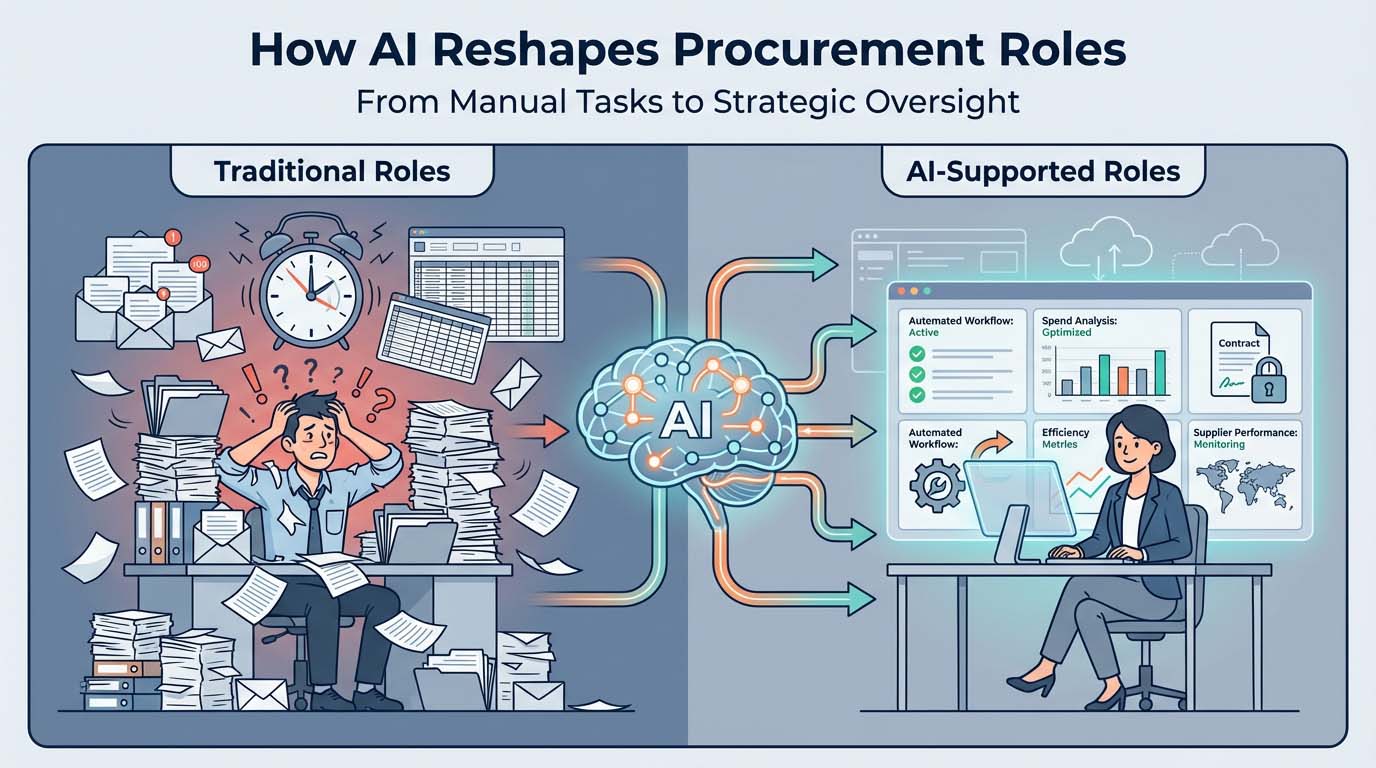
Artificial intelligence (AI) is now embedded in many procurement workflows, changing how procurement professionals allocate time and responsibility. Rather than eliminating roles, AI redistributes tasks between people and systems across sourcing, purchasing, and coordination. This shift is most visible in operational procurement, where large volumes of unstructured information, such as emails, PDFs, catalogs, and supplier messages, must be processed daily. This post is part of our complete guide to AI in procurement, which covers the wider picture. A short answer version is in how AI changes the procurement buyer's role.
Gartner observes that generative AI in procurement has moved from experimentation into structured pilot use cases across sourcing, contract management, and purchasing operations.
What does "AI transforming roles in procurement" mean?
AI transforming roles in procurement refers to a gradual redistribution of work across the procurement lifecycle enabled by technologies such as machine learning and natural language processing. These technologies support tasks such as extracting data from supplier communications, structuring quotes, flagging inconsistencies, and routing approvals.
In practice, AI does not independently manage suppliers or define procurement strategy. Instead, it alters how information reaches purchasers, buyers, procurement coordinators, and managers, reducing manual preparation work while increasing the importance of review, judgment, and exception handling. This is part of a broader story about how AI improves procurement across the lifecycle.
Related concepts and terminology
E-procurement refers to digital systems that manage purchasing and supplier interactions and increasingly incorporate AI-based analytics layers.
Procurement automation describes rule-based execution such as automatic purchase order creation or approval routing. AI-assisted procurement focuses on structuring unstructured data to support human decision-making. For a deeper look at how these technologies work together, see how AI is transforming procurement automation.
Where role friction appears in practice
In many organizations, procurement roles evolved around manual workflows. Purchasers and buyers often reformat supplier quotes received by email, procurement coordinators reconcile incomplete order data, and procurement supervisors or managers review transactions primarily to identify errors rather than to improve outcomes.
These frictions are most visible in catalog-based purchasing, indirect spend, and MRO procurement.
Why traditional approaches struggle
Traditional procurement models rely heavily on human coordination to manage variability. As transaction volumes grow, this approach struggles to scale. Manual validation becomes a bottleneck, and information passed through emails or spreadsheets is difficult to audit.
Deloitte notes that generative AI is increasingly explored in procurement to address operational inefficiencies rather than to replace strategic roles.
How AI-enabled approaches change role boundaries
AI-enabled tools primarily change how information flows between roles, which is why a thoughtful approach to introducing AI to your procurement team matters as much as the technology itself. Purchasers and buyers spend less time extracting data and more time reviewing structured comparisons. Procurement coordinators shift toward workflow monitoring and exception handling. Procurement managers and supervisors rely more on system-generated summaries and alerts rather than transaction-level reviews, freeing them to focus on how AI can support strategic sourcing decisions.
Gartner predicts that a growing share of procurement activities, particularly in contract and purchasing workflows, will be supported by AI-driven analysis rather than manual review.
Role responsibilities: before and after AI support
| Role | Traditional focus | With AI-supported workflows |
|---|---|---|
| Purchaser | Transaction execution, order placement, follow-ups | Monitoring system-driven orders, handling exceptions |
| Buyer | Manual PO creation, email coordination, data entry | Review of structured inputs, supplier selection |
| Procurement Coordinator | Order validation, re-keying data | Workflow monitoring, issue resolution |
| Procurement Manager | Transaction approvals, manual reporting | Oversight, policy enforcement, performance analysis |
| Procurement Supervisor | Quality checks, escalations | Exception governance, process optimization |
| Sourcing Specialist | RFx preparation, manual comparison | Scenario analysis using structured datasets |
A buyer's day: before and after AI support (illustrative example)
Consider a buyer handling 15 RFQs across 40 suppliers. The numbers below are illustrative, not measured, but they show how the work shifts.
Before AI support. The buyer opens the inbox to dozens of supplier replies in mixed formats: PDFs, spreadsheets, and quotes pasted into email bodies. Most of the morning goes to copying prices, quantities, and lead times into a comparison sheet, then chasing two suppliers who quoted the wrong part. A real decision waits until after lunch.
After AI support. The same quotes arrive already extracted and normalized into one comparison view, with mismatched part numbers flagged. The buyer skips the data entry and starts the day reviewing a structured shortlist, clarifying the two flagged exceptions, and selecting suppliers. The clerical hours move toward judgment and supplier conversations.
Examples of AI use in procurement workflows
AI is applied to specific tasks such as extracting pricing and lead times from supplier quotes, normalizing catalog data, flagging inconsistencies, and generating summaries for procurement managers and supervisors. These capabilities usually sit on top of existing tools, acting as the AI layer a procurement stack is often missing rather than a full system replacement.
Digital Commerce 360 reports that AI is increasingly embedded in procurement tools as a background capability rather than a standalone system.
Common misconceptions and limitations
AI reduces the clerical workload of procurement professionals but does not replace them. Decision quality still depends on data quality, system integration, and governance. Human judgment remains essential for supplier relationships, negotiations, and policy decisions.
FAQ
What procurement roles are most affected by AI?
Operational roles such as purchasers, buyers, and procurement coordinators are most directly affected because their work involves repetitive handling of unstructured data and supplier communications.
Does AI change the role of procurement managers and supervisors?
Yes. Managers and supervisors increasingly focus on oversight, exception handling, and performance interpretation rather than reviewing individual transactions.
Is AI mainly used in sourcing or purchasing?
AI is used in both areas, but adoption is currently more visible in purchasing and contract analysis workflows, as noted by Gartner.
Are there free or low-cost AI tools for procurement tasks?
Some general-purpose AI tools can support narrow tasks such as data extraction or summarization. However, most integrated procurement solutions with embedded AI are commercial.
Can AI fully automate procurement workflows?
No. Human intervention remains necessary for exceptions, negotiations, approvals, and supplier relationship management.
Does AI require changes in procurement skills?
Yes. Skills related to data interpretation, system literacy, exception management, and process ownership are becoming more important than manual data entry.
Key takeaways
- AI reshapes procurement roles by changing information flow rather than eliminating positions.
- Purchasers, buyers, and procurement coordinators are most directly affected.
- Managers and supervisors shift toward oversight and exception governance.
- Human judgment remains central to procurement decision-making.
- Outcomes depend on data quality, system integration, and process design.