ai procurement layer Series — Part 1 of 6
- 1The AI Layer Your Procurement Stack Is Missing
- 25 Risks of AI in Procurement (And How to Eliminate Each One)
- 3How AI Finally Solves the Tail Spend Problem
- 4Buyer24 Alongside SAP Ariba, Coupa, and Oracle
- 5From Request to Award: How AI Automates the Pre-Procurement Workflow
- 6How to Introduce AI to Your Procurement Team Without the Guesswork
SAP Ariba, Coupa, and Oracle Procurement Cloud handle procurement transactions well, and most teams have invested heavily in them. (For the bigger picture of where AI fits across sourcing, see our complete guide to AI in procurement.)
Much of the hard work still happens outside these systems, in email inboxes, Slack threads, and spreadsheets labeled "Quote Comparison v3 FINAL (2).xlsx." A stakeholder says "we need a new logistics provider," and a buyer spends the next two weeks manually researching suppliers, drafting RFQ emails, chasing responses, reading PDF quotes line by line, and copying numbers into a comparison template.
This is the procurement gap: the unstructured, manual, and often invisible work between a business need and a structured requisition. It is the kind of work procurement automation is meant to handle, but ERP systems do not cover it. Procurement platforms assume it is already done, and buyers spend much of their time on it.
AI has become a board-level priority. In a 2025 Gartner survey, 68% of chief procurement officers named AI and generative AI a top technology priority, and the sourcing gap is one of the clearest places to apply that investment. For procurement teams, an AI layer is becoming a core part of digital transformation.
The Gap Your Platform Doesn't Cover
Every major procurement platform was designed around structured workflows: create a requisition, route it for approval, issue a purchase order, receive goods, and process invoices. These systems do that work well.
They all assume that someone has already decided what to buy, from whom, and at what price. Most of the procurement work happens in that earlier phase:
- A stakeholder submits a vague request ("we need better packaging")
- A buyer clarifies requirements through multiple rounds of back-and-forth
- Potential suppliers are identified through manual research or outdated lists
- RFQ emails are drafted individually and sent to each supplier
- Follow-ups go out when responses don't come back on time
- Quotes arrive in different formats (PDFs, emails, spreadsheets) and need to be manually compared
- Counter-offers are exchanged over email
- A recommendation is assembled in a slide deck or spreadsheet
- Finally, the winning supplier's data is entered into the procurement system
None of this work is tracked or standardized, and none of it happens inside the platform you are paying for.
Why "AI-Powered" Features From Your ERP Aren't Enough
Every major procurement vendor has added AI capabilities to its platform, such as spend classification, invoice matching, and anomaly detection. These features improve the workflows those platforms already handle. They reflect the wider story of how AI is transforming procurement automation and the broader set of generative AI use cases in procurement, but adding AI to an ERP does not close the sourcing gap.
The data doesn't exist in the system yet. AI features in Ariba or Coupa work on structured data that's already in the platform. The sourcing gap is, by definition, the phase before data enters the system. You can't apply AI analytics to emails in a buyer's Gmail inbox.
The workflow doesn't exist in the system yet. These platforms have sourcing modules, but they're designed for large, formal sourcing events. For a $20K purchase, the overhead of setting up a full e-sourcing project outweighs the value.
The communication happens outside the system. Supplier negotiation happens over email, and that is unlikely to change. Procurement platforms capture the result of negotiations (a contract, a PO), not the negotiation itself.
For this phase, procurement teams need an AI layer that sits in front of the ERP.
What an AI Layer Does
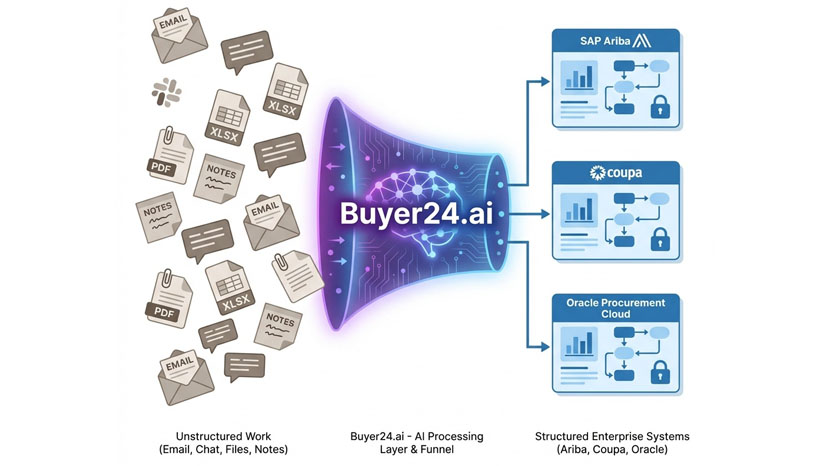
An AI procurement layer sits between the unstructured world (email, Slack, vague requests) and the structured world (your ERP, your procurement platform). It handles the translation.
| Phase | Without AI Layer | With AI Layer |
|---|---|---|
| Request intake | Vague email or Slack message | Structured request with clarified requirements |
| Supplier research | Manual searches, outdated lists | AI-assisted discovery with verified data |
| RFQ distribution | Copy-paste emails, manual follow-up | Automated outreach with tracked responses |
| Quote analysis | Spreadsheet gymnastics | Normalized comparison with extracted data |
| Negotiation | Untracked email chains | Guided counter-offers with human approval |
| Handoff to ERP | Manual data entry | Structured data ready for your system of record |
Your existing platform remains the system of record. The AI layer feeds it cleaner inputs, faster, instead of competing with it. This describes how Buyer24 fits with existing ERP and procurement tools without replacing them.
Design Principles
Five principles separate AI that procurement teams trust from AI that gets piloted and abandoned.
1. Buyers Approve What the AI Prepares
The AI drafts RFQ emails, and a buyer reviews and sends them. The AI extracts and compares quote data, and a buyer validates it before sharing it with stakeholders. The AI suggests a negotiation counter-offer, and a buyer approves it before it goes out.
The AI does the preparation work and does not make procurement decisions, so buyers can make better decisions faster.
2. Extract Data From Real Documents
The highest-risk use of AI is asking it to generate information, which can produce invented supplier capabilities, fabricated pricing, or hallucinated lead times. Buyer24 extracts and structures data from real documents, such as supplier quotes, RFQ responses, and the prices vendors submitted.
Every number in a quote comparison traces back to a document from a real supplier.
3. Contained Scope
General-purpose AI can be asked to do almost anything, so it can go wrong in many ways. A purpose-built procurement AI operates within defined boundaries (intake, sourcing, quoting, and vendor communication), which keeps its behavior predictable, testable, and auditable.
4. Data Isolation
Procurement data such as supplier pricing, contract terms, and negotiation strategies is among the most commercially sensitive in any organization. An AI layer must process this data in a secure, isolated environment without using it to train models or sharing it across customers.
5. Progressive Automation
Teams do not have to automate everything at once. You can start with intake triage, then add RFQ automation, then quote extraction. Each step builds confidence, and at every stage you can increase or reduce the AI's involvement.
How It Works Alongside Major Platforms
SAP Ariba + AI Layer
Ariba handles POs, contracts, and supplier lifecycle. The AI layer handles the pre-Ariba workflow: collecting requirements, running supplier outreach, gathering and comparing quotes, and packaging the awarded supplier's data for onboarding into Ariba.
Coupa + AI Layer
Coupa is strong in spend management and approval workflows. The AI layer handles the earlier work of turning a vague business need into a ready-to-submit requisition with competitive pricing attached.
Oracle Procurement Cloud + AI Layer
Oracle handles high-volume transactional procurement. The AI layer acts as the sourcing engine. It discovers suppliers, manages RFQs, and normalizes quote data so it flows cleanly into Oracle's structured workflows.
We will cover each of these integrations in more detail in an upcoming post.
Tail Spend
The biggest ROI for an AI procurement layer is in tail spend rather than in your top-tier categories. Tail spend is the bottom 80% of transactions by volume, which are too small to justify a full sourcing event but too numerous to ignore.
For a $15K purchase that would never warrant a buyer's full attention, an AI layer can collect requirements, identify suppliers, send RFQs, extract quotes, and present a recommendation. The buyer reviews the result instead of running the sourcing by hand, which is a step toward touchless procurement for the transactions that need buyer attention least.
Across hundreds of tail-spend transactions per quarter, that time saving adds up to a large gain in team productivity.
The tail spend use case is covered in a dedicated post on how AI finally solves the tail spend problem.
FAQ
What is an AI procurement layer?
An AI procurement layer sits between unstructured inputs (email, Slack, vague requests) and the structured world of your ERP and procurement platform, handling the translation between them. It manages the pre-procurement work like intake, supplier research, RFQ distribution, quote analysis, and negotiation support, then hands clean, structured data to your system of record.
Does an AI procurement layer replace SAP Ariba, Coupa, or Oracle?
No. Your existing platform remains the system of record. The AI layer sits in front of it and feeds it cleaner inputs faster rather than competing with it. Ariba still handles POs, contracts, and supplier lifecycle; Coupa still handles spend management and approvals; Oracle still handles high-volume transactional procurement.
Why aren't the AI features built into my ERP enough?
Built-in ERP AI features work on structured data that is already in the platform, but the sourcing gap is the phase before data enters the system. You can't apply AI analytics to emails in a buyer's inbox, the formal sourcing modules are too heavy for small purchases, and supplier negotiation happens over email, so platforms capture only its result.
What is the procurement gap?
The procurement gap is the unstructured, manual, and often invisible work between a business need and a structured requisition. It includes clarifying vague requests, researching suppliers, drafting RFQ emails, chasing responses, comparing quotes in different formats, and exchanging counter-offers. Your ERP doesn't touch it, your procurement platform assumes it's already done, and buyers spend much of their time stuck in it.
What principles make an AI procurement layer trustworthy?
Five principles separate AI that teams trust from AI that gets abandoned: humans approve while AI executes, extraction rather than generation of data, a contained scope limited to intake/sourcing/quoting/communication, your data staying isolated and never used to train shared models, and progressive automation so you can dial AI involvement up or down at each step.
Where does an AI procurement layer deliver the most ROI?
The biggest ROI is in tail spend, the bottom 80% of transactions by volume that are too small to justify a full sourcing event but too numerous to ignore. For a purchase that would never warrant a buyer's full attention, the AI layer can collect requirements, identify suppliers, send RFQs, extract quotes, and present a recommendation, turning hours of sourcing into minutes of review across hundreds of transactions per quarter.
Summary
Using AI in procurement does not require replacing your procurement stack, waiting for your ERP vendor to add AI to a platform designed before it, or relying on autonomous AI decisions. It requires an AI layer that understands procurement, works with your existing systems, and keeps humans in control. Buyer24 is built to be that layer.
This is the first post in our series on AI in procurement. The next post, 5 Risks of AI in Procurement (And How to Eliminate Each One), looks at the concerns holding procurement teams back and how to address them.
Ready to see how Buyer24 works alongside your current procurement platform? Request a demo and see the AI layer in action with your real workflows.