
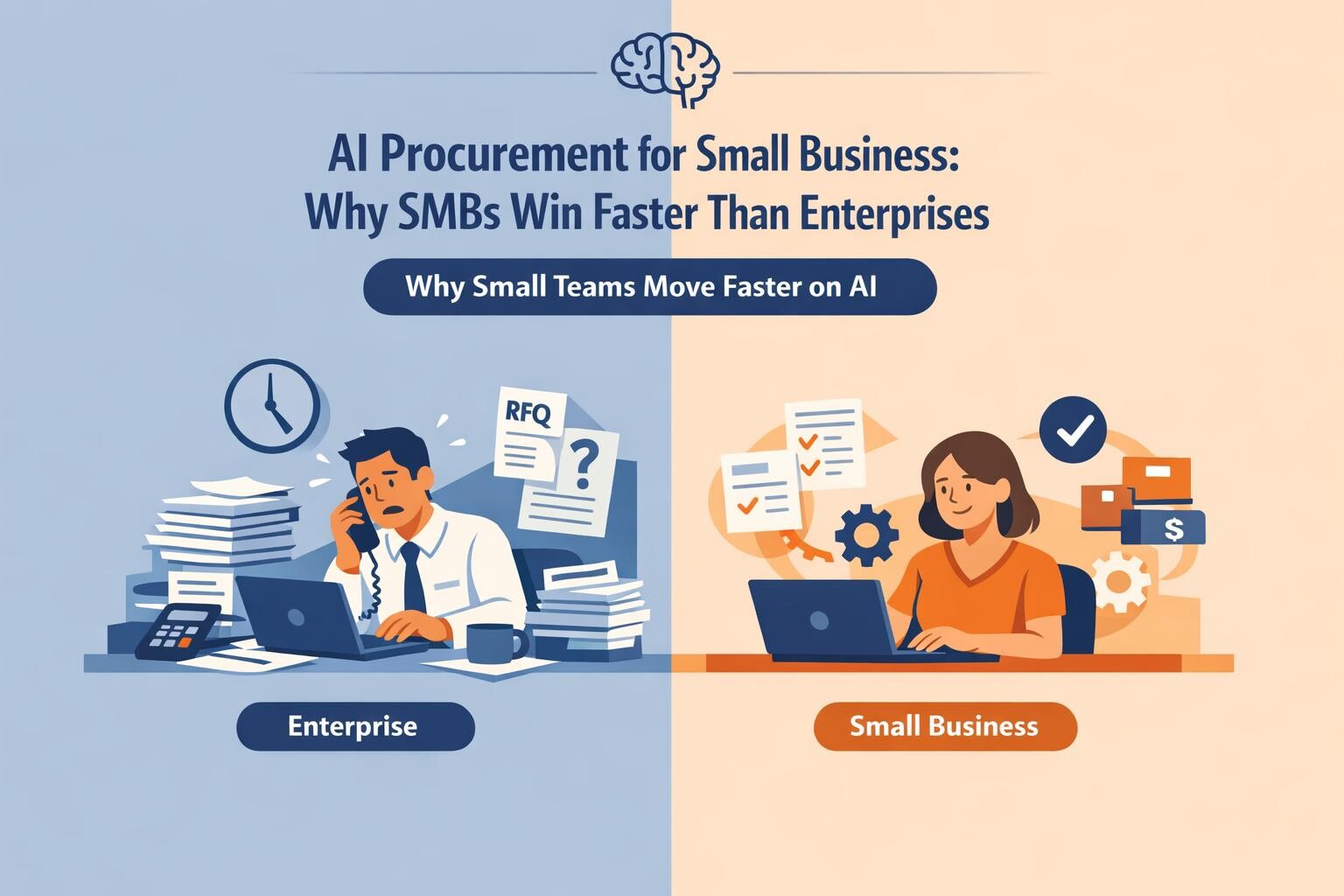
The conventional wisdom about new technology is that big companies go first. They have the budgets, the IT teams, and the appetite for early bets, so they pilot, scale, and pull ahead while smaller firms wait for the price to fall. With most enterprise software, that pattern held for decades. A short answer version is in whether small businesses benefit from AI in procurement.
AI in procurement is breaking that pattern. By mid-2025, the U.S. Federal Reserve found small businesses adopting AI faster than large firms, a first-time reversal of the usual order. Enterprise adoption had plateaued while small businesses kept accelerating. This indicates that the things which make a small procurement team feel disadvantaged are, for this particular shift, advantages.
This guide explains why small and mid-sized businesses can capture value from AI in procurement faster than enterprises. The things that slow enterprise adoption (legacy systems, siloed data, governance committees and annual cycles) are largely absent in an SMB. It pairs with our complete guide to AI procurement automation.
Are small businesses really adopting AI faster than enterprises?
Yes, and the data marks a genuine reversal. By mid-2025 the U.S. Federal Reserve (2025) found small businesses adopting AI faster than large firms for the first time, while enterprise adoption plateaued. Generative-AI use among small firms rose from about 40% to 58% during 2025, and the adoption gap with large firms narrowed sharply.
For most of the cloud era, large firms led small ones on technology adoption by a wide margin. According to the 2026 small-business AI adoption surveys, the SMB-versus-large gap narrowed from roughly 1.8x to about 1.2x in a single year.
The same surveys report that a large majority of SMBs using AI say it has produced revenue gains. That matters because small teams rarely keep tools that do not pay for themselves. When a lean buyer adopts something, it is usually because it is already working.
The timing has two causes. AI tools got cheap and instant to deploy, which removes the historic SMB barrier of cost and IT capacity. At the same time, enterprises ran into structural friction that small firms do not have. For the broader market view, see how AI is transforming SMB procurement.
Why do enterprises move slowly on AI in procurement?
Enterprises move slowly because their scale works against them on AI. About 74% of procurement leaders say their data isn't AI-ready (Gartner), and large organizations carry the most fragmented data of all. Legacy ERP suites, siloed systems, governance committees, and annual procurement cycles each add months between a good idea and a working result.
The data problem comes first. A large enterprise runs sourcing across many regions, business units, and systems that were never designed to talk to each other. Per enterprise AI-readiness research (2026), only about 55% of organizations believe they have a reliable data foundation for AI, even though 91% say one is essential. The gap between "we need it" and "we have it" is where projects stall.
Governance and change management
Big AI decisions in big companies pass through review. Security, legal, data governance, and procurement committees each weigh in, often in sequence. Every layer is reasonable on its own. Together they turn a two-week pilot into a two-quarter program before a single quote is processed.
Legacy systems and annual cycles
An enterprise has already bought a heavy procurement suite, so any new tool has to integrate with it rather than replace it. Integration is slow and political. Budgets are set annually, so even an obvious win can wait for the next planning cycle.
Deloitte State of AI in the Enterprise 2026 found roughly 73% of organizations use AI regularly, yet only about 10% describe it as core to operations. Adoption is broad, but most enterprises have not yet built AI into their daily workflows. We cover the people side in how to introduce AI to your procurement team.
Why can SMBs move faster?
Small businesses move faster because they lack the friction that slows enterprises. There is no legacy procurement suite to integrate, no governance committee to clear, and no annual cycle to wait for. The person who decides is usually the person who buys, so a tool can go from idea to live in days. The 40%-to-58% jump in SMB AI use during 2025 reflects exactly this speed.
In an enterprise, the AI user and the AI buyer are different people separated by several approval layers. In a small business, they are often the same person, which shortens the timeline from months to an afternoon.
Small, cleaner data
A small firm has fewer suppliers, fewer systems, and far less historical sprawl. Its data is not perfect, but it is contained. Cleaning a few hundred supplier records and a year of quote history can be done in a weekend. The AI-readiness gap that paralyzes enterprises is much smaller at SMB scale.
Turnkey, low-cost tools
Modern procurement AI is delivered as a service. There is no server to provision, no IT project, and often no migration. Many tools connect to an existing inbox and start working. For a small team without a dedicated IT function, this often decides whether a tool gets adopted at all.
Every saved hour matters more
In a five-person operation, a buyer who reclaims ten hours a week is reclaiming a meaningful share of the company's total capacity. The same ten hours vanish into the noise of a 500-person enterprise. The relative payoff of automation is simply larger when the team is small, which is why SMBs feel the gain fast and keep the tool. Spend Matters makes a similar case in its coverage of how AI is reshaping SMB procurement.
Where does AI deliver the fastest wins for a small procurement team?
The fastest wins come from the mechanical, repetitive parts of sourcing: sending RFQs, extracting quotes from PDFs and emails, chasing supplier responses, and handling tail spend. Boston Consulting Group (BCG) reports that organizations using AI in procurement can cut overall costs by up to 45% and reduce procurement team workload by about 30%. For a lean team, the workload figure has the most effect on day-to-day work.
A small team benefits most from automating the four tasks that consume the most hours for the least judgment. Each one is a clean, well-bounded job that AI does reliably.
RFQ sending and follow-up
Drafting a request for each supplier, sending it, and remembering who has not replied is pure overhead. AI drafts tailored requests from one spec and runs timed, polite follow-ups. Our guide to RFQ automation covers the full cycle, and RFQ templates standardize what goes out.
Quote extraction and comparison
This is the single biggest time sink and the biggest win. Suppliers reply in mismatched PDFs, email bodies, and spreadsheets. AI reads them all, pulls out prices, quantities, lead times, and terms, then builds a like-for-like table. See supplier quote management and AI-powered quote comparison for the detail.
Tail spend
Small purchases rarely get competitive quotes because chasing them by hand is not worth the time. AI makes that competition cheap enough to be worthwhile, and this is where many uncaptured savings sit. We go deeper in AI for tail spend procurement.
The BCG figures describe enterprise programs, so treat the exact percentages as a ceiling rather than a promise for a five-person team. The direction holds at any size: less workload, lower cost and more competition per buy.
What can a small team realistically automate first?
Start with one task. The most realistic first step for a small team is quote handling: forward a supplier email into an AI tool and let it extract the pricing into a comparable format. That single move removes the most tedious, error-prone work in sourcing without changing anything else about how the team operates.
The principle is to sequence tasks by the ratio of pain to effort. Pick the task that hurts most and takes the least setup. For almost every small team, that is reading and retyping quotes.
| Step | What you automate | Setup effort | Why first |
|---|---|---|---|
| 1 | Quote extraction from emails and PDFs | Forward one email | Highest pain, zero process change |
| 2 | Side-by-side quote comparison | Use extracted data | Builds on step 1, no new input |
| 3 | RFQ drafting and sending | One spec, many suppliers | Saves repetitive writing |
| 4 | Timed supplier follow-ups | Turn on reminders | Recovers lost responses |
| 5 | Tail-spend sourcing | Apply the flow to small buys | Captures savings you skipped before |
Each step reuses what the last one set up, so the team never faces a big-bang cutover. By the time follow-ups are automated, the buyer has already trusted the extraction for weeks. Trust builds through small, visible wins, and small teams can run this kind of rollout without a change-management program.
What does the SMB AI procurement stack look like without an ERP?
It is built around the inbox rather than a suite. Most small businesses run procurement on email, PDFs, and a spreadsheet, with no ERP at all. The right AI stack for them is a lightweight, inbox-first tool that reads quotes where they already land and structures them, rather than a heavy platform that demands migration.
Enterprises layer AI on top of an existing ERP and source-to-pay suite, which is why their projects are integration projects. A small team has no such suite, so it skips the integration problem entirely. That absence, often seen as a weakness, is what lets the stack stay simple.
| Dimension | Enterprise suite stack | SMB inbox-first stack |
|---|---|---|
| Core system | ERP plus source-to-pay platform | Email and a spreadsheet |
| Deployment | Multi-month integration project | Connect an inbox, start in days |
| IT involvement | Dedicated team required | Little to none |
| Data migration | Large and risky | Minimal or none |
| Cost model | Annual enterprise license | Low monthly subscription |
| Time to first value | Quarters | Days to weeks |
The lean stack needs to turn unstructured supplier replies into structured, comparable data without forcing the team to change how it works or how suppliers reply. Dashboards, integrations and advanced analytics are optional and can come later. For the bigger picture of modernizing without ripping anything out, see our view on digital transformation in procurement.
How do you measure ROI when you are a lean team?
Measure ROI in hours first, dollars second. For a small team, the clearest return is reclaimed time: hours saved per request, shorter cycle time, higher supplier response rates, and more comparable quotes per RFQ. BCG estimates AI can cut procurement workload by about 30%, and for a lean team that time converts directly into capacity the business can feel.
Dollar savings matter too, but they are slower to prove and noisier. Hours saved show up in week one. Track a simple before-and-after baseline on the metrics in the table.
The figures shown are illustrative examples and will vary by category, supplier mix, and starting point.
| Metric | How to measure | Illustrative shift |
|---|---|---|
| Buyer hours per request | Time logged across all steps | 6-12 hrs to 1-2 hrs |
| Cycle time | Days from request to award | 2-4 weeks to under 1 week |
| Response rate | % of suppliers who quote | Rises with timed follow-ups |
| Quotes per request | Comparable bids received | More competition per buy |
| Tail-spend coverage | % of small buys actually quoted | Rises from near zero |
The biggest single saving is almost always quote extraction and normalization, the step that eats 30 to 90 minutes per request by hand and drops to a few minutes of checking. A lean team should not focus only on price savings, because more comparable quotes and faster cycles usually deliver more value than squeezing the last percent off unit price.
What are the risks and limits for SMBs?
The main risks are data quality, acting before reviewing, and over-automation. AI extracts and compares well, but it reflects the data it is given, and only about 55% of organizations believe they have a reliable data foundation for AI per enterprise AI-readiness research (2026). For a small team the fix is straightforward but needs discipline: keep a human in the loop on every award.
Review before you act
AI should prepare decisions, and a person should make them. Let it draft outreach, extract quotes, and build the comparison, then have a person approve the send and sign the award. The buyer stays accountable. This single rule prevents almost every serious automation mistake.
Watch data quality
Errors in the input carry through to the output. A misread part number or an outdated supplier record propagates quietly. Small teams have an advantage here, since their data is small enough to keep clean, but they have to actually do it. Spot-check extractions early until trust is earned.
Avoid over-automation
Strategic relationships, complex negotiations, and high-risk or one-off buys still belong with a person. The goal is to automate the routine 80% so the team can focus on the critical 20%, with judgment kept in the loop. We cover this fully in AI procurement risks and how to manage them.
How do you get started in 30 days?
Start narrow and let evidence drive expansion. A realistic 30-day plan is to baseline your current effort in week one, pilot AI quote extraction on a single category in weeks two and three, then review the time saved and decide what to add. It needs no IT project, migration or committee. The aim is a low-risk proof that one buyer can run within a normal workload.
Week 1: baseline
Measure what you do now: hours per request, cycle time, and how many suppliers actually respond. Without a baseline you cannot prove the gain.
Weeks 2-3: pilot one task
Pick the highest-pain task, usually quote extraction, on one category such as MRO or tail spend. Forward real supplier emails into the tool and compare the output to your manual work. Keep approval with the buyer at every step.
Week 4: review and decide
Compare pilot results to your baseline. If hours dropped and the data held up, add the next step, comparison or follow-ups. If something broke, fix the input before expanding. Then widen one task at a time. For the change-management detail, see how to introduce AI to your procurement team, and to map the full request-to-award flow, how AI automates the pre-procurement workflow.
A small team's advantage is speed of iteration. It can run this loop in a month rather than a year because there is no one to wait for.
FAQ
Are small businesses really adopting AI faster than large enterprises?
Yes, and it is the first time this has happened. By mid-2025 the U.S. Federal Reserve (2025) found small businesses adopting AI faster than large firms, while enterprise adoption plateaued. Generative-AI use among small firms rose from about 40% to 58% during 2025, and the adoption gap with large firms narrowed from roughly 1.8x to about 1.2x in a single year.
Why can small businesses adopt AI in procurement faster than enterprises?
Because they lack the friction that slows big firms. There is no legacy ERP suite to integrate, no governance committee to clear, and no annual budget cycle to wait for. The person who decides is usually the person who buys, so adoption takes days. Smaller, cleaner data also makes AI work well without a long preparation project.
What should a small team automate first in procurement?
Start with quote handling. Forward a supplier email or PDF into an AI tool and let it extract pricing into a comparable format. It is the highest-pain, lowest-effort task and changes nothing else about how you work. Once that is trusted, add side-by-side comparison, then RFQ drafting and timed follow-ups, one step at a time.
Do you need an ERP to use AI in procurement?
No. Most small businesses run sourcing on email, PDFs, and a spreadsheet with no ERP at all. Inbox-first AI tools meet them there, reading quotes where they already arrive and structuring them. Skipping the ERP integration that slows enterprises is part of why small teams reach value in days rather than quarters.
How much can AI realistically save a small procurement team?
Boston Consulting Group (BCG) reports AI can cut procurement workload by about 30% and overall costs by up to 45%, though those figures describe larger programs and should be treated as a ceiling. For a lean team, the most reliable return is reclaimed hours per request, which appear in week one and convert directly into capacity.
What are the biggest risks for a small business using AI in procurement?
The main risks are poor data quality, acting before a human reviews, and over-automating judgment work. The fix is one rule: AI prepares decisions, a person approves them. Keep humans on every award, spot-check extractions early, and leave strategic negotiations and high-risk buys to people.
Is enterprise AI adoption really stalling?
Adoption is broad but shallow. Deloitte State of AI in the Enterprise 2026 found roughly 73% of organizations use AI regularly, yet only about 10% describe it as core to operations. Most enterprises have AI somewhere in the building but not yet in the daily workflow, largely because of integration, governance, and data-readiness friction in large organizations.
How long does it take a small team to see results from AI in procurement?
Often within the first month. A practical plan baselines current effort in week one, pilots AI quote extraction on one category in weeks two and three, and reviews time saved in week four. Because there is no IT project or committee to wait for, a small team can run the full proof loop in days rather than quarters.
Key takeaways
- Small businesses are adopting AI faster than large firms for the first time; by mid-2025 the U.S. Federal Reserve (2025) confirmed the reversal, with SMB generative-AI use rising from about 40% to 58% during 2025.
- Enterprises move slowly because of legacy ERP suites, siloed data (74% of leaders say their data isn't AI-ready, per Gartner), governance committees, and annual cycles. Deloitte State of AI in the Enterprise 2026 found only about 10% treat AI as core to operations.
- SMBs win on speed because the decision-maker is the user, the data is small and clean, and inbox-first tools deploy in days without an ERP.
- The fastest wins are quote extraction, comparison, RFQ follow-up, and tail spend; BCG estimates AI can cut procurement workload by about 30%.
- Start by forwarding one supplier email into an AI tool, then expand one task at a time on a 30-day, low-risk plan.
- Keep a human on every award: AI prepares decisions, people approve them.