
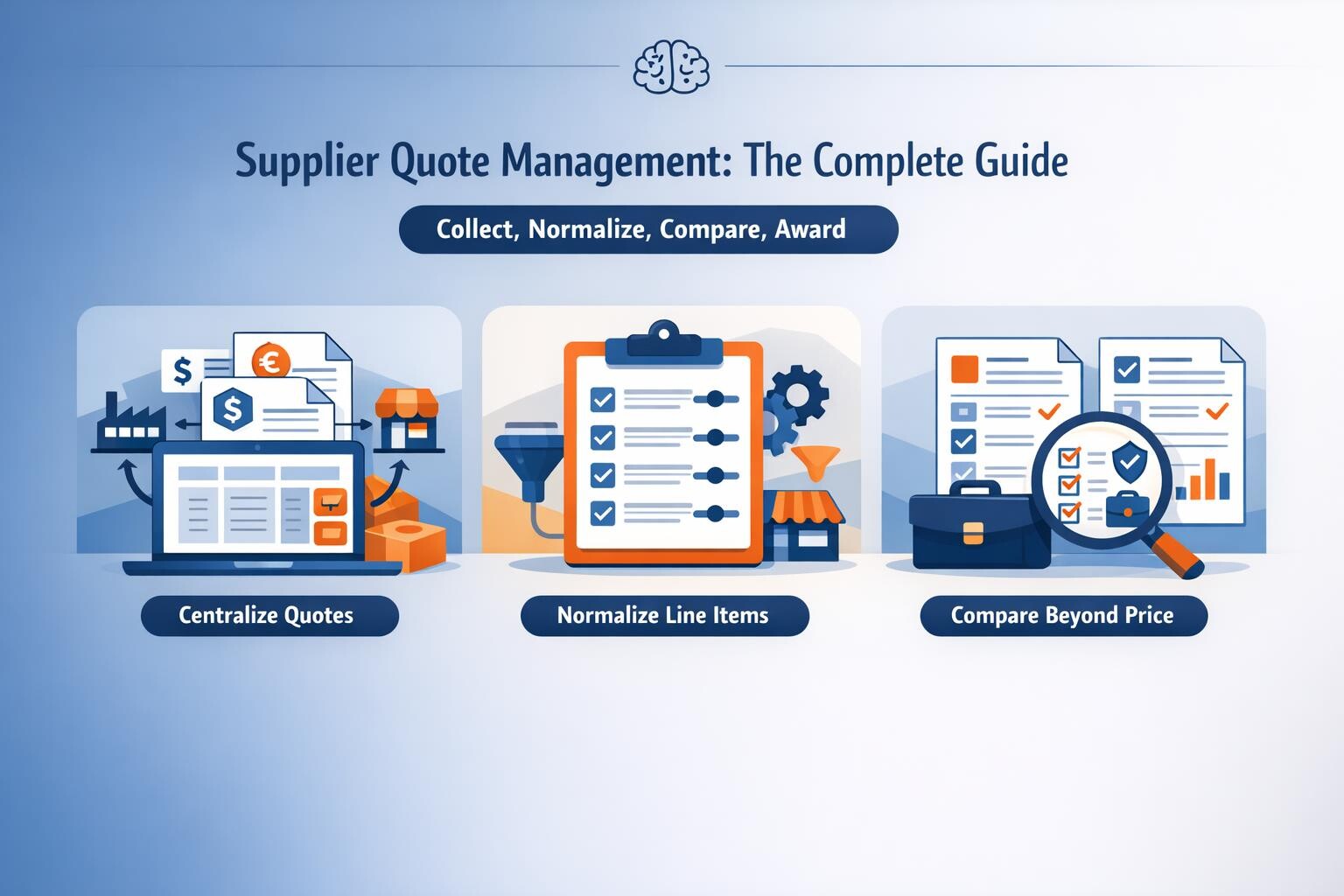
Supplier quote management is the discipline of collecting, structuring, comparing, and acting on the quotes suppliers send in response to a request. It covers everything between "the quotes are arriving" and "the award is made and documented": intake, normalization into comparable data, evaluation beyond price, and a defensible record of why one supplier won.
In practice, the hard part is rarely the decision itself. Quotes land as PDFs on letterhead, prices buried in email bodies, and spreadsheets that no two suppliers format the same way. Buyers spend most of their time turning those mismatched documents into a fair, like-for-like comparison. Good quote management removes that friction while keeping judgment with the people accountable for it.
This guide is the companion to our complete guide to automating RFQs. RFQs are how quotes are requested, and quote management covers what happens once they come back.
What is supplier quote management?
Supplier quote management is the structured handling of vendor quotes from intake through award: collecting them in any format, normalizing them into comparable data, evaluating price alongside total cost and risk, and recording the decision. It is the operational layer that turns scattered offers into a defensible choice. In a 2025 Gartner survey, 68% of CPOs named AI and generative AI a top technology priority.
The term covers more than a side-by-side price table. A quote carries units of measure, lead times, minimum order quantities, payment terms, shipping responsibility, and validity dates. Managing quotes well means capturing all of that as data, not leaving it in attachments.
The work has two connected parts. The mechanical part is getting every quote into one place and making the numbers comparable. The analytical part is weighing the comparable quotes against what your organization values, then awarding and documenting.
When the mechanical part is done by hand, the analysis suffers. Buyers run out of time, so they default to the lowest sticker price. Strong quote management protects the analysis by automating the routine work underneath it. If you ever pass a quote on to a customer or another party, it also pays to know what to redact when forwarding a quote so margins and supplier identities stay protected. For the request side of this loop, see our best practices for managing RFQs.
Why is comparing supplier quotes so hard?
Comparing supplier quotes is hard because quotes arrive unstructured and inconsistent. Every vendor uses a different format, unit, and pricing logic, so nothing lines up cleanly, and the result is slow, manual reconciliation that is prone to error. The problem is structural. 74% of procurement leaders say their data isn't AI-ready (Gartner, 2025).
Three problems show up on almost every comparison.
Mixed, unstructured formats
One supplier sends a PDF on letterhead. Another puts pricing in the email body. A third attaches a spreadsheet built to their own template. Before any comparison can start, a buyer has to read each document, find the relevant numbers, and retype them. A single misread decimal can send the award to the wrong vendor.
Apples-to-oranges line items
Even when the numbers are legible, they describe different things. One quote prices per unit, another per box of 100, a third per pallet. Lead times appear as weeks, business days, or calendar days. One price includes shipping, another adds tooling charges, a third leaves freight as "TBD." Until these are reconciled, the comparison is misleading.
Incomplete or ambiguous quotes
Missing fields force assumptions. When a quote omits payment terms or marks duties "not included," the buyer either chases the supplier or guesses. Guessing breaks the comparison quietly. Much of this is preventable upstream with disciplined RFQ validation and quality control so suppliers quote against complete requirements.
How do you collect and organize supplier quotes?
You collect and organize supplier quotes by routing every response into one system of record instead of individual inboxes, so each quote is captured as structured data the moment it arrives. Deloitte's 2025 Global CPO Survey found respondents citing enhanced decision-making (67.7%) as a top value they expect from GenAI, and better decisions need organized data.
Quotes scatter as soon as they arrive. Some land with the buyer, some with the requester, and some in a shared inbox nobody owns. Reassembling them later wastes hours and quietly drops responses.
Centralize the inbound channel
Give suppliers one place or one address to respond to, tied to the specific request. This keeps every quote attached to the right RFQ and prevents responses from getting lost across personal inboxes.
Capture quotes as data, not files
A stored PDF is a record, not comparable information. The goal is to extract line items, prices, quantities, lead times, and terms into structured fields as quotes come in, so comparison needs no further data entry.
Track who has and hasn't responded
Organized intake makes follow-up obvious. You can see at a glance which suppliers have quoted and which need a reminder. Low response rates are usually operational, and we cover the causes in why RFQs don't get answered on time.
How do you normalize quotes for a fair comparison?
You normalize quotes by converting every offer onto a common basis: the same unit of measure, currency, time period, and delivery terms, with hidden charges pulled into view. Normalization is what makes a like-for-like comparison possible. Done by hand it is slow and error-prone.
Normalization aligns several dimensions at once. Each one, left unaligned, distorts the result.
Line items and units of measure
Convert per-box, per-pallet, and per-piece pricing to a single per-unit figure. Restate lead times in one consistent unit. This is where most manual comparisons go wrong, because the conversions are tedious and easy to fumble.
Currency and incoterms
Convert foreign-currency quotes at a documented rate, and adjust for delivery responsibility. A "FOB origin" price and a "delivered" price are not comparable until freight is added to the first. Incoterms decide who pays for shipping, insurance, and customs.
Payment terms
Net 30 versus net 60 versus 2% early-pay discount changes the real cost of money. Factor payment terms into the effective price rather than treating headline numbers as final.
In this example, three quotes that look different all normalize to $4.20 per unit.
| Field | Supplier A | Supplier B | Supplier C |
|---|---|---|---|
| Listed price | $4.20/unit | $420/box (100) | $0.042/pc |
| Normalized price | $4.20/unit | $4.20/unit | $4.20/unit |
| Lead time | 4 weeks | 20 business days → 4 weeks | 30 days → ~4.3 weeks |
| MOQ | 1,000 units | 10 boxes → 1,000 units | 1,000 pc → 1,000 units |
| Shipping | FOB origin (+$180) | Delivered (incl.) | FOB origin (+$210) |
| Payment terms | Net 30 | Net 60 | 2/10 net 30 |
For a deeper walk-through of the manual method, our field-tested quote comparison tips cover normalization templates, scoring, and hidden costs in detail.
How do you compare supplier quotes beyond price?
You compare supplier quotes beyond price by scoring them on total cost of ownership, lead time, quality, and risk, then weighting each factor by what the purchase actually demands. The lowest sticker number is rarely the lowest true cost. Much of the value of better sourcing comes from judgment rather than arithmetic, and enhanced decision-making (67.7%) topped the GenAI value list in Deloitte's 2025 survey. The case for awarding on total cost rather than unit price is made in total cost of ownership versus lowest price.
Price is one input among several. A quote that wins on unit price can lose badly once freight, tooling, late deliveries, or quality failures are counted.
Total cost of ownership
Add every cost the purchase carries over its life: freight, duties, tooling, testing, warranty, and the cost of carrying inventory if delivery timing is uneven.
Lead time, quality, and risk
Lead time affects production and working capital. Quality history predicts rework and returns. Supplier risk covers financial stability, capacity, and single-source exposure. None of these appear on the price line, yet each can outweigh it, which is why it pays to learn how to score supplier performance with hard metrics rather than guesswork.
Weighted scoring
For competitive buys with multiple stakeholders, a weighted scoring model gives the most defensible decision. Define the criteria, assign weights, score each supplier, and let the math surface the best overall value.
| Criterion | Weight | Supplier A | Supplier B | Supplier C |
|---|---|---|---|---|
| Total cost | 40% | 4 | 5 | 3 |
| Lead time | 25% | 5 | 3 | 4 |
| Quality history | 20% | 4 | 4 | 5 |
| Supplier risk | 15% | 3 | 4 | 5 |
| Weighted total | 100% | 4.10 | 4.15 | 3.95 |
The scores are an illustrative example. Supplier B wins narrowly although it has the slowest lead time, and Supplier A is 0.05 behind. With a margin that small, a different weighting would change the winner, so agree the weights before the quotes arrive. For the underlying method, see how to build supplier quote comparison with AI around configurable priorities.
What role does AI play in supplier quote management?
AI handles the mechanical core of quote management. It reads quotes from any PDF or email, extracts the line items and terms, normalizes them into comparable fields, and flags deviations or outliers for review. The buyer interprets and decides. The opportunity is large because 74% of procurement leaders say their data isn't AI-ready (Gartner, 2025), and AI extraction is how unstructured quotes become usable data.
Extraction from PDFs and email
Machine learning and natural language processing read quotes in whatever shape they arrive (PDF, email body, spreadsheet, or image) and pull out prices, quantities, lead times, and terms, which removes retyping and copy-paste errors.
Normalization
Once extracted, the data is converted to consistent units, currency, and delivery basis automatically. The conversions that take a buyer 30 to 90 minutes per request drop to a few minutes of spot-checking.
Deviation and outlier flagging
AI compares each quote against the others and against expected ranges, then flags anomalies: a price far below market, a missing tooling charge, a lead time that doesn't fit the pattern. These flags catch the errors that quiet manual comparison misses.
AI is also consistent. A buyer gets less careful by the fifth quote of the day, and AI does not. As volume rises, automated data quality holds steady while manual quality degrades. For the broader request-to-award picture, see how AI automates the pre-procurement workflow.
How do you evaluate quotes in complex or regulated buys?
You evaluate quotes in complex or regulated buys by enforcing a fixed, documented process: standardized fields, a transparent bid tabulation, and a complete audit trail that records every quote and the rationale for the award, because defensibility is the priority. In a 2025 Gartner survey, 72% of CPOs named data and analytics technologies a top priority, which depends on trustworthy records.
Complex buys raise the stakes on consistency. The same evaluation criteria must apply to every supplier, and the reasoning must survive scrutiny months later.
Bid tabulation
A bid tabulation lays out all quotes against identical line items so differences are visible and the comparison is reproducible. Standardized fields prevent the apples-to-oranges problem from reaching the decision and make the result easy for a third party to verify.
Audit trail
Every request, quote, follow-up, and decision rationale should be captured automatically and be exportable. When a choice is questioned during a budget review or audit, the record answers "why this supplier?" without anyone reconstructing it from deleted email.
Regulated buyers, public sector especially, depend on this. The discipline that protects them also benefits any team that has ever struggled to explain a past award. Capturing the record as you go costs nothing extra and removes a recurring source of risk.
What are common mistakes when evaluating supplier quotes?
The most common mistakes are awarding on sticker price alone, comparing un-normalized quotes, ignoring hidden costs, and failing to document the decision. Each one quietly steers buyers toward the wrong supplier. Avoiding them is mostly a matter of discipline rather than technology, though structure helps. In Deloitte's 2025 survey, enhanced decision-making (67.7%) was the top value respondents expected from GenAI.
Watch for these red flags before you award.
- Prices well below market. Usually a sign of misread requirements, quality concerns, or unsustainable pricing rather than a genuine bargain.
- Un-normalized comparison. Comparing per-box to per-unit, or FOB to delivered, produces a confident but wrong answer.
- Hidden costs left out. Freight, duties, tooling, testing, and warranty exclusions can erase apparent savings.
- Vague specifications. A supplier quoting an unclear scope may not be quoting what you actually need.
- Missing terms. Payment, warranty, or delivery conditions marked "TBD" should be clarified, not assumed.
- No documentation. An undocumented award cannot be defended or repeated.
All of these are shortcuts taken under time pressure. Automating the mechanical work removes that pressure, which is why clean intake and normalization matter as much as the evaluation itself. Clear supplier communication also prevents many ambiguities before they reach the comparison.
How do you measure quote management efficiency?
You measure quote management efficiency across three axes: cycle time, response rate, and savings or cost per request. Track each before and after any process change to make the gain visible. Published benchmarks are thin. Procurement leaders surveyed by Gartner in 2024 expected GenAI to raise productivity by about 23% over 12 to 18 months, an expectation rather than a measured result.
The figures in the table are illustrative examples, based on typical Buyer24 customer workflows, and will vary by category and supplier mix.
| Metric | How to measure | Illustrative shift |
|---|---|---|
| Cycle time | Days from quotes received to award | 1-2 weeks → 2-4 days |
| Buyer hours per request | Time logged on intake, normalization, comparison | 6-12 hrs → 1-2 hrs |
| Response rate | % of suppliers who return a quote | Rises with timed follow-ups |
| Comparable quotes per request | Quotes that reach a like-for-like state | More competition per buy |
| Savings | Awarded price vs. baseline or should-cost | Better visibility, better awards |
The single largest line-item saving is normalization, the step that consumes 30 to 90 minutes per request by hand and drops to minutes once automated. In Deloitte's survey, productivity (49.4%) was the second most cited value expected from GenAI.
Do not measure price savings alone. Faster cycles and more comparable quotes often deliver more value than squeezing the last percent off unit price, because more good quotes mean better decisions on every buy.
How do you choose quote management software?
Choose quote management software on four criteria: extraction accuracy on your real, messy formats, fit with your existing ERP and tools, a complete and exportable audit trail, and a supplier experience that doesn't add friction. Because 74% of procurement leaders say their data isn't AI-ready (Gartner, 2025), test any tool on your own quotes rather than on vendor demos.
Extraction accuracy
Feed the tool your worst real PDFs and email replies. Accuracy on clean samples means little. Messy, mixed-format quotes are the true test of whether a system can replace manual data entry.
ERP and tool fit
The system should hand structured award data into your existing procurement or ERP platform without re-keying. Integration friction is a common reason tools are not adopted.
Audit trail
Every quote, follow-up, comparison, and decision rationale should be captured automatically and be exportable. This protects regulated and audited buyers and means nobody has to reconstruct why a supplier was chosen.
Supplier experience
If suppliers must log into a clunky portal to quote, response rates fall. The best tools let suppliers reply in their normal formats and do the structuring on your side.
Score each tool against your real workflow rather than a generic feature sheet. Categories with high quote volume, such as tail spend and fragmented component buying, surface a tool's strengths and weaknesses fastest. Teams sourcing across many electronic component distributors are a good stress test, since part numbers and pricing breaks rarely align cleanly.
FAQ
What is supplier quote management?
Supplier quote management is the structured handling of vendor quotes from intake through award. It covers collecting quotes in any format, normalizing them into comparable data, evaluating price alongside total cost and risk, and documenting the decision. The goal is a fair, defensible award rather than a default to the lowest sticker price.
How is quote management different from RFQ automation?
RFQ automation covers requesting quotes: structuring the request, selecting suppliers, sending it, and chasing responses. Quote management covers what happens once quotes return: collecting, normalizing, comparing, and awarding. They are two halves of one sourcing cycle, which is why our RFQ automation guide and this page are companions rather than alternatives. Both sit inside the wider process covered in our practitioner's guide to strategic sourcing.
Why is comparing supplier quotes so difficult?
Quotes arrive unstructured and inconsistent. Every vendor uses a different format, unit of measure, and pricing logic, so nothing lines up without manual reconciliation. Buyers must read each document, retype numbers, convert units and currencies, and surface hidden charges before a fair comparison is even possible. That reconciliation is slow and error-prone by hand.
What does it mean to normalize a quote?
Normalizing a quote means converting it onto a common basis so it can be compared fairly: the same unit of measure, currency, time period, and delivery terms, with hidden charges like freight and tooling pulled into view. Without normalization, a per-box price and a per-unit price look comparable but are not, which leads to wrong awards.
Should I always pick the lowest quote?
No. The lowest sticker price is rarely the lowest true cost. Hidden costs such as freight, duties, tooling, testing, and warranty exclusions can erase apparent savings. Prices far below market often signal misread requirements or quality risk. Total cost of ownership and weighted scoring reveal the real value behind each number.
How does AI help with supplier quote management?
AI reads quotes from any PDF or email, extracts line items and terms, normalizes them into comparable fields, and flags outliers like below-market prices or missing charges. The buyer reviews and decides. In a 2024 Gartner survey, procurement leaders expected GenAI to raise productivity by about 23% over 12 to 18 months, a forecast rather than a measured result.
How do I measure whether quote management is working?
Track three things before and after any change: cycle time from quotes received to award, supplier response rate, and savings or cost per request. The biggest single saving usually comes from normalization, which can drop from 30 to 90 minutes per request to a few minutes of spot-checking once automated.
What should I look for in quote management software?
Prioritize extraction accuracy on your real, messy formats, integration with your existing ERP, a complete and exportable audit trail, and a supplier experience that doesn't add friction. Test extraction on your own worst PDFs and emails rather than clean vendor demos, since most procurement data isn't yet structured for AI.
Key takeaways
- Supplier quote management runs from intake through award: collecting quotes, normalizing them into comparable data, evaluating beyond price, and documenting the decision.
- Comparison is hard because quotes arrive unstructured and inconsistent; normalization is the step that makes a fair, like-for-like view possible.
- Evaluate on total cost of ownership, lead time, quality, and risk, then weight each factor by what the purchase demands, not on sticker price alone.
- AI handles extraction, normalization, and outlier flagging; buyers keep judgment, negotiation, and the final award.
- Procurement leaders surveyed by Gartner in 2024 expected GenAI to raise productivity by about 23% over 12 to 18 months (Procurement and Supply); measure your own baseline rather than relying on the forecast.
- Choose tools on extraction accuracy, ERP fit, audit trail, and supplier experience, and measure results with cycle time, response rate, and savings.