
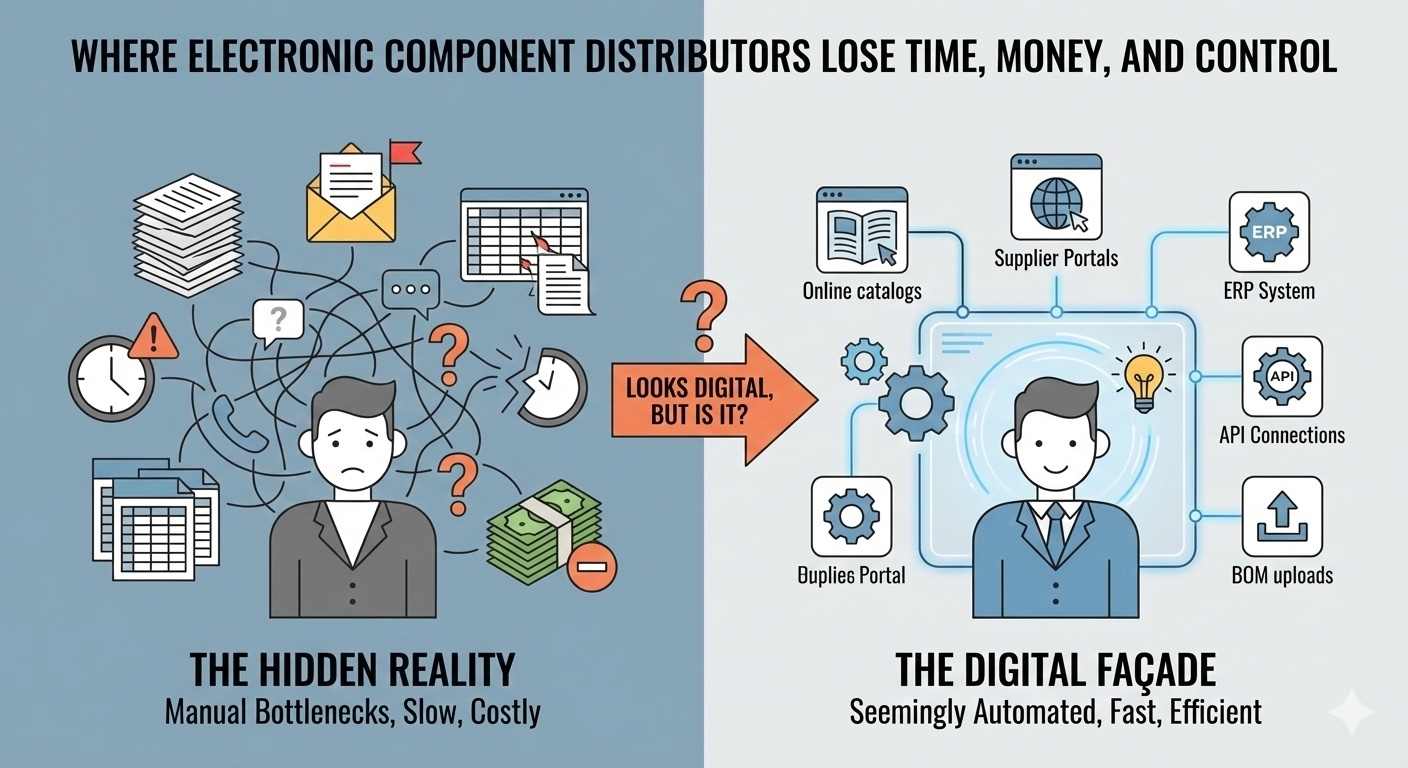
Electronic component distribution looks digital on the surface. Online catalogs, supplier portals, ERP systems, APIs, and BOM uploads give the impression that procurement is highly automated and efficient.
In practice, much of the work of turning RFQs into purchase orders is still manual.
Across distributors of electronic components, the same operational bottlenecks repeat themselves. They slow down response times, increase operational costs, and reduce predictability, even in organizations that have already invested heavily in technology. Many of these pressures are specific to electronic component sourcing, where part complexity and supply volatility compound every delay. Because components are so often sourced from international suppliers, lead-time and shipping-schedule risk add another layer to every order.
Why Digital RFQs Still Need Manual Interpretation
Most RFQs (requests for quote) arrive in a structured digital format: spreadsheets, BOM exports, or system-generated lists. Yet very few of them are ready for automated processing.
Typical issues include:
- Incomplete or outdated manufacturer part numbers (MPNs)
- Missing lifecycle or obsolescence data
- Unclear compliance requirements (RoHS, REACH, conflict minerals)
- Absence of an approved vendor list or preferred supplier hierarchy
- Inconsistent formatting across different customers and systems
Knowing how to handle inconsistent quote formats is often what separates fast distributors from slow ones. Because of these issues, RFQs immediately require human interpretation. Sales engineers, inside sales teams, and buyers must manually clarify requirements, cross-reference part numbers, and contact suppliers for availability.
This turns what should be a fast digital workflow into a slow, manual one. RFQ response times stretch from hours to days, quote accuracy drops due to interpretation errors, and conversion rates suffer as customers move on to faster competitors. These delays are a major reason RFQs don't get answered on time. For an intermediary, much of this manual work also involves transforming and redacting quotes before you forward them onward to customers and suppliers.
The Gap Between Quote and Purchase Order
Many teams assume the hardest part is over once a customer accepts a quote, but the most fragile part of the process starts there.
Between quote acceptance and PO creation, several things must happen:
- Availability must be rechecked. Stock levels change constantly, and what was available during quoting may be gone
- Data is re-entered into ERP systems. This is often done manually, which introduces transcription errors
- Commercial conditions must be confirmed. MOQ (minimum order quantity), NCNR (non-cancellable, non-returnable), and allocation rules need verification
- Internal approvals are required. Margin reviews, credit checks, and compliance sign-offs add wait time
This creates a manual handoff between sales and procurement, usually handled by order management or inside sales. During this stage, delays accumulate. Orders are frequently lost due to stock changes, pricing shifts, or simply slow internal processing while the customer finds an alternative source. Understanding why suppliers lose quotes across your whole pipeline turns these one-off losses into a pattern you can actually fix.
Supplier Confirmation Still Depends on Humans
Even today, real supplier confirmation is rarely fully automated.
Catalogs and ERPs may display availability and lead times, but this data is often indicative rather than firm. Final confirmation typically comes through email exchanges or manual supplier portal interactions. Suppliers protect their allocation, especially for constrained parts, and buyers must wait for human approval on the supplier side.
In practice:
- Displayed stock may be allocated to other customers
- Lead times shown are estimates rather than commitments
- Pricing can change between inquiry and order placement
- Suppliers require manual confirmation for large or unusual orders
While this back-and-forth happens, orders remain on hold and customer commitments become uncertain. This directly impacts supplier response times, delivery promise accuracy, and overall customer satisfaction.
Alternates and Compliance Do Not Scale
In electronic components, substitutions are risky. Unlike commodities where alternatives are interchangeable, every electronic component alternate must be carefully validated.
Validation requirements include:
- Form. Physical dimensions, pin configuration, package type
- Fit. Mounting compatibility, thermal characteristics
- Function. Electrical specifications, performance parameters
- Lifecycle risk. Is the alternate also approaching end-of-life?
- Compliance. Customer-specific requirements for automotive, medical, aerospace, or military applications
This validation work cannot be easily automated and relies heavily on experienced sales engineers. As RFQ volumes grow, these specialized teams become overloaded, so cost-to-serve grows and response times slow down when customers most need fast answers.
Many distributors face a difficult choice. They can quote quickly with unvalidated alternates (risking returns and customer dissatisfaction) or quote slowly with proper validation (risking lost sales to faster competitors).
Small PO Errors Cause Large Disruptions
A single mistake in a purchase order can force the entire process to restart.
Common errors include:
- Incorrect MPN or part number transcription
- Wrong packaging type (tape and reel vs. tubes vs. trays)
- MOQ mismatches between customer order and supplier requirement
- Incorrect date codes or revision levels
- Missing compliance documentation
Each correction requires cancellation, re-approval, and often re-quoting. This adds delay and frustration for both internal teams and customers. Suppliers may charge restocking fees or refuse returns on NCNR orders.
Over time, these errors compound into higher rework and cancellation rates, lower profitability, and eroded customer trust.
Lack of End-to-End Visibility
Perhaps the most damaging issue is the lack of clear visibility across the full RFQ-to-PO lifecycle.
Managers often cannot answer basic questions:
- Do delays originate in initial response, supplier confirmation, or order processing?
- Which team members or roles create bottlenecks?
- Which suppliers consistently cause delays or errors?
- What is the true cost-to-serve for different customer segments?
- How do response times correlate with win rates?
Without this visibility, organizations rely on manual follow-ups and firefighting instead of structured improvement. Problems are addressed reactively rather than prevented proactively.
This reduces SLA performance, makes outcomes unpredictable, and diffuses accountability. Teams know something is wrong but cannot pinpoint exactly what or where.
Why Electronic Distribution Is Different
The bottlenecks described above exist in many distribution segments. However, electronic component distribution faces unique pressures that amplify their impact:
Supply volatility. Allocation constraints, long lead times, and sudden shortages are common. A delay of hours can mean the difference between securing stock and losing the order.
Technical complexity. Parts are not interchangeable. Every substitution requires engineering judgment, and mistakes have serious consequences for end products.
Low error tolerance. Electronic components go into products where failures are costly or dangerous. Quality and compliance requirements are stringent.
Global supply chains. Suppliers and customers span multiple time zones and languages, adding communication friction to every transaction.
Thin margins. Distribution margins are tight, making operational efficiency essential for profitability.
This combination of complexity, volatility, and margin pressure means that operational inefficiencies hit electronic component distributors harder than many other industries.
How Distributors Address These Bottlenecks
The bottlenecks in electronic component distribution are avoidable. They come from manual handoffs, fragmented systems, and processes designed for a simpler era.
Organizations that address these challenges focus on:
- Reducing manual data handling at every stage of the RFQ-to-PO process, often by letting AI automate the pre-procurement workflow before requests ever reach the ERP
- Improving data quality at the point of entry rather than correcting errors downstream
- Creating visibility across the full lifecycle to enable measurement and improvement
- Automating routine decisions while preserving human judgment for complex cases
Pairing these operational fixes with proven best practices for managing RFQs efficiently helps distributors turn faster response times into higher win rates.
The technology to solve these problems exists today. Distributors that do not prioritize their operational foundations will continue to lose time, money, and control to avoidable inefficiencies.
FAQ
Why are RFQs in electronic component distribution so hard to process automatically?
Most RFQs arrive in a structured digital format yet still need human interpretation. Incomplete or outdated manufacturer part numbers, missing lifecycle data, unclear compliance requirements, and inconsistent formatting across customers all force buyers to clarify requirements and cross-reference parts manually. That turns a fast digital workflow into a slow one, stretching response times from hours to days.
Where do most delays happen in the RFQ-to-PO workflow?
The most fragile stage sits between quote acceptance and purchase order creation. Stock availability must be rechecked, data is re-entered into ERP systems by hand, commercial conditions like MOQ and NCNR need confirmation, and internal approvals add wait time. Orders are frequently lost here when stock changes or pricing shifts while the customer waits.
Why can't electronic component substitutions be automated?
Every alternate must be validated for form, fit, function, lifecycle risk, and compliance. Unlike commodities, parts are not interchangeable, and a wrong substitution can fail in automotive, medical, or aerospace applications. This validation relies on experienced sales engineers, so as RFQ volumes grow these specialized teams become a bottleneck.
How do small purchase order errors cause large disruptions?
A single mistake, such as an incorrect part number, wrong packaging type, or MOQ mismatch, can force cancellation, re-approval, and re-quoting. Suppliers may charge restocking fees or refuse returns on non-cancellable, non-returnable orders. Over time these errors compound into higher rework rates, more cancellations, and eroded customer trust.
What makes electronic component distribution different from other sectors?
Several pressures amplify ordinary bottlenecks: supply volatility and allocation constraints, technical complexity that rules out easy substitutions, low error tolerance, global supply chains spanning time zones and languages, and thin margins. This combination means operational inefficiencies hit electronic component distributors harder than most other industries.