
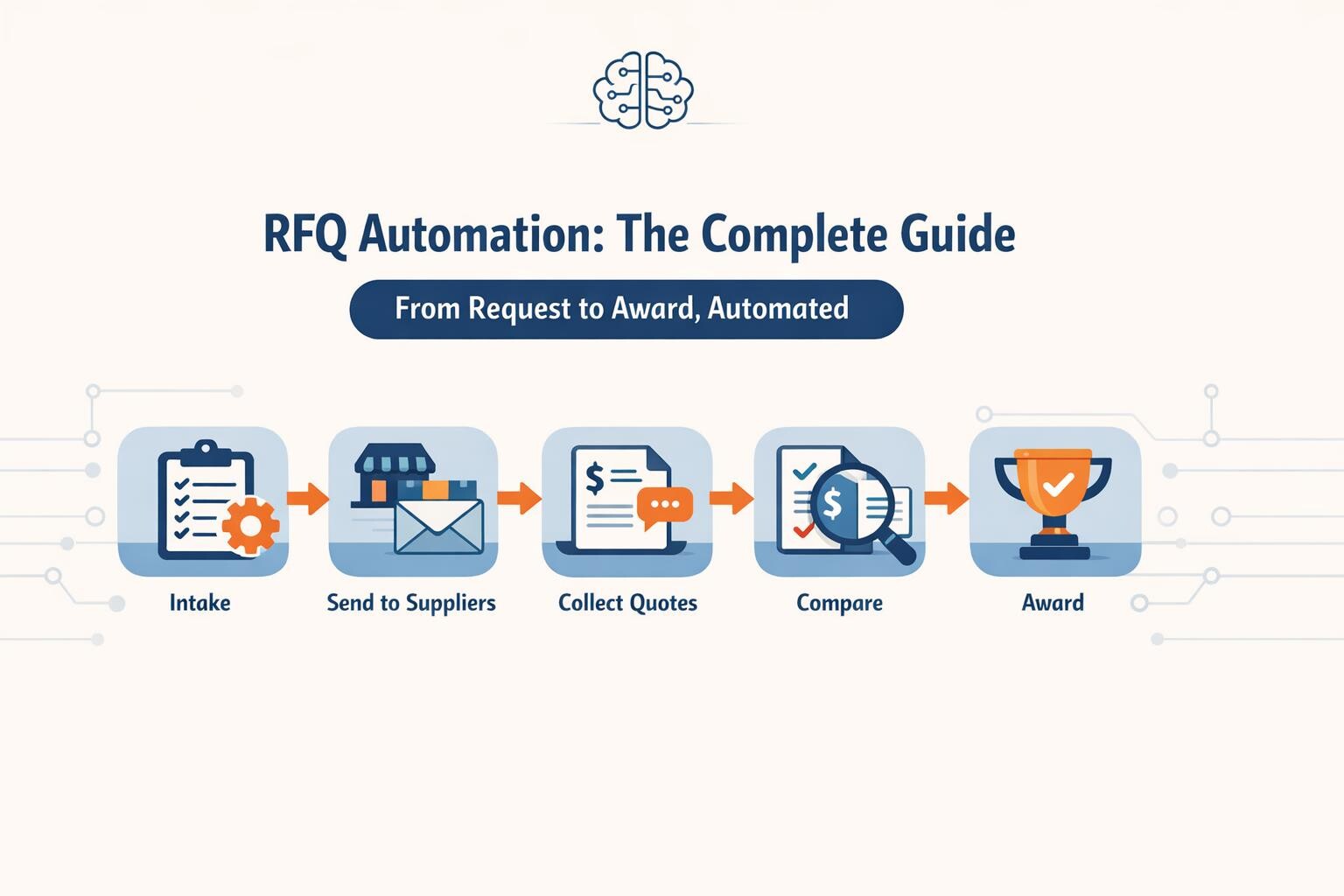
RFQ automation is the use of software, increasingly AI, to run the request-for-quote process end to end: structuring the request, selecting and contacting suppliers, collecting quotes in any format, normalizing them into comparable data, and presenting a side-by-side comparison for award. It replaces manual email, PDF handling, and spreadsheet work.
An RFQ round is one step inside a larger cycle, and our practitioner's guide to strategic sourcing covers the process it sits inside, from category segmentation to the supplier scorecard.
In practice, buyers spend most of their sourcing time on the mechanical work around the buying decision, such as chasing responses, retyping prices from PDFs, and reconciling units. RFQ automation targets that mechanical layer. It keeps the human in charge of judgment while removing the repetitive steps that slow every quote cycle down.
What is RFQ automation?
RFQ automation is software that handles the repetitive steps of the request-for-quote cycle so buyers can focus on decisions instead of data entry. Modern systems use machine learning and natural language processing to read unstructured quotes from PDFs and emails. Interest is high: in a 2025 Gartner survey, 68% of CPOs named AI and generative AI a top technology priority.
A traditional RFQ lives in inboxes, attachments, and a hand-built spreadsheet. An automated RFQ lives in one structured workflow where every request, supplier, and quote is captured as data.
What changes most is how quotes are read. Suppliers reply in their own formats: a PDF on letterhead, pricing in the email body, an Excel template, or a paragraph buried in a proposal. NLP and machine learning extract the line items, prices, quantities, and terms from each one, then map them to a common structure.
Once a quote is data rather than a document, comparison, follow-up, audit trails, and reporting all become automatic. A good starting point for the request itself is using consistent RFQ templates that standardize what you send out.
How does the RFQ process work step by step?
The RFQ process runs in six stages: intake, supplier selection, sending the request, collecting quotes, comparing them, and awarding. Each stage is a handoff point where manual work and delay creep in. In a 2024 Gartner survey, procurement leaders expected GenAI to raise productivity by about 23% over the next 12 to 18 months.
Intake
A stakeholder requests something. The buyer turns a vague need into a complete, quotable specification: quantities, technical details, delivery dates, and quality requirements. Incomplete intake is the most common cause of bad quotes later.
Supplier selection
The buyer decides who to ask. This means checking existing suppliers tagged by capability and, when needed, finding new candidates that can actually meet the spec.
Sending the RFQ
Each supplier gets a clear request with the spec, a deadline, and a response format. Sending individually and tracking who got what is tedious but matters.
Collecting quotes
Responses arrive in mixed formats over days or weeks. Non-respondents need polite, timed follow-ups. This is where most cycles stall.
Comparing quotes
Prices, units, lead times, and terms get normalized into a like-for-like table. Differences such as included shipping or tooling charges get flagged.
Awarding
The buyer selects a supplier, notifies the winner, declines the rest professionally, and files the decision for audit. For the full request-to-award view, see how AI automates the pre-procurement workflow.
RFQ vs RFP vs RFI: what's the difference?
An RFQ requests price for a well-defined item, an RFP requests proposals for a complex or open-ended need, and an RFI gathers general market information before either. The distinction matters because automation works best where requirements are structured, which is exactly the RFQ's strength. Confusing the three leads to vague requests and poor supplier responses.
| Dimension | RFI (Information) | RFQ (Quote) | RFP (Proposal) |
|---|---|---|---|
| Purpose | Explore the market | Get firm pricing | Evaluate solutions |
| Requirement clarity | Loose, exploratory | Tightly defined | Defined goal, open method |
| Primary decision factor | Capability and fit | Price and terms | Value, approach, price |
| Supplier response | Capability overview | Itemized quote | Detailed proposal |
| Best fit for automation | Partial | High | Partial |
| Typical use | New category research | Repeat or spec'd buys | Strategic or custom work |
Use an RFI when you don't yet know who can help, an RFQ when you know what you want and need a price, and an RFP when the solution itself is part of the decision. RFQ automation delivers the cleanest return because quotes are inherently comparable once normalized.
Why does the manual RFQ process break down?
The manual RFQ process breaks down because it runs on email, attachments, and spreadsheets that no single system tracks. Quotes scatter across inboxes, follow-ups get forgotten, and comparison data is retyped by hand. The problem is structural. 74% of procurement leaders say their data isn't AI-ready (Gartner, 2025).
First, response rates suffer. Vague requests sent to generic inboxes with tight deadlines often get ignored. We cover the root causes in detail in why RFQs don't get answered on time, and most of them are operational problems rather than "slow suppliers."
Second, comparison is slow and error-prone. A buyer opens five different documents, hunts for the price, and retypes it into a spreadsheet while converting per-unit to per-box and weeks to calendar days. A single misread decimal or missed tooling charge can send the award to the wrong supplier.
Third, there's no audit trail. When the decision is questioned months later, the rationale lives in someone's deleted email folder. Regulated buyers feel this acutely. In our experience working with procurement teams, the audit gap surfaces most painfully during budget reviews, when no one can reconstruct why a supplier was chosen.
How does AI automate the RFQ process?
AI automates the RFQ process stage by stage: it structures intake, drafts and tracks supplier outreach, extracts quotes from any PDF or email, normalizes them into comparable fields, and builds the side-by-side comparison. The buyer reviews and decides at each gate. Deloitte's 2025 Global CPO Survey found respondents citing enhanced decision-making (67.7%) and productivity (49.4%) as the main value they expect from GenAI.
Intake structuring
The buyer or stakeholder describes a need conversationally. AI recognizes missing fields and asks targeted follow-up questions, producing a complete, structured specification in one session instead of several days of email.
Supplier outreach
AI drafts a tailored RFQ for each selected supplier from the structured spec, with deadline and response format included. The buyer reviews and approves before anything sends. Delivery, opens, and responses are then tracked automatically.
Follow-up
Non-respondents receive timed, polite reminders drafted for buyer approval. This single step recovers quotes that manual processes routinely lose.
Quote extraction
This is the core of RFQ automation. AI reads PDFs, email-body pricing, spreadsheets, and mixed responses, then extracts line items, prices, quantities, lead times, and terms. We go deeper in AI-powered supplier quote comparison.
Normalization
Extracted data is converted into consistent units so quotes compare like for like.
| Field | Supplier A | Supplier B | Supplier C |
|---|---|---|---|
| Unit price | $4.20/unit | $420/box (100) → $4.20/unit | $0.042/pc → $4.20/unit |
| Lead time | 4 weeks | 20 business days → 4 weeks | 30 days → ~4.3 weeks |
| MOQ | 1,000 units | 10 boxes → 1,000 units | 1,000 pc → 1,000 units |
| Tooling | $2,500 one-time | Included | $0 |
| Shipping | FOB origin | Delivered (incl.) | FOB origin |
Comparison and award
AI presents a clean comparison, flags outliers and gaps, and summarizes commercial differences. The buyer makes the award. For practical scoring methods, see our quote comparison tips, and for the full quote side of sourcing, our complete guide to supplier quote management covers collection, comparison, and award in one place. The biggest gain is consistency rather than speed on any single quote. AI doesn't get sloppy on the fifth supplier, so data quality rises as volume grows, which is the opposite of what happens with manual entry.
What can you automate, and what stays human?
You can automate the mechanical and repetitive parts of an RFQ: structuring requests, drafting outreach, chasing responses, extracting and normalizing quotes, and assembling comparisons. Judgment stays human: final supplier selection, negotiation strategy, relationship calls, and risk tolerance. The split matters because agentic AI in supply chain and procurement is projected to grow from $2B in 2025 to $53B by 2030 (Gartner), yet decision authority remains with people.
| Task | Automate | Keep human |
|---|---|---|
| Requirement intake structuring | Yes | Review only |
| Supplier shortlisting | Suggest candidates | Final selection |
| RFQ drafting and sending | Draft | Approve |
| Follow-up reminders | Yes | Oversight |
| Quote extraction and normalization | Yes | Spot-check |
| Comparison table and outlier flags | Yes | Interpret |
| Negotiation strategy | Prepare data | Decide and execute |
| Award decision | Recommend, with the reasons shown | Decide |
| Audit documentation | Yes | Sign-off |
AI handles preparation and structure, and the buyer handles strategy and accountability. Quality control fits the same model, where AI scores completeness and the buyer confirms. See RFQ validation and quality control for how that check works before a request even goes out.
Where does RFQ automation deliver the most value?
RFQ automation delivers the most value in high-volume, repetitive, or fragmented sourcing: MRO, electronic components and manufacturing, tail spend, and public-sector buying. These categories share many small quotes and heavy comparison work, which is exactly what automation removes. Demand reflects the trend. In a 2025 Gartner survey, 68% of CPOs named AI and generative AI a top technology priority.
MRO and indirect
Maintenance, repair, and operations buying involves frequent low-value orders across many suppliers. Automation handles the volume so buyers aren't overloaded with routine quotes.
Electronic components and manufacturing
Component sourcing is fast-moving, spec-heavy, and prone to stockouts. Quote turnaround directly affects production. Distributors who sit between customers and suppliers also have to think about processing RFQs and quotes as an intermediary, deciding what to pass through and what to mask. See where electronic component distributors lose time, money, and control for the bottlenecks automation targets.
Tail spend
Tail spend is the long tail of small, unmanaged purchases that rarely get competitive quotes because negotiating them manually isn't worth the time. Automation makes competition economical, which is one reason AI procurement for small business often delivers an outsized return, because lean teams handle the same fragmented buying without the headcount enterprises assign to it. Read more in AI for tail spend procurement.
Public sector
Regulated buying demands fixed fields, documented requirements, and a defensible audit trail. Automation enforces consistency and captures the record automatically. See public sector procurement for the compliance angle.
How do you measure RFQ automation ROI?
Measure RFQ automation ROI across three axes: cycle time, response rate, and cost per request. Published benchmarks are thin. Procurement leaders surveyed by Gartner in 2024 expected GenAI to raise productivity by about 23% over 12 to 18 months, an expectation rather than a measured result. Track these metrics before and after rollout to make the gain visible.
The figures in this table are illustrative examples, based on typical Buyer24 customer workflows, and will vary by category and supplier mix.
| Metric | How to measure | Illustrative shift |
|---|---|---|
| Cycle time | Days from request to award | 2-4 weeks → 1-2 weeks |
| Buyer hours per request | Time logged across all steps | 8-15 hrs → 1-2 hrs |
| Response rate | % of suppliers who quote | Rises with timed follow-ups |
| Quotes per request | Comparable bids received | More competition per buy |
| Cost per request | Loaded buyer time per cycle | Falls with hours saved |
Across typical Buyer24 customer workflows, the single biggest line-item saving is quote extraction and normalization, the step that consumes 30 to 90 minutes per request when done by hand and drops to a few minutes of spot-checking once automated.
Don't measure only price savings. Faster cycles and higher response rates often deliver more value than squeezing the last percent off unit price, because more comparable quotes mean better decisions on every buy.
How do you choose RFQ automation software?
Choose RFQ automation software on four criteria: quote-extraction accuracy across messy real-world formats, fit with your existing ERP and tools, a complete audit trail, and a supplier experience that doesn't add friction. Because 74% of procurement leaders say their data isn't AI-ready (Gartner, 2025), test extraction on your own quotes rather than on vendor demos.
Extraction accuracy
Feed the tool your worst real PDFs and email replies. Accuracy on clean samples means little, because messy, mixed-format quotes are what the tool will face in practice.
ERP and tool fit
The system should hand off structured award data into your existing procurement or ERP platform without re-keying. Integration friction hurts adoption.
Audit trail
Every request, quote, follow-up, and decision rationale should be captured automatically and exportable. This protects regulated and audited buyers.
Supplier experience
If suppliers have to log into a clunky portal to quote, response rates drop. The best tools let suppliers reply in their normal formats and do the structuring on your side.
A short evaluation tied to the best practices for managing RFQs will surface fit faster than a long feature comparison. Score each tool on your real workflow rather than on a generic spec sheet.
How do you roll out RFQ automation?
Roll out RFQ automation in a low-risk sequence: pick one high-volume category, run a short pilot, measure against your baseline, then expand. Starting small de-risks the change and builds internal proof. Adoption is usually a bigger barrier than technology. 74% of procurement leaders say their data isn't AI-ready (Gartner, 2025), and a focused pilot lets you fix data and process issues at small scale.
1. Baseline first
Measure current cycle time, buyer hours, and response rates before changing anything. Without a baseline you can't prove the gain.
2. Pick one category
Choose a high-volume, low-complexity area such as MRO or tail spend. Repetitive quotes show results fastest.
3. Run a contained pilot
Limit it to a few buyers and a defined supplier set for a fixed window. Keep human approval at every gate so trust builds gradually.
4. Measure and expand
Compare pilot results to your baseline, capture buyer feedback, then widen to the next category. For change management specifics, see how to introduce AI to your procurement team without the guesswork.
Each category you add benefits from the lessons of the last, and skeptical buyers become advocates once they see hours come back.
FAQ
What is RFQ automation?
RFQ automation is software, increasingly AI-driven, that handles the repetitive steps of the request-for-quote process: structuring requests, contacting suppliers, collecting quotes in any format, normalizing them into comparable data, and assembling a side-by-side comparison. It replaces manual email, PDF handling, and spreadsheet work while keeping the buyer in charge of decisions.
How does AI automate the RFQ process?
AI structures intake by asking for missing details, drafts and tracks supplier outreach, and reads quotes from PDFs, email bodies, and spreadsheets. It then normalizes units, prices, lead times, and terms into a like-for-like comparison and flags outliers. The buyer reviews and approves at each stage and makes the final award decision.
What's the difference between an RFQ, an RFP, and an RFI?
An RFQ requests firm pricing for a well-defined item. An RFP requests proposals for a complex or open-ended need where the solution itself is part of the decision. An RFI gathers general market information before either, when you don't yet know who can help. RFQ automation works best because quotes are inherently comparable once normalized.
Does RFQ automation replace buyers?
No. Automation handles mechanical work: structuring requests, drafting outreach, chasing responses, and extracting and comparing quotes. Judgment stays human, including final supplier selection, negotiation strategy, relationship decisions, and risk tolerance. The buyer's role shifts from administrative executor to strategic decision-maker, with approval required at every gate.
How much does RFQ automation improve productivity?
In a 2024 Gartner survey, procurement leaders expected GenAI to raise productivity by about 23% over 12 to 18 months, which is a forecast rather than a measured result. Actual results vary by category, request complexity, and supplier mix. Measure your own baseline cycle time, buyer hours, and response rates before and after rollout to quantify the gain.
What should I look for in RFQ automation software?
Prioritize quote-extraction accuracy on your real, messy formats, integration with your existing ERP, a complete and exportable audit trail, and a supplier experience that doesn't add friction. Test extraction on your own worst PDFs and emails rather than clean vendor demos, since most procurement data isn't yet structured for AI.
How do I start automating RFQs?
Start small and low-risk. Measure your current cycle time and buyer hours, pick one high-volume category such as MRO or tail spend, and run a contained pilot with a few buyers. Keep human approval at every gate, compare results to your baseline, then expand category by category as buyers see the time savings.
Which procurement categories benefit most from RFQ automation?
High-volume, repetitive, or fragmented sourcing benefits most: MRO and indirect spend, electronic components and manufacturing, tail spend, and regulated public-sector buying. These categories share many small quotes and heavy comparison work, which is exactly what automation removes. They also tend to have the weakest existing process visibility, so the relative gain is largest.
Key takeaways
- RFQ automation runs the request-for-quote cycle end to end: intake, supplier selection, outreach, quote extraction, normalization, comparison, and award.
- AI handles the mechanical work; buyers keep judgment, negotiation, and the final award decision.
- Quote extraction and normalization from PDFs and emails is the core capability and the biggest time saver.
- Procurement leaders surveyed by Gartner in 2024 expected GenAI to raise productivity by about 23% over 12 to 18 months (Procurement and Supply); measure your own baseline rather than relying on the forecast.
- The highest-value categories are MRO, components and manufacturing, tail spend, and public sector.
- Choose tools on extraction accuracy, ERP fit, audit trail, and supplier experience, then roll out with a small, measured pilot.