
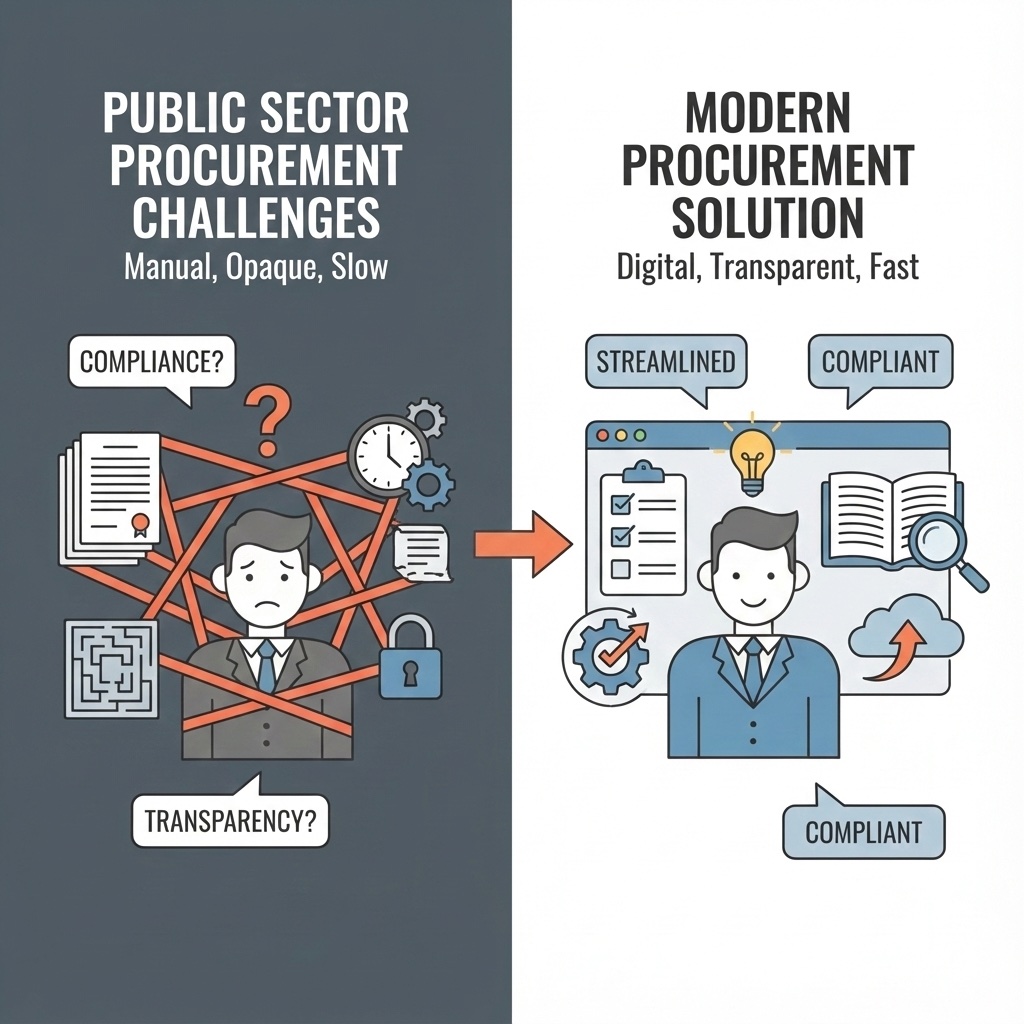
How Public Procurement Differs
Public sector procurement works under different conditions from private sector purchasing. As stewards of taxpayer funds, government agencies must demonstrate value for money, transparency, and accountability in every purchasing decision. For a concise primer on the field, see what government procurement in the public sector involves.
This guide covers the key obstacles facing public sector procurement professionals, practical strategies for overcoming them, and how modern AI-powered tools can help agencies do more with less while maintaining full compliance.
The Core Challenges
1. Regulatory Complexity
One of the biggest challenges in public sector procurement is keeping up with the many regulations and legal requirements that apply. The procurement process is subject to laws covering:
- Competition requirements
- Anti-discrimination provisions
- Anti-corruption safeguards
- Environmental standards
- Small business and diversity mandates
In the United States, the Federal Acquisition Regulation (FAR) is updated regularly, impacting how public institutions approach bidding, documentation, and vendor selection. Similar frameworks exist at state and local levels, each with their own requirements.
Regulations change often. Updates can be triggered by policy changes, economic events, cybersecurity threats, or supply chain disruptions.
2. Budget Constraints
Public sector procurement professionals often face difficult decisions when balancing quality and cost with tight budgets. Limited funding creates pressure to:
- Achieve more with less
- Justify every expenditure
- Demonstrate clear value for money
- Balance immediate needs against long-term value
Budget restraints complicate the ability to secure necessary resources while maintaining fiscal responsibility to the community. Automation becomes essential under these constraints, because AI tools like Buyer24 can handle routine RFQ tasks without adding headcount.
3. Transparency and Accountability Requirements
Because funds come from public taxes or grants, procurement must demonstrate transparency and accountability in how funds are managed. Public sector professionals are public servants, directly accountable if they fail to manage funds appropriately.
This means:
- Extensive documentation requirements
- Open bidding processes in many cases
- Public records and audit trails
- Political and media scrutiny
Every supplier communication, quote and decision must be documented and defensible. For public sector compliance, tools that automatically maintain complete audit trails are essential.
4. Staffing and Expertise Shortages
Entities across the country struggle to find skilled, experienced people to fill procurement vacancies. Smaller entities face particular challenges finding dedicated, certified, and experienced procurement professionals. This shapes how schools handle procurement and how procurement differs for universities with limited specialist staff.
A lack of skilled professionals can:
- Hinder efficiency
- Affect decision quality
- Create compliance risks
- Lead to burnout among existing staff
This staffing gap is one of the strongest arguments for AI-assisted procurement. When a two-person procurement office is handling hundreds of RFQs annually, automation becomes a necessity.
5. Limited Supplier Competition
In government procurement, finding and qualifying suppliers can be difficult due to regulations and compliance requirements. Even after finding a reasonable supplier, maintaining smooth supply chain performance presents ongoing challenges.
Limited suppliers and competition can restrict the availability of quality services and goods, often leading to higher prices. Tools that help agencies communicate with more suppliers, including those who speak different languages, can expand the competitive field.
The same problem appears on the other side of the counter. A small reseller bidding on a government solicitation has to find an eligible supplier for every line before the due date; that process is covered in how to source supplier quotes for a government solicitation.
Key Regulations Shaping Public Procurement
Key frameworks include:
Federal Level
- Federal Acquisition Regulation (FAR): The primary regulation for federal agency purchases
- Procurement Integrity Act: Rules around conflicts of interest, fair competition, and anti-corruption
- Buy America Laws: Requirements to prioritize domestically produced goods
State and Local Level
- Local preference laws: Encouraging or mandating selection of regional vendors
- Small business set-asides: Reserved purchases for small businesses
- MWBE requirements: Mandates for minority and women-owned business enterprise participation, a core part of supplier diversity in procurement
- Sustainable procurement standards: Environmental and social responsibility requirements
Recent Developments
In the UK, the Procurement Act 2023 is a significant overhaul aimed at simplifying public procurement. Similar modernization efforts are underway in many jurisdictions.
Strategies for Success
Use Technology
E-procurement systems and automated compliance checks can:
- Support compliance with regulations
- Minimize errors
- Shorten procurement cycles
- Promote transparency and accountability
- Create automatic audit trails
AI-powered tools like Buyer24 go further and automate the entire RFQ process, from sending requests to suppliers to collecting and organizing quotes, while maintaining complete records for audit and compliance purposes.
Invest in Training
Given staffing challenges, developing existing team members is important. Prioritize:
- Certification programs
- Continuing education
- Cross-training within teams
- Knowledge management systems
Standardize Processes
Create standardized procedures that ensure consistency and compliance:
- Template documents for common purchases
- Checklists for regulatory requirements
- Defined approval workflows
- Clear escalation paths
For the high-volume RFQ work that dominates many procurement offices, applying the best practices for managing RFQs efficiently can cut cycle times while keeping processes auditable.
Build Supplier Relationships
Even within regulatory constraints, investing in supplier relationships is worthwhile, and mastering supplier communication is central to keeping bidders engaged:
- Conduct vendor outreach events
- Provide clear guidance on doing business with your agency
- Communicate requirements and timelines proactively
- Offer feedback to unsuccessful bidders
Plan for Compliance
Build compliance into your processes from the start:
- Include compliance checkpoints at each procurement stage
- Document decisions and rationale contemporaneously
- Conduct regular internal audits
- Stay current on regulatory changes
Balancing Competing Priorities
Speed vs. Compliance
Stakeholders want fast results, but cutting corners creates risk. Build efficiency into compliant processes rather than bypassing them. AI automation helps here. Buyer24 can process RFQs faster than manual methods while maintaining complete compliance documentation.
Cost vs. Quality
Lowest price isn't always best value. Document your evaluation criteria and the rationale for weighting factors beyond price.
Competition vs. Efficiency
Open competition is important, but managing hundreds of responses isn't efficient. Find the right balance for each purchase. Automated tools that normalize and compare quotes make it possible to solicit more bids without drowning in paperwork.
Standardization vs. Flexibility
Standardized processes ensure consistency, but every purchase is unique. Build flexibility into your frameworks.
How Buyer24 Supports Public Sector Procurement
Buyer24's AI procurement agent is designed with these public sector requirements in mind.
Complete Audit Trails
Every email, quote and supplier communication is automatically documented and searchable. When auditors or public records requests come in, you have complete, organized records ready.
Do More With Less
Small procurement teams can handle larger workloads without adding staff. The AI agent handles routine RFQ distribution, follow-ups, and quote collection, freeing your team to focus on evaluation and decision-making.
Expand Your Supplier Base
With automatic translation to 35+ languages, you can reach suppliers you couldn't communicate with before. This can increase competition and reduce costs while meeting domestic preference requirements for final awards.
Maintain Human Control
AI handles the routine work, but humans make the decisions. Your procurement professionals review quotes, evaluate suppliers, and make award recommendations. The AI makes sure nothing falls through the cracks.
Works With Existing Systems
Buyer24 integrates with your existing email (Gmail, Outlook, government email systems), so there's no massive IT project required. Your team keeps working the way it always has, with faster turnaround and better documentation.
Trends
Digital Transformation
More agencies are adopting e-procurement platforms that automate routine tasks and improve transparency. AI-powered tools go a step further and handle supplier communication as well as document management. Agencies unsure how to begin can follow a practical roadmap for digital transformation in procurement.
Data-Driven Decision Making
Analytics tools help identify patterns, track performance, and demonstrate value. When all your procurement communications are in one system, you gain visibility you did not have before.
Sustainability Focus
Environmental and social responsibility requirements are becoming more prominent.
Supplier Diversity
Increasing emphasis on small business, minority-owned, and local supplier participation.
FAQ
What is the Federal Acquisition Regulation (FAR)?
The Federal Acquisition Regulation (FAR) is the primary rulebook governing how US federal agencies buy goods and services. It covers competition requirements, documentation, and vendor selection. The FAR is updated regularly, so public sector buyers must track changes to stay compliant with bidding and award rules.
How does the UK Procurement Act 2023 change public procurement?
The Procurement Act 2023 is a significant overhaul aimed at simplifying UK public procurement. It consolidates older rules, increases transparency expectations, and modernizes how contracting authorities run competitions and publish award information.
Why are audit trails so important in public sector procurement?
Because funds come from public taxes or grants, every supplier communication, quote, and decision must be documented and defensible. Complete audit trails support open records requests, withstand media and political scrutiny, and prove that public money was spent fairly. They are a compliance requirement.
Can AI tools help small public procurement teams stay compliant?
Yes. Many public agencies run lean teams that handle hundreds of RFQs each year. AI-assisted tools automate routine distribution, follow-ups, and quote collection while maintaining searchable records. In a 2025 Gartner survey, 68% of CPOs named AI and generative AI a top technology priority (SCMR).
How can agencies expand supplier competition under regulatory constraints?
Limited competition often drives higher prices in government procurement. Agencies can widen the field through vendor outreach events, clearer guidance, and tools that translate communication across languages. Reaching more qualified suppliers increases competition while still meeting domestic preference rules at the final award stage.
Key Takeaways
Public sector procurement teams can handle these challenges by:
- Understanding the regulatory environment and staying current on changes
- Using technology to automate compliance and improve efficiency
- Investing in people through training and development
- Standardizing processes while maintaining appropriate flexibility
- Building supplier relationships within regulatory constraints
- Documenting everything to support accountability and audit requirements
The goal is to show that public funds are spent wisely, fairly, and in the public interest.
Modern AI tools like Buyer24 can help you meet this standard more efficiently by handling the routine work while ensuring the documentation and transparency that public sector procurement demands.
Ready to see how AI can help your agency? Schedule a demo to learn how Buyer24 supports public sector procurement teams.