
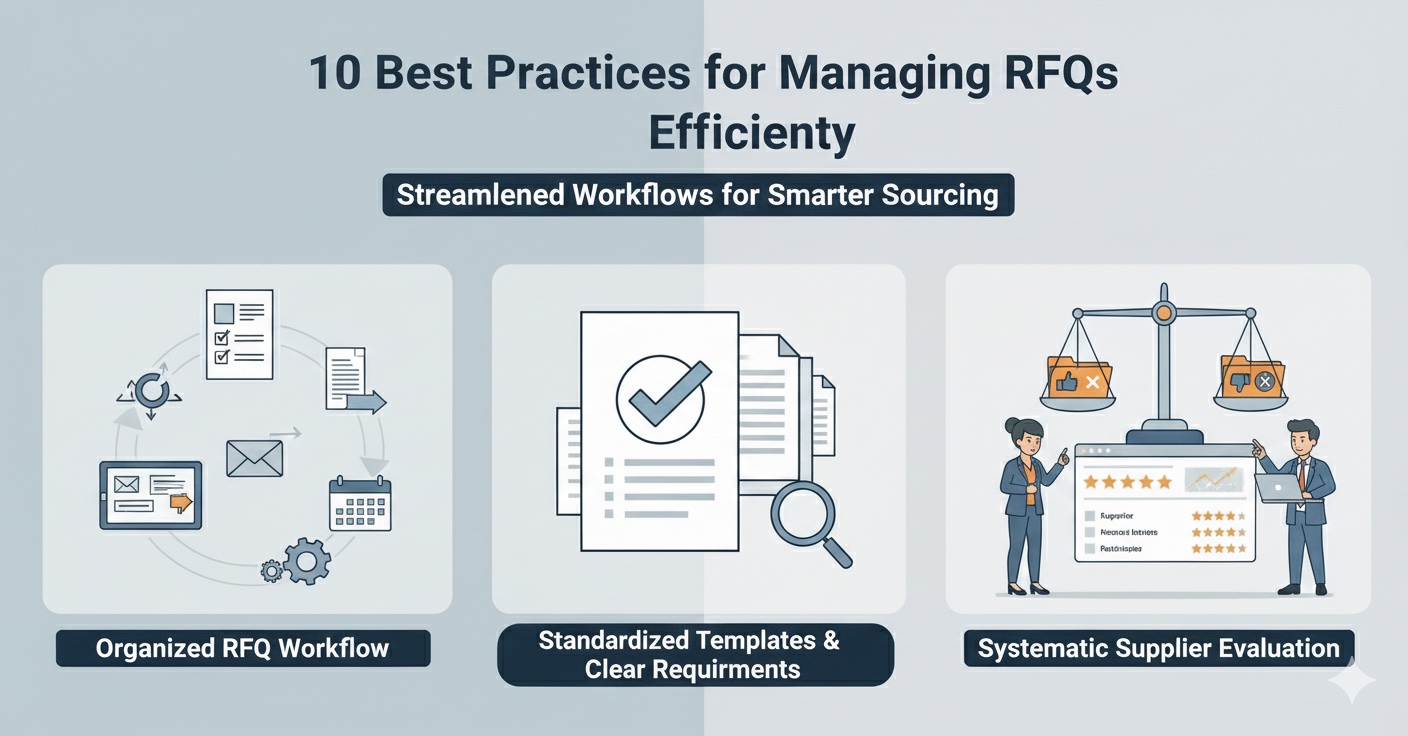
The RFQ Process
The Request for Quote (RFQ) process is fundamental to effective procurement. A well-run RFQ process produces competitive pricing, stronger supplier relationships, and good value for your organization, while a poorly run one wastes time, frustrates suppliers, and leaves money on the table.
This guide covers ten proven best practices for managing RFQs and how tools like Buyer24 can help you implement them. For the bigger picture on tying these practices together, see our complete guide to RFQ automation.
1. Invest Time in Preparation
Preparation affects every later step of the bidding process. Start by collaborating with stakeholders to clearly define:
- The project's purpose and scope
- Detailed product or service requirements
- Quantities and delivery timelines
- Evaluation criteria and their weights
Time spent on preparation saves more time later. Vague or incomplete RFQs lead to back-and-forth clarifications, inconsistent quotes, and poor decisions, and they're one of the leading reasons RFQs don't get answered on time.
2. Create Standardized Templates
When every RFQ follows a different structure, vendors struggle to respond efficiently and your team wastes time reconciling inconsistent data.
Create and enforce standardized RFQ templates across your organization:
- Centralize document formats in a shared library
- Include standardized pricing tables for easy comparison
- Define approval workflows for consistency
- Ensure all categories use the same core structure
A pricing table template that calculates total cost when quantities and specifications are entered makes quote comparison much easier. Knowing what an RFQ template should include ensures you capture every field suppliers need.
Buyer24 helps here by providing a consistent structure for every request. Each RFQ is organized the same way, with standardized fields for specifications, quantities, and deadlines, which makes it easy to compare responses across suppliers. To get started fast, you can build reusable RFQ templates that create consistent, professional requests in seconds.
3. Be Specific About Requirements
Ambiguous requests produce inaccurate quotes. To create an effective RFQ, provide:
- Detailed specifications: Part numbers, materials, tolerances, standards (for a worked example on a made-to-print category, see what to include in an aluminum casting RFQ)
- Clear quantities: Exact numbers, not ranges when possible
- Firm timelines: Specific delivery dates, not "ASAP"
- Evaluation criteria: What matters most, such as price, quality, or speed
Being clear and specific minimizes confusion and ensures accurate supplier responses. Suppliers can't quote what they don't understand, so it pays to learn how to write an effective RFQ and which common RFQ mistakes to avoid. AI-powered RFQ validation is built to catch ambiguity before you send, by scoring quality and flagging missing details so issues never reach your suppliers.
4. Invite the Right Number of Suppliers
Aim to invite a manageable number of suppliers, typically between three and eight, so you receive competitive bids without being overwhelmed by responses.
Too few suppliers means less competition. Too many means:
- More time spent answering questions
- Longer evaluation periods
- Lower quality of attention per response
- Supplier fatigue for future RFQs
Select suppliers based on category expertise, past performance, and strategic importance to your organization.
5. Communicate Clearly and Consistently
Keep bidders informed throughout the RFQ process:
- Send acknowledgments when you receive bids
- Share timelines for bid opening and decision dates
- Respond promptly to supplier questions
- Maintain confidentiality of vendor offers unless it's an open bid
In your documentation and conversations with vendors, set specific guidelines and expectations. Clear communication eliminates confusion and results in more accurate quotes.
Many procurement teams struggle here. Email chains get lost, questions go unanswered, and suppliers feel ignored. Centralizing all supplier communication in one place, organized by request, keeps every message, quote, and follow-up visible in a single thread so nothing falls through the cracks.
6. Use Technology to Your Advantage
Procurement software can automate much of the RFQ process, cutting down on manual labor while reducing mistakes. Modern RFX management systems can:
- Distribute documents instantly
- Centralize supplier communications
- Automate reminders and follow-ups
- Normalize responses for easy comparison
- Maintain audit trails automatically
Using technology throughout the RFQ process can be a major improvement, freeing teams to focus on high-value strategic work.
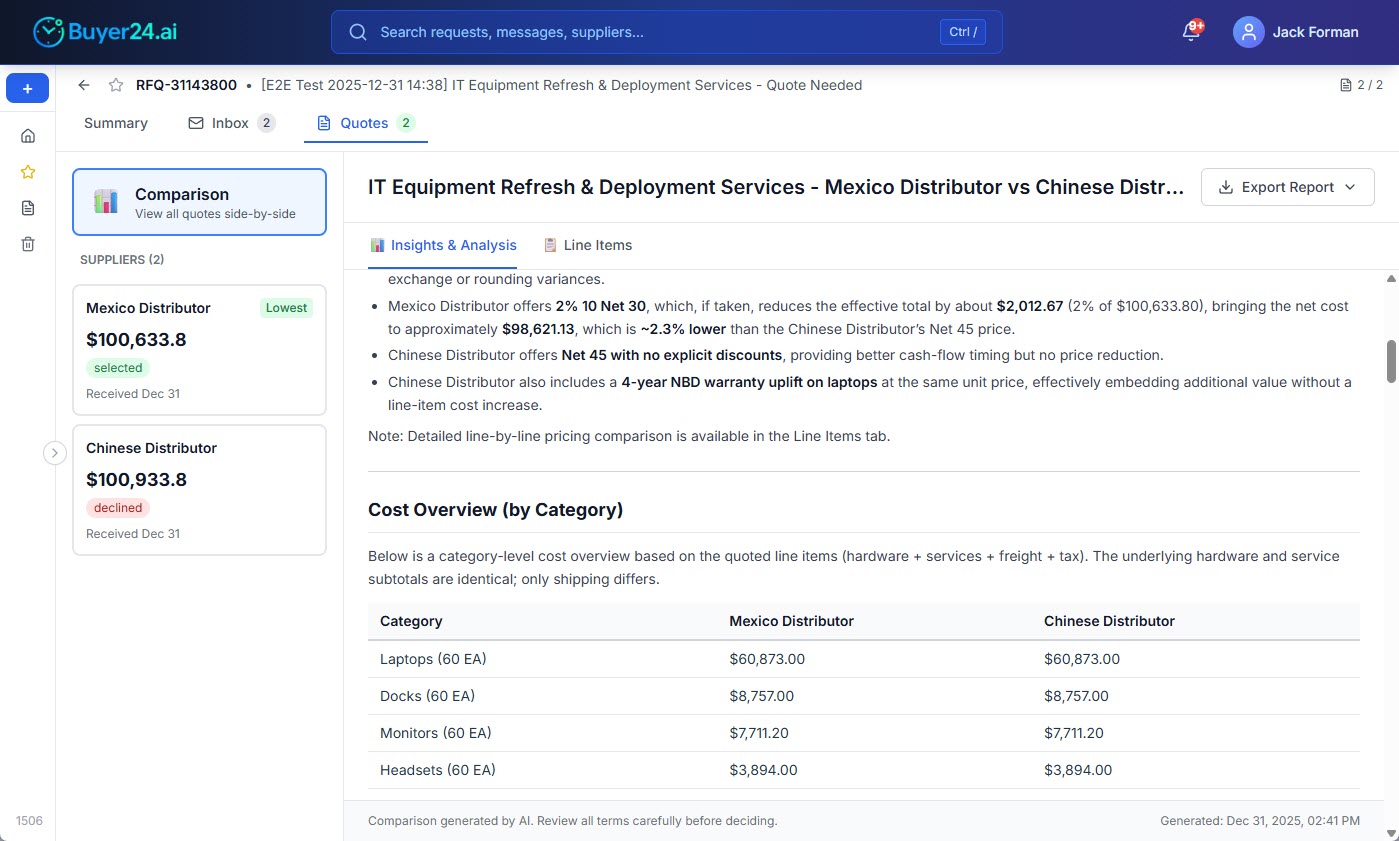
Buyer24 is purpose-built for this. It automatically captures supplier quotes from emails, parses pricing and terms, and presents them in a comparable format. Instead of manually extracting data from PDF attachments and building spreadsheets, you see all quotes side-by-side instantly. By applying intelligent AI-powered quote comparison that standardizes quotes across formats and highlights the best options based on price, delivery, and terms, teams make faster, more data-driven sourcing decisions.
7. Establish Clear Evaluation Criteria
Before sending the RFQ, define how you'll evaluate responses. Common criteria include:
- Price: Total cost rather than unit price alone
- Quality: Based on specifications or past performance
- Delivery: Timeframes and reliability
- Supplier reputation: Track record and references
Use scoring models that weight each criterion based on importance. For commodities, price might carry more weight. For custom products, quality and technical capability might be more important. For a deeper walkthrough of weighted scoring and normalization, see these expert quote comparison tips from procurement professionals.
Whatever criteria you choose, define the weighting before responses arrive. Deciding what matters most, such as delivery speed, total cost, or supplier reliability, and scoring every quote against that fixed framework keeps evaluations consistent and defensible.
8. Consider Total Cost of Ownership
Don't evaluate quotes on unit price alone. Factor in:
- Shipping, taxes, and duties
- Setup or tooling fees
- Quality assurance and testing costs
- Warranty and support terms
- Payment terms and financing costs
For complex purchases, Total Cost of Ownership (TCO) analysis prevents selecting the "cheapest" option that actually costs more over time.
9. Document Everything
Document all actions taken during the RFQ process:
- Number of bids sent and received
- Evaluation criteria and scoring
- Committee members involved in evaluation
- Rationale for the final decision
- Communications with suppliers
This documentation protects your organization, supports compliance requirements, and provides valuable data for improving future RFQ processes.
Where possible, capture this record automatically. When every email, quote, and status change is timestamped, auditing a sourcing decision or referencing past pricing becomes simple, with no manual logging required.
10. Close the Loop Professionally
Once you've selected a winner and signed the contract:
- Notify unsuccessful bidders promptly and professionally
- Thank them for their participation
- Provide feedback if appropriate and requested
- Maintain the relationship for future opportunities
You may need these suppliers for future projects. Treating them ethically at this stage ensures they'll invest time in bidding on your next RFQ.
Sourcing from International Suppliers
International suppliers may offer better pricing or specialized capabilities, but they are often overlooked because language differences make communication difficult and error-prone.
Buyer24's automatic translation removes most of this barrier. When a supplier responds in Chinese, German, or Spanish, Buyer24 translates the message to your language automatically, and your replies are translated back.
Benefits of a Well-Run RFQ Process
Organizations that run their RFQ process well see these benefits:
- Faster sourcing cycles: Less back-and-forth means quicker decisions
- Better pricing: Competition and clarity drive value
- Stronger supplier relationships: Professional processes earn respect
- Reduced risk: Documentation and consistency prevent problems
- Time savings: Standardization removes the need to rebuild each request from scratch
Start with one or two of these practices, measure the improvement, and build from there. Tools like Buyer24 can speed up that progress significantly.
FAQ
How many suppliers should I invite to an RFQ?
Aim for a manageable number, typically between three and eight. Too few limits competition; too many lengthens evaluation, lowers attention per response, and causes supplier fatigue. Select based on category expertise, past performance, and strategic importance so you get competitive bids without being overwhelmed.
What should a good RFQ template include?
A strong template captures detailed specifications, exact quantities, firm delivery dates, and clear evaluation criteria. Include a standardized pricing table so quotes are easy to compare. Standardizing the structure across your organization helps suppliers respond efficiently and saves your team from reconciling inconsistent data.
Why do suppliers ignore or delay RFQ responses?
The most common cause is vague or incomplete requests. When specifications, quantities, or deadlines are unclear, suppliers wait for clarification instead of quoting. Lost email threads and slow responses make it worse. Clear, specific, well-organized RFQs sent through a single tracked channel get faster, more accurate quotes.
What is total cost of ownership, and why does it matter?
Total cost of ownership (TCO) looks beyond unit price to include shipping, taxes, duties, tooling fees, quality testing, warranty, and payment terms. Evaluating on unit price alone often selects a "cheapest" option that costs more over time. For complex purchases, TCO analysis prevents that mistake.
How can AI improve the RFQ process?
AI can capture quotes from emails, parse pricing and terms, and present responses in a comparable format, replacing manual data entry and spreadsheet building. It can also automate follow-ups, maintain audit trails, and flag missing details before sending. In a 2025 Gartner survey, 68% of CPOs named AI and generative AI a top technology priority (SCMR).
Ready to Transform Your RFQ Process?
See how Buyer24 can help you manage RFQs more efficiently with centralized communication, automatic quote extraction, and side-by-side comparison.