
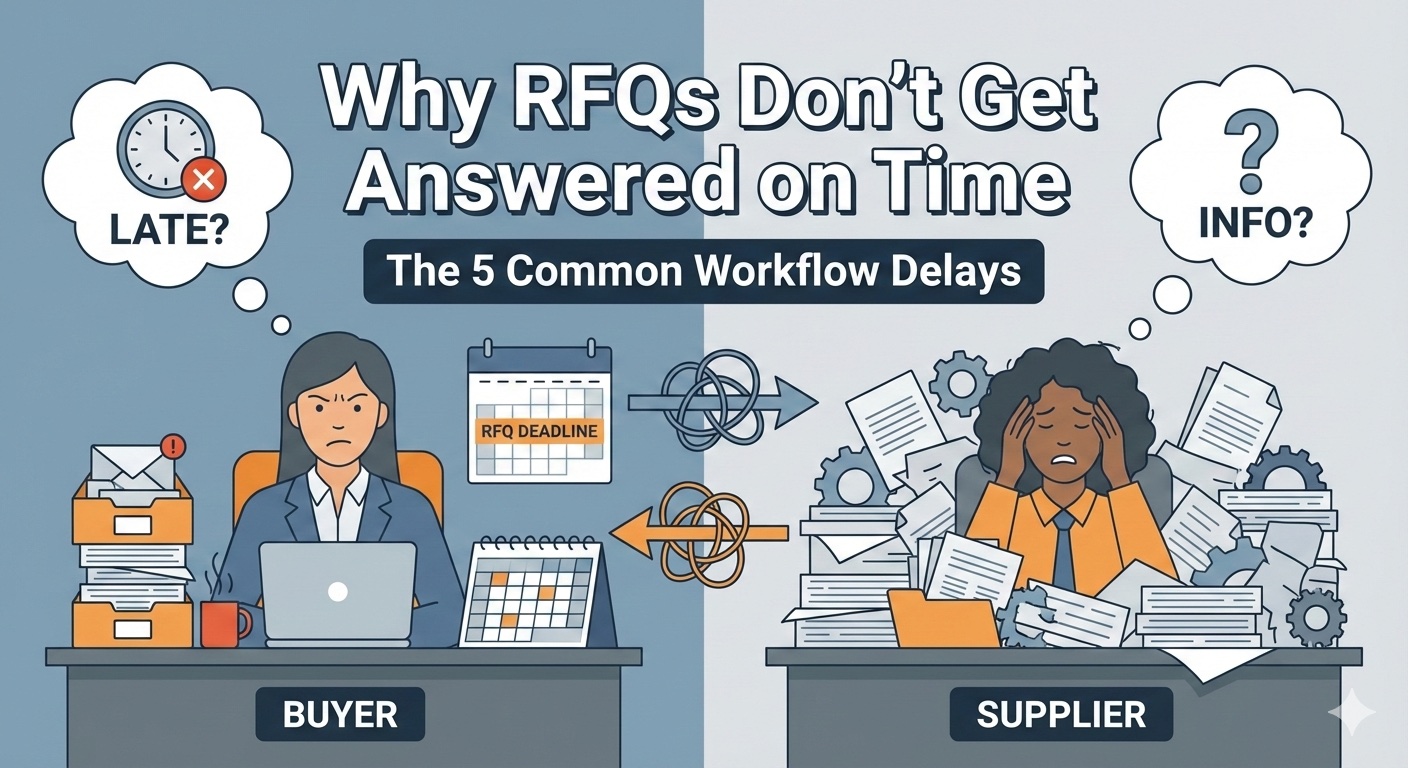
Where RFQ Delays Come From
Late or missing RFQ responses are one of the most common frustrations in B2B procurement. A request is sent, days pass, follow-ups begin, and eventually someone concludes that "the supplier is unresponsive."
In practice, delays usually have specific operational causes inside everyday order-to-purchase workflows, on both the buyer and the supplier side. Our RFQ automation guide shows how a more structured process closes many of these gaps. Once responses do arrive, handling supplier quotes end to end keeps the momentum going through comparison and award.
Most of these problems can be solved with better processes and the right tools.
The Real Cost of Delayed RFQ Responses
When RFQ responses are delayed or missing:
- Projects stall waiting for pricing information
- Procurement teams waste hours on follow-ups and manual tracking
- Urgent needs get rushed to whoever responds first, who is not necessarily the best supplier
- Supplier relationships suffer from frustration on both sides
- Savings are missed when you can't compare enough options
Procurement teams lose a significant share of their time to administrative tasks like chasing quotes and managing communications, and that time could otherwise go to strategic sourcing and relationship building. In the 2025 Global CPO Survey, 49.4% of procurement leaders pointed to productivity gains as a key value they expect from generative AI.
Common Causes on the Buyer Side
Many RFQ delays start with the buyer rather than the supplier.
1. Incomplete or Unclear RFQs
Suppliers often don't respond because the RFQ is vague. When key details such as quantities, specifications, delivery timing or quality requirements are missing, the recipient has to choose between:
- Reply with questions (delays the process further)
- Guess at the requirements (leads to inaccurate quotes)
- Move on to other work (no response at all)
Many suppliers choose option three. They're busy, and incomplete RFQs signal that the buyer isn't serious or organized. For a category-level view of what a complete package contains, see what to include in an aluminum casting RFQ. Few suppliers want to invest time in a quote that will likely need revision anyway. In fast-moving niches, incomplete RFQs are especially costly, as described in where electronic component distributors lose time, money, and control. The same problem now exists on the supplier side, where buyers' agents drop suppliers they can't read or reach, as explained in how to be found by AI buying agents.
What's often missing:
- Exact quantities (not "approximately" or "TBD")
- Technical specifications or part numbers
- Required delivery dates (not "ASAP")
- Quality standards or certifications needed
- Packaging or shipping requirements
- Payment terms
The fix: Create standardized RFQ templates that force completeness, and follow proven RFQ best practices so every request is clear from the start. Completeness matters even more in formal, regulated settings, because public sector procurement often mandates fixed fields and documented requirements, and a vague request there can be disqualified outright. Include all required fields and don't send until everything is filled in. You can also run AI-powered RFQ validation to score quality and catch missing details before sending. Buyer24 helps here by providing a consistent structure for every request, ensuring nothing gets missed.
2. Sent to the Wrong Contact
Emails sent to generic addresses like sales@, info@, or purchasing@ often go unread. These inboxes are:
- Monitored irregularly (if at all)
- Overwhelmed with spam and marketing emails
- Managed by people who don't know where to forward requests
Even when the email reaches someone, they may not know who handles that product category or have the authority to respond.
The fix: Build and maintain a contact database with named individuals for each supplier and category. When you find a good contact, save it. Over time, you'll build a reliable network of people who actually respond.
3. No Follow-Up Process
Many RFQs are sent and forgotten. The buyer waits, assumes silence means "no," and either gives up or scrambles at the last minute.
Without a tracking system or scheduled follow-ups, requests are forgotten on both sides. The supplier might have intended to respond but got busy. A simple reminder could have gotten you a quote.
The fix: Implement systematic follow-up schedules. Send reminders at 2-3 days, then again at 5-7 days. Track which suppliers have responded and which haven't. See our guidance on how to follow up with suppliers on RFQs and how to handle late supplier responses when reminders aren't enough. Buyer24 automates the follow-up. You can see at a glance which requests are awaiting responses and send follow-ups directly from the platform.
4. Unrealistic Deadlines
"Need quote by EOD" emails sent at 4pm rarely get responses. Suppliers need time to:
- Review the requirements
- Check inventory or production capacity
- Consult with their team on pricing
- Prepare a professional quote document
Rushing suppliers leads to either no response or hasty quotes with inflated "safety margin" pricing.
The fix: Plan ahead and learn how to set realistic RFQ deadlines and timelines. Give suppliers at least 3-5 business days for standard requests, longer for complex or custom items. If you have a genuinely urgent need, call first rather than relying on an email with a tight deadline.
5. Language Barriers
In global procurement, language differences create real friction. Suppliers may:
- Struggle to understand technical requirements in a foreign language
- Hesitate to respond in imperfect English
- Misinterpret key details due to translation issues
- Simply skip RFQs they can't easily read
This limits your supplier pool and means you're missing out on competitive options from international vendors.
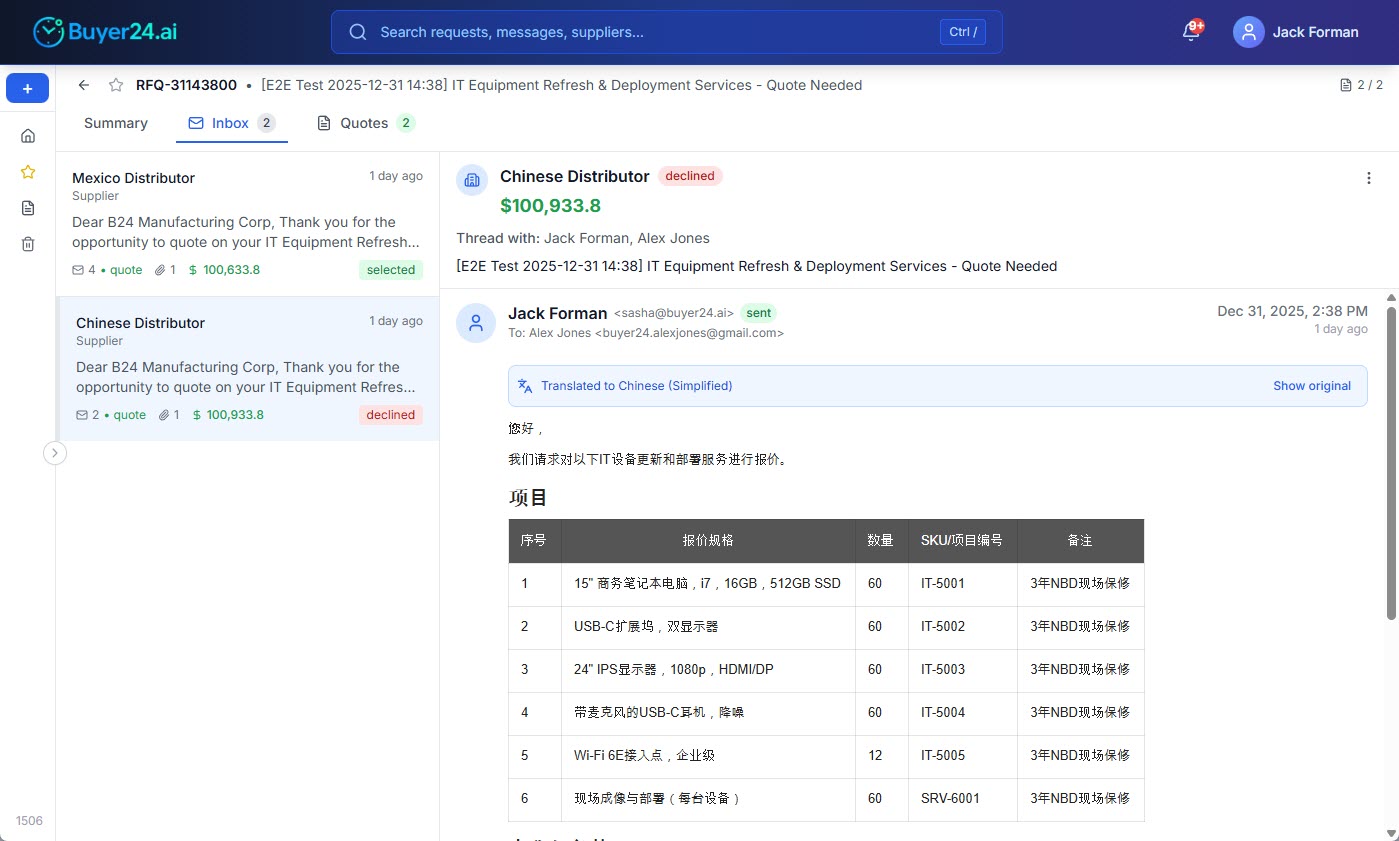
The fix: Use tools that handle translation automatically. Buyer24's automatic email translation for suppliers lets you communicate in more than 35 languages. Supplier messages are translated into your language, and your replies are translated back. This removes language barriers and misunderstandings and gives you a much wider global supplier pool.
Common Causes on the Supplier Side
Understanding the supplier's perspective helps you write RFQs that get answered.
1. Buried in the Inbox
Suppliers, especially sales teams at larger companies, receive hundreds of emails daily. Your RFQ is competing with:
- Customer service requests
- Internal communications
- Other RFQs from other buyers
- Marketing emails and spam
If your RFQ doesn't stand out, has a vague subject line, or looks like a mass email, it may never be opened, let alone answered. Getting this right starts with how to communicate RFQ requirements to suppliers clearly and concisely.
What helps:
- Clear, specific subject lines: "RFQ: 500 units SKU-12345, delivery by March 15"
- Professional formatting that's easy to scan
- Mention of your company name if you're an established customer
- Indication of order size or value if it's significant
2. Manual Quote Workflows
Many suppliers, especially small and mid-sized ones, lack sophisticated quoting systems. When your RFQ arrives, it triggers a manual process:
- Sales rep reviews the request
- Checks with warehouse on availability
- Consults with production on lead times
- Gets pricing approval from management
- Creates quote document manually
- Sends response
Each step involves a different person, different system, and potential delays. If any link in the chain is busy, traveling, or out sick, the whole process stalls.
What helps: Be patient with smaller suppliers who may offer better pricing or service. Send complete information upfront so they don't have to come back with questions. Consider whether the supplier is a good fit for time-sensitive requests.
3. Unclear Profitability
Before investing time in a quote, suppliers quickly assess:
- Is this a real opportunity or a price check?
- Is the volume worth our time?
- Can we actually deliver what they're asking for?
- Will this customer be difficult to work with?
If your RFQ is for a non-standard item, very low volume, or seems like you're just gathering comparison prices with no intent to buy, suppliers may skip it entirely.
What helps:
- Be upfront about your intentions and timeline
- Indicate if this is a one-time purchase or potential recurring business
- Mention your company and industry to establish credibility
- If you're early in the process, say so, because suppliers appreciate honesty
4. Previous Bad Experiences
If a supplier has quoted you before and never heard back, or has had difficult experiences with your organization, it may deprioritize future requests.
Suppliers remember:
- Buyers who get quotes and never respond
- Excessive negotiation after quotes are submitted
- Late payments or difficult procurement processes
- Unreasonable demands or scope changes
What helps: Close the loop professionally, even when you don't select a supplier. A brief "thank you, we went with another vendor this time" maintains the relationship for future opportunities. Investing in stronger supplier communication overall makes vendors far more likely to prioritize your future requests.
How Buyer24 Helps
Buyer24 is designed to address the root causes of delayed and missing RFQ responses.
Centralized Tracking
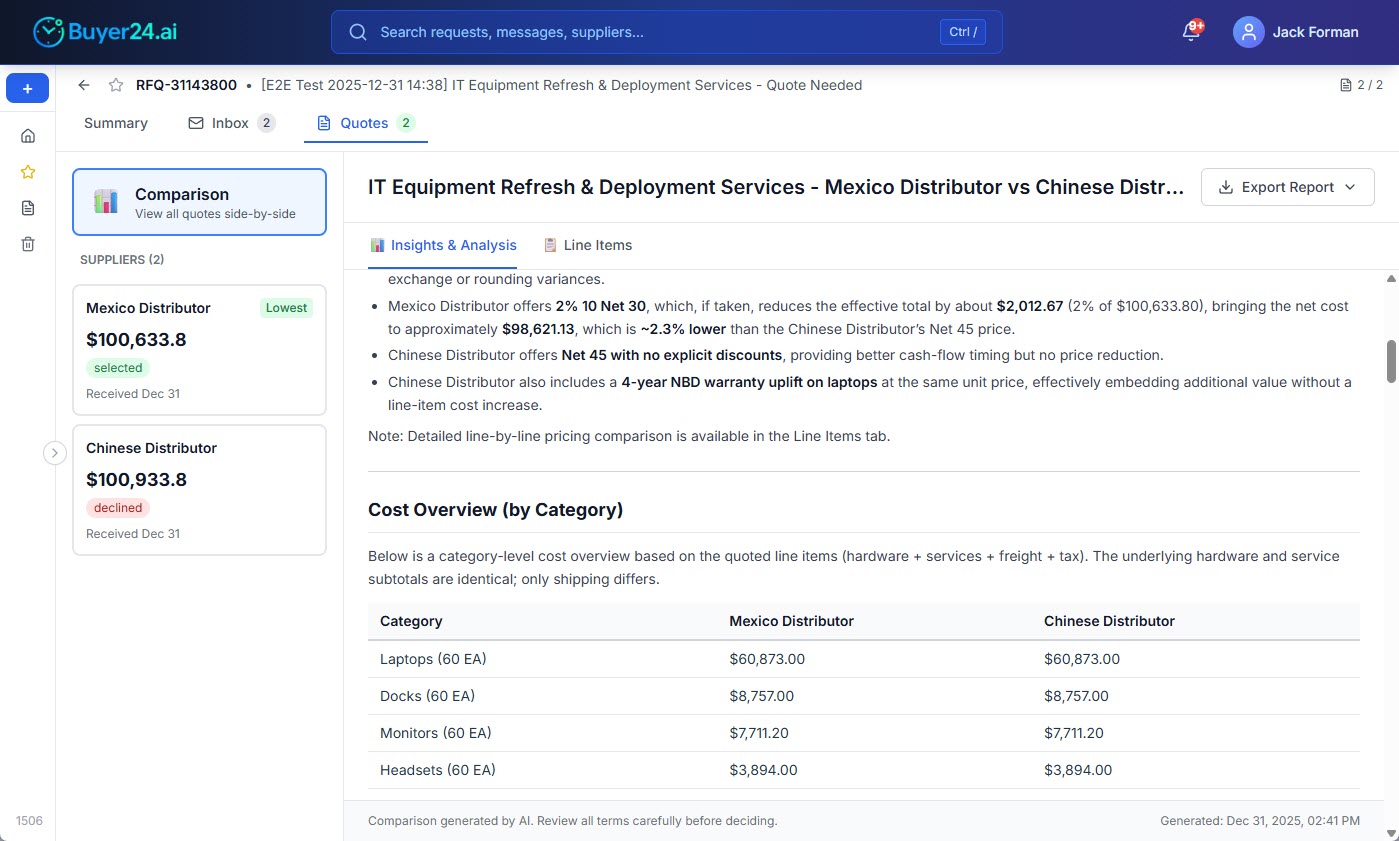
Every RFQ and supplier response is kept in one place. You can see instantly which suppliers have responded, which are pending, and which need follow-up, so nothing falls through the cracks.
Automatic Translation
Messages translate automatically in both directions, so you can communicate with suppliers worldwide without language barriers and source globally.
Structured Communication
All messages are organized by request with full thread history, so you do not have to search through email folders or lose track of conversations.
Quote Extraction
When suppliers respond, Buyer24's AI automatically extracts pricing, quantities, and terms, which makes comparison instant and eliminates manual data entry.
Follow-Up Reminders
Know exactly when suppliers haven't responded and send follow-ups directly from the platform. Systematic follow-up increases response rates.
Professional Templates
Ensure your RFQs include all necessary information. Consistent, complete requests get better responses.
Summary of Fixes
For Faster Responses:
- Clear subject lines and formatting. Make it easy to scan and prioritize
- Named contacts. Reach the right person directly instead of a generic inbox
- Complete information. Include all specs, quantities, and requirements upfront
- Reasonable deadlines. Give suppliers time to respond properly
- Structured follow-ups. Automate reminders so nothing slips
- Language accessibility. Use translation tools for international suppliers
- Professional closing. Thank suppliers even when you don't select them
For Better Relationships:
- Be honest about your timeline and intentions
- Respond to quotes, even if declining
- Pay on time and honor commitments
- Provide feedback that helps suppliers improve
- Treat suppliers as partners
Conclusion
RFQ delays are rarely caused by one slow person or one bad supplier. They result from unclear inputs, manual processes, communication gaps, and lack of visibility, so the solution is to fix the process rather than push people harder.
By understanding the real causes of delayed responses and implementing systematic improvements, you can increase your RFQ response rates while building better supplier relationships.
Tools like Buyer24 make this easier by centralizing communication, automating follow-ups, and eliminating barriers like language differences, which leads to more quotes, faster responses, and better sourcing decisions.
FAQ
Why don't suppliers respond to my RFQs?
Most non-responses trace back to operational gaps rather than slow suppliers. The common causes are incomplete or unclear RFQs, requests sent to generic inboxes instead of named contacts, no follow-up process, unrealistic deadlines, and language barriers. Fixing the inputs and the process usually fixes the response rate.
How long should I give suppliers to respond to an RFQ?
Give suppliers at least 3-5 business days for standard requests, and longer for complex or custom items. Suppliers need time to review requirements, check inventory or capacity, consult on pricing, and prepare a professional quote. If a need is genuinely urgent, call first rather than sending an email with a tight deadline.
What information should an RFQ include to get a response?
Include everything a supplier needs to quote without coming back with questions: exact quantities, technical specifications or part numbers, required delivery dates, quality standards or certifications, packaging or shipping requirements, and payment terms. Standardized RFQ templates help force completeness so nothing gets missed.
How do I follow up on an RFQ without being pushy?
Use a systematic follow-up schedule rather than ad-hoc chasing. A practical pattern is a reminder at 2-3 days and another at 5-7 days, while tracking which suppliers have responded and which haven't. A simple, polite reminder often recovers a quote from a supplier who intended to respond but got busy.
Should I send RFQs to generic addresses like sales@ or info@?
Avoid generic inboxes when you can. They're monitored irregularly, overwhelmed with spam, and often managed by people who don't know where to route the request. Build and maintain a contact database of named individuals for each supplier and category so your RFQs reach someone who can actually respond.
How can I get quotes from international suppliers despite language barriers?
Language differences cause suppliers to misinterpret requirements or skip RFQs they can't easily read. Use tools that translate communication automatically in both directions, so you can write in your language and suppliers read in theirs. Buyer24's automatic translation lets you communicate with suppliers in more than 35 languages and reduces misunderstandings.
Ready to Fix Your RFQ Response Rates?
See how Buyer24 can help you get more quotes, faster responses, and better visibility into your procurement communications.