
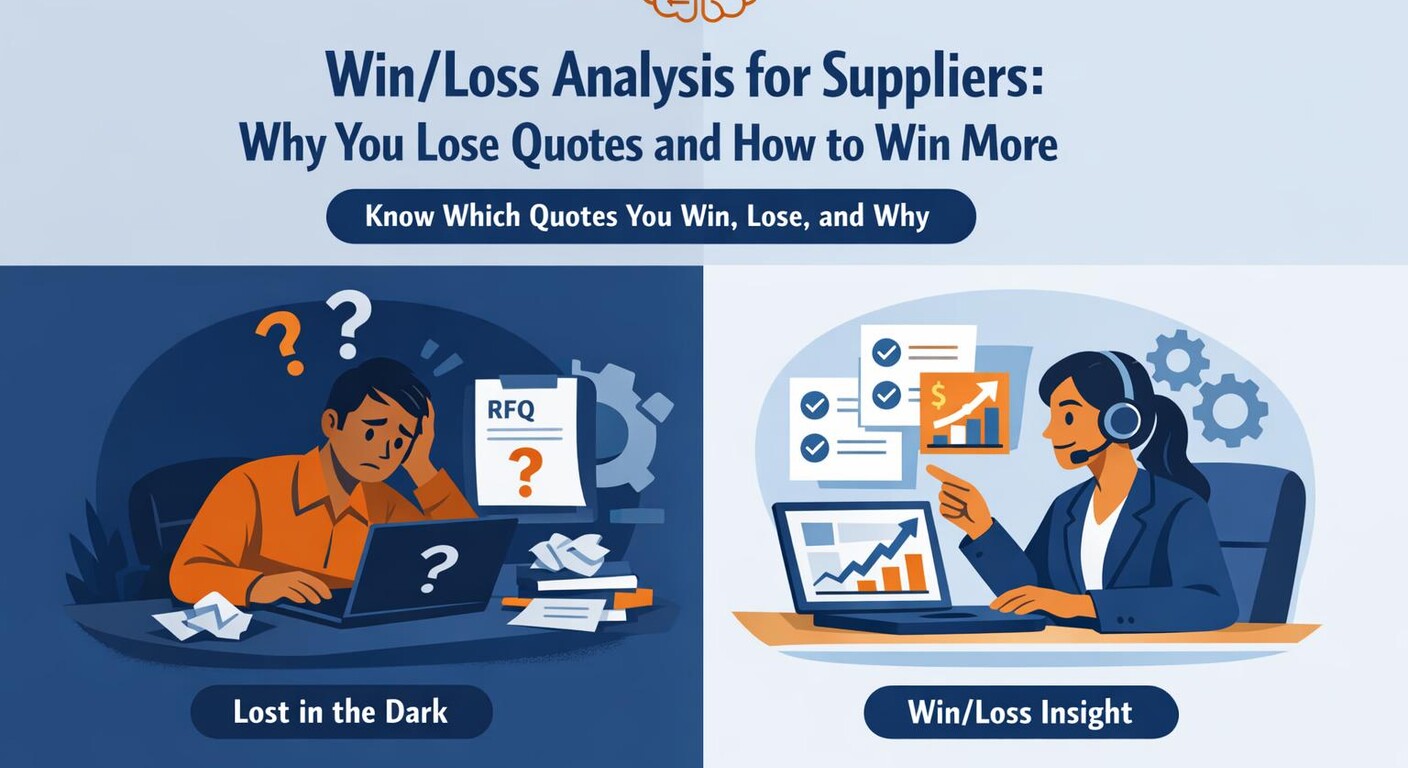
Win/loss analysis for suppliers is the practice of tracking which of your quotes and bids you win or lose, then studying the patterns behind them: by price, lead time, customer, and product. It turns a scattered history of sent quotes into evidence you can act on, instead of a gut feeling about how business is going.
Most suppliers have little visibility here. They know they are busy quoting and that some orders land and some do not, but they cannot say what their real win rate is or why the losses happen. Without that data they guess, cutting price when they might not need to, chasing the wrong customers, and repeating the same mistakes on the next bid.
This guide covers what win/loss analysis means for a company that responds to RFQs, how to calculate and segment your quote win rate, why quotes are actually lost, and how to turn those losses into wins. It is the seller-side mirror of how buyers measure the suppliers they work with.
What is win/loss analysis for suppliers?
Win/loss analysis for suppliers is the systematic review of quotes you won and lost to find the patterns behind each outcome. The payoff is measurable. Roughly 63% of companies running a win/loss program report a rise in win rate, climbing to 84% for programs active two or more years, according to Clozd.
For a supplier, the raw material is your quote history. Every RFQ you answered ended in one of three states: you won it, you lost it, or the customer never decided. Win/loss analysis takes that pile and sorts it by the variables that drive the result, so a vague sense of "we're doing okay" becomes a set of facts you can defend.
You track outcomes by price, by lead time, by customer, and by product line. The aim is to see where you consistently win, where you consistently lose, and what separates the two, so your next quote is shaped by evidence rather than habit.
Research summary: Win/loss analysis is the structured study of won and lost quotes to expose the patterns behind each result. About 63% of companies running such a program report improved win rates, rising to 84% once the program has run two or more years, per Clozd. For suppliers, the inputs are price, lead time, customer, and product.
To understand the mechanics from the ground up, see our primer on what win/loss analysis involves.
Why can't most suppliers tell you their win rate?
Most suppliers cannot state their win rate because the data never lands in one place. Quotes go out from individual inboxes, spreadsheets, and ERP screens, and outcomes are rarely recorded at all. Without a single record of what was sent and what came back, there is no denominator to divide by, so the number simply does not exist.
The cause is the way quoting work is organized. A busy inside sales team fires off dozens of quotes a week under deadline pressure. Logging each one, then circling back weeks later to mark it won or lost, is exactly the housekeeping that gets skipped when the phone is ringing.
Lost quotes are the worst blind spot. A won quote at least becomes an order, so it leaves a trace in the system. A lost quote usually just goes quiet. The customer stops replying, and the supplier never learns whether they lost on price, on lead time, or because they answered three days too late. The loss teaches nothing because no one captures it, which is why win/loss data stays invisible for so many quoting teams.
In our experience, this is why so many suppliers overestimate how well they are doing. Wins are visible and memorable, while losses fade. Ask a sales manager for a win rate and you often get an optimistic guess anchored on the deals that closed rather than on the far larger set of quotes that quietly went nowhere.
Key statistic: No-decision losses, where the customer buys nothing at all, exceed losses to any single competitor by two to three times, according to Clozd. For suppliers, those silent no-decisions are also the hardest outcomes to capture, which is a core reason most cannot state an accurate win rate.
The scattering of quotes across channels is the root cause, and it is the same fragmentation we describe in supplier quote management.
What is a good quote win rate?
A good quote win rate depends heavily on your market, but the benchmarks give a frame. Average B2B win rates sit around 21%, according to a HubSpot survey of more than 1,000 sales reps (reported by Salesmotion), and the Ebsta x Pavilion 2025 GTM Benchmarks put the median at 19%, down from 29% a year earlier. Smaller deals convert far better than large ones.
The spread by deal size is wide. SMB deals close at about 31%, while enterprise deals run near 15%, per the same benchmark data. So a "good" number for a supplier quoting small, transactional orders looks nothing like a good number for one bidding on large, complex contracts. Compare yourself to your own segment rather than to a blended average.
Context matters as much as the headline. A 20% win rate on quotes you barely qualified is weak. The same 20% on carefully chosen bids in a competitive category may be strong. The rate is only meaningful next to what you quoted and who you were up against.
| Segment | Typical win rate | Source |
|---|---|---|
| B2B average | ~21% | HubSpot |
| 2025 trend | ~19%, down from ~29% | Ebsta x Pavilion |
| SMB deals | ~31% | Optifai, via Salesmotion |
| Enterprise deals | ~15% | Optifai, via Salesmotion |
What the research shows: Average B2B win rates sit near 21% (HubSpot), with 2025 data showing a slide toward 19% from about 29% a year earlier (Ebsta x Pavilion). SMB deals convert around 31% versus roughly 15% for enterprise (Optifai benchmark of B2B SaaS companies, via Salesmotion), so suppliers should benchmark against their own deal size rather than a blended figure.
For the step-by-step method, see how to calculate a quote win rate.
Why do suppliers lose quotes?
Suppliers lose quotes for more reasons than price, and treating price as the only cause is a costly mistake. Research from Satrix Solutions finds that pricing is rarely the sole reason a B2B deal is lost. Lead time, response speed, quote completeness, and plain no-decisions all send business elsewhere.
The instinct to blame price is strong because price is the easiest reason for a customer to give. "You were too expensive" ends the conversation politely. It often masks the real driver, such as a competitor who replied first, quoted a shorter lead time, or made the order easier to place. Cutting price to fix a problem that was never about price only reduces margin.
| Loss reason | What it usually signals | Fix direction |
|---|---|---|
| Price | Often cited, rarely the whole story | Verify before discounting |
| Lead time | Competitor promised sooner | Improve or communicate honestly |
| Slow response | You answered after the decision formed | Speed up the quote |
| Incomplete quote | Missing detail forced the buyer to chase | Quote in full, first time |
| No decision / no-quote | Buyer stalled, or you declined to bid | Qualify and follow up |
No-decision deserves special attention, because it is the largest loss category and the least understood. Clozd finds no-decision losses outnumber losses to any single competitor by two to three times. When a buyer buys nothing, the problem is often urgency, confidence, or follow-up rather than your price.
Key insight: Pricing is rarely the sole reason a B2B deal is lost, per Satrix Solutions, and no-decision losses outnumber losses to any single competitor by two to three times, per Clozd. Suppliers who reflexively discount to win are treating a price symptom that frequently masks lead time, response speed, or a stalled buyer.
We break down the response side of this in detail in why RFQs don't get answered and in our guide to why suppliers lose quotes.
How do you calculate and segment your quote win rate?
You calculate quote win rate by dividing quotes won by the total of quotes won plus lost, then multiplying by 100. A supplier who wins 30 of 150 decided quotes runs a 20% win rate, right at the B2B average of about 21% reported by HubSpot. Most of the value comes from segmenting that number.
The base formula is simple: win rate = won / (won + lost). Decide up front how you treat no-decisions. Many suppliers track two rates, one that excludes no-decisions to measure head-to-head competitiveness, and one that includes them to measure how much quoted volume actually converts. Both are useful for different questions.
Segmentation is where a single number becomes a set of decisions. The same overall 20% can hide a 40% win rate with one customer and 5% with another. Break the rate down along the dimensions that shape your business.
- By customer. Which accounts do you win consistently, and which do you keep quoting and never land?
- By product line. Where are you genuinely competitive, and where are you filling out someone else's comparison?
- By lead-time band. Do your win rates collapse when your quoted lead time crosses a threshold?
- By quote speed. How does win rate change when you respond in an hour versus a day versus a week?
The last cut, by quote speed, is often the most revealing. When you sort wins and losses by how fast you replied, a pattern usually appears, and the slow quotes rarely come out well.
Key takeaway: Quote win rate is won divided by won plus lost, times 100; a supplier winning 30 of 150 decided quotes runs 20%, near the ~21% B2B average (HubSpot). Segmenting that rate by customer, product, lead-time band, and response speed converts one figure into targeted decisions about where to compete.
How does response speed affect whether you win?
Response speed strongly affects whether you win. Firms that respond to an inbound lead within an hour are about seven times more likely to qualify it than those who wait longer, and roughly sixty times more likely than those who wait 24 hours or more, according to Harvard Business Review.
That research studied sell-side lead response, which maps almost exactly onto a supplier answering an RFQ. When a buyer sends a request, they are often sending it to several suppliers at once. The first credible, complete quote back shapes the comparison and frequently anchors the decision before slower bidders even reply.
Speed is also where manual quoting hurts most. While your quote sits in a queue, a faster competitor can win the business you were about to bid on.
Speed and price are also linked, which many suppliers miss. A fast, complete quote reduces the buyer's incentive to keep shopping, which means you often win at a higher price than a slow supplier who arrives late and feels forced to discount. Faster quoting can therefore protect margin as well as win rate.
Evidence: Firms responding to a lead within one hour are about seven times likelier to qualify it than those waiting longer, and sixty times likelier than those waiting a full day, per Harvard Business Review. For suppliers answering RFQs, quote speed shapes the comparison before slower bidders reply.
We cover the operational causes of slow replies in why RFQs don't get answered and how automation compresses the cycle in our RFQ automation guide.
What can win/loss data actually tell you?
Win/loss data tells you where to compete, at what price, and where to stop wasting effort. Since pricing is rarely the sole reason deals are lost (Satrix Solutions), the data usually surfaces levers beyond discounting: the customers you should prioritize, the products where you win, and the pricing bands that convert without giving away margin.
Pricing bands are one of the clearest signals. When you plot won and lost quotes against your quoted margin, you often find a range where you win comfortably and a cliff beyond which you lose. That tells you how much room you actually have, which is usually more than the sales team fears and sometimes less than they hope.
Customer and product patterns direct your energy. If you win 40% of quotes with a handful of accounts and under 5% with a long tail of one-off requesters, the data is telling you where to invest attention and where to stop over-serving. The same logic applies to product lines where you are structurally uncompetitive.
The no-quote decision is an often overlooked output, because not every RFQ is worth answering. When win/loss data shows a category where you almost never win, declining to quote frees your team to respond faster on the requests you can actually land.
Research highlight: Because pricing is rarely the sole reason B2B deals are lost (Satrix Solutions), win/loss data typically reveals non-price levers: the pricing bands that convert, the customers worth prioritizing, and the categories where declining to quote frees capacity to win the requests you can realistically land.
For the wider view of turning quote history into decisions, see how to improve a quote win rate.
How can supplier portals and analytics surface win/loss insights?
Supplier portals and analytics can surface win/loss insights by capturing quote outcomes automatically, then showing win rate, response time, and loss patterns in one place. Most suppliers are held back by data capture rather than by the calculation, because of the same fragmentation we see when quotes scatter across inboxes. Roughly 63% of firms running a win/loss program lift their win rate (Clozd).
The mechanics are straightforward once outcomes are recorded at the source. A system that already handles your incoming RFQs and outgoing quotes knows what you sent, when you sent it, and, if the outcome is fed back, whether you won. From there, the win rate and response-time views build themselves, without a spreadsheet to maintain by hand.
Buyer24 is building supplier-side win/loss insights into its procurement network, so a supplier could see win rate, response time, and patterns across their quoting activity. This is emerging network value rather than a finished, shipped product, and it grows more useful as more quote and outcome data flows through one place. Treat it as a direction rather than a current feature. Before any of that matters, a buyer's agent has to be able to find and reach you at all, which is the subject of how to be found by AI buying agents.
The concept mirrors the buyer side exactly. Buyers already score supplier reliability using OTIF and response data captured automatically. Win/loss insight applies the same idea in the other direction, with the supplier watching their own quoting performance instead of the buyer watching delivery. Both depend on capturing outcomes as a byproduct of normal work, which is central to good supplier quote management.
Key insight: The main barrier to supplier win/loss analysis is data capture rather than calculation, since roughly 63% of firms with a win/loss program lift their win rate (Clozd) once outcomes are tracked. A portal that records quotes and outcomes at the source can surface win rate, response time, and loss patterns without manual spreadsheets.
How do you turn lost quotes into won ones?
You turn lost quotes into won ones by acting on the patterns, running a short, repeatable loop rather than a one-off audit. The upside grows over time. Win/loss programs typically deliver a 10 to 20% win-rate lift, and 84% of programs running two or more years report gains, per Clozd.
Start by capturing every outcome, including the losses that usually go silent. You cannot analyze what you never recorded, and losses hold most of the lessons. Even a lightweight record, won or lost, reason, price, lead time, and response time, is enough to begin seeing patterns within a quarter.
Then close the loop in four repeating steps.
- Capture each quote and its outcome as it resolves, wins and losses alike.
- Segment the results by customer, product, lead-time band, and response speed.
- Act on the clearest pattern first: quote faster, adjust a band, or stop quoting a category you keep losing.
- Review the next batch to confirm the change moved the number, then repeat.
The action with the largest effect, in our experience, is usually speed. Because first responders qualify leads about seven times more often (Harvard Business Review), compressing response time often lifts win rate before you touch price at all. Fix speed first, then refine pricing and targeting with the data.
Key statistic: Win/loss programs typically deliver a 10 to 20% win-rate lift, and 84% of programs running two or more years report gains, per Clozd. The mechanism is a repeating loop: capture every outcome, segment it, act on the clearest pattern, and review whether the change moved the number.
For suppliers quoting complex or international orders, the same loop applies on top of the practices in managing overseas suppliers and component distribution bottlenecks. Tighter supplier communication makes every step of the loop faster.
FAQ
What is win/loss analysis for a supplier?
Win/loss analysis for a supplier is the structured review of quotes you won and lost, sorted by price, lead time, customer, and product, to find the patterns behind each outcome. It turns a scattered quote history into evidence. Companies running such programs report win-rate gains around 63% of the time, per Clozd, rising with program maturity.
How do I calculate my quote win rate?
Divide quotes won by the total of quotes won plus lost, then multiply by 100. Winning 30 of 150 decided quotes gives a 20% win rate, near the roughly 21% B2B average reported by HubSpot. Decide how to treat no-decisions, and consider tracking two rates: one excluding them for competitiveness, one including them for conversion.
What is a good win rate for quotes?
It depends on your segment. Average B2B win rates sit near 21% (HubSpot), sliding toward 19% in 2025 from about 29% a year earlier (Ebsta x Pavilion). SMB deals convert around 31% while enterprise runs near 15%. Compare yourself to your own deal size and category rather than a single blended benchmark number.
Why do suppliers lose quotes if their price is competitive?
Because price is rarely the whole story. Satrix Solutions finds pricing is seldom the sole reason a B2B deal is lost. Suppliers also lose to slower response, longer lead times, incomplete quotes, and no-decisions. In fact, no-decision losses outnumber losses to any single competitor by two to three times, according to Clozd.
Does responding faster really win more quotes?
Yes, and the effect is large. Harvard Business Review found firms responding within an hour are about seven times likelier to qualify a lead than those who wait longer, and sixty times likelier than those who wait a full day. A fast, complete quote often anchors the buyer's comparison before slower competitors even reply.
How long before win/loss analysis improves my win rate?
Some gains appear within a quarter once you start capturing outcomes, but the gains grow over time. Clozd reports about 63% of programs see win-rate increases, rising to 84% for programs running two or more years, with a typical 10 to 20% lift. Consistency of capture matters more than sophistication early on.
Should I quote every RFQ I receive?
No. Win/loss data often reveals categories where you almost never win. Declining to quote those frees your team to respond faster on requests you can realistically land, and speed strongly drives conversion. Saying no strategically protects capacity and, because first responders win far more often, can raise your overall win rate.
Key takeaways
- Win/loss analysis for suppliers tracks which quotes you won or lost by price, lead time, customer, and product, turning a scattered quote history into patterns you can act on.
- Most suppliers cannot state their win rate because quotes scatter across inboxes and outcomes, especially losses, go unrecorded. No-decision losses outnumber competitor losses by two to three times (Clozd).
- Benchmark against your segment: B2B averages near 21% (HubSpot), slipping toward 19% in 2025 (Ebsta x Pavilion), with SMB near 31% and enterprise near 15%.
- Price is rarely the sole reason for a loss (Satrix Solutions); segment win rate by customer, product, lead-time band, and response speed to find the real levers.
- Speed wins: responding within an hour makes qualifying about seven times likelier (Harvard Business Review).
- Run a capture, segment, act, review loop. Win/loss programs typically deliver a 10 to 20% win-rate lift, reaching 84% reporting gains after two or more years (Clozd).