
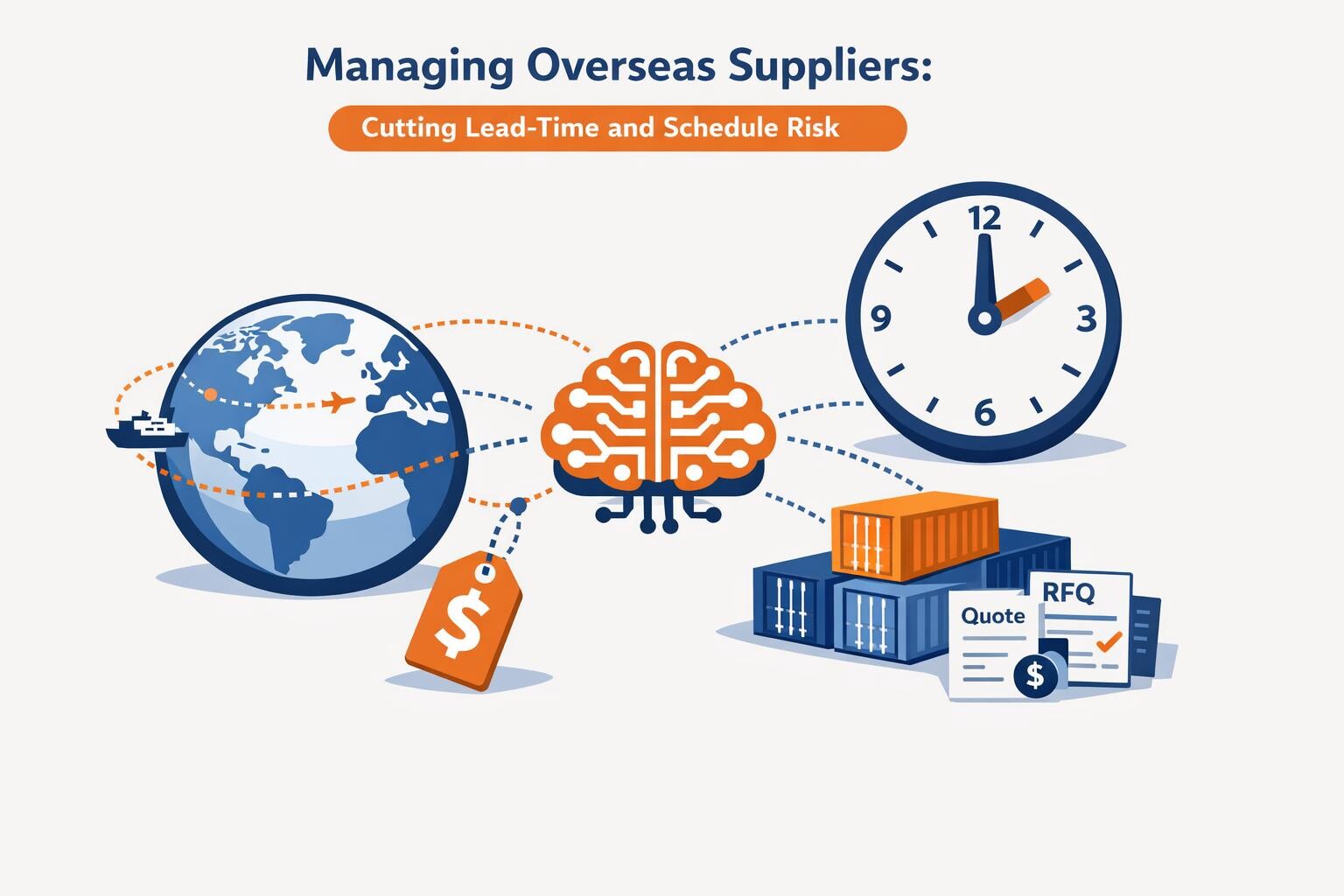
Managing overseas suppliers means capturing the price advantage of international sourcing while controlling the lead-time and schedule risk that comes with it. A factory abroad often quotes well below your domestic options, but it also brings another language, a twelve-hour timezone gap, and shipping schedules you cannot fully trust. A short answer version is in how to reduce lead-time risk with overseas suppliers.
Most buyers know the pattern. The best price lands in the inbox, then the back-and-forth begins. Clarifying a spec takes three days because every reply waits for the other side of the world to wake up. A quote arrives in a language you half understand. The container that was promised for the 12th shows up on the 20th. This guide lays out a practical way to keep the savings and shrink the delay. Deciding whether a category belongs offshore at all is a sourcing-strategy question, covered in our practitioner's guide to strategic sourcing.
Why do overseas suppliers offer better prices but cause delays?
Overseas suppliers usually win on unit price because of lower labor and input costs, but that gap gets eaten by friction: longer communication loops, translation effort, and shipping that runs late. Roughly one in three ocean shipments arrives off schedule, according to the Sea-Intelligence Global Liner Performance report (late 2025).
The tradeoff is structural. A domestic supplier sits in your timezone, speaks your language, and ships in days. An overseas supplier may offer a materially lower price but adds distance to every step: each clarification, each revision, each shipment. The savings appear up front in the quote, while the costs are spread across the whole cycle.
A common refrain we hear from buyers is some version of "my best prices are from overseas, but the back-and-forth in another language kills me." The price wins the comparison, but the process puts the schedule at risk, and managing overseas suppliers well means closing that gap deliberately. Suppliers face the same problem from their side, and the best ones study which quotes they win and lose to respond faster the next time you reach out. Where the supplier is in mainland China, the checks before the first order have their own route, covered in verifying a Chinese supplier in 2026.
The unit price is what you negotiate, but landed cost and lead time are what you actually pay. We cover that comparison fully in our guide to comparing supplier quotes fairly. A cheaper part delivered three weeks late can cost more than a pricier part delivered on time.
What are the real risks of sourcing overseas?
The real risks of overseas sourcing fall into four buckets: language and timezone friction, shipping-schedule unreliability, quality and compliance gaps, and longer RFQ loops. Each one adds days or uncertainty. In the Sea-Intelligence Global Liner Performance report (late 2025), late vessel arrivals averaged close to five days of delay.
Language and timezone friction
Two languages and a large timezone gap turn a simple clarification into a multi-day exchange. A question sent at 4pm your time may not get read until the next business day abroad, and the answer may not return until the day after that. Misread specs compound the problem, because each correction restarts the loop. This is a frequent frustration among buyers sourcing internationally, and we cover the response-gap side of it in why RFQs go unanswered.
Shipping-schedule unreliability
With around a third of ocean shipments arriving off schedule in the late-2025 Sea-Intelligence reading, and late arrivals averaging close to five days, a "guaranteed" delivery date is really a probability. Port congestion, blank sailings, and customs holds all stretch the timeline further. Treating the promised date as the actual date is the most common planning mistake.
Quality and compliance gaps
Distance makes inspection harder. A defect you would catch on a domestic dock might travel across an ocean before anyone notices. Compliance documentation, certifications, and material specs also need closer verification when you cannot easily visit the site. Before any of this, confirm the entity itself, its owners and its certificates through the sources in how to verify a supplier online.
Longer RFQ loops
Every stage of the request-for-quote cycle stretches across borders. Sending, clarifying, revising, and awarding each carry timezone lag. A loop that takes three days domestically can take two weeks internationally, which is why structure matters so much for cross-border supplier communication.
How do you write an RFQ that overseas suppliers can actually quote?
Write the RFQ so an overseas supplier can quote it without a single clarifying email: exact specs, explicit units, part numbers, Incoterms, currency, and a clear deadline. Ambiguity is expensive across timezones, where one missing detail costs days.
Every clarification an overseas supplier needs costs you a full timezone round trip, often two days. A complete RFQ removes those round trips before they start.
Include these elements on every international RFQ:
- Exact specifications with tolerances, materials, and grades stated explicitly. "304 stainless steel," not "stainless."
- Explicit units for quantity, price, and measurement. State whether price is per unit, per box, or per kilogram.
- Part numbers wherever they exist, including your internal reference and any manufacturer number.
- Incoterms so responsibility and cost split are unambiguous. FOB, CIF, DDP, and others mean very different landed costs.
- Currency stated outright, with payment terms.
- A clear deadline in the supplier's local date as well as yours.
A short, structured template works better than a long prose email. Consistent formatting also helps the supplier reply in a structure you can compare later. For the full method, see our RFQ best practices, which matter even more when a timezone gap makes every mistake costly.
State dates in an unambiguous format, a detail that is often overlooked. "06/07/2026" reads as June 7 in the US and July 6 in much of the world. Writing "7 June 2026" removes a small ambiguity that can derail a delivery schedule.
How do you handle the language barrier?
Handle the language barrier by translating both directions: send the RFQ in the supplier's language and read their quote in yours. Clear, native-language requests cut clarification cycles and speed responses. In Deloitte's 2025 Global CPO Survey, 67.7% of respondents cited enhanced decision-making as a top value they expect from generative AI (Art of Procurement, 2025).
A supplier reading a request in their own language understands it faster and quotes more accurately. The errors that trigger back-and-forth (a misread tolerance, a confused delivery date, a wrong unit) drop sharply when the request arrives in clear native language. You also remove the temptation for the supplier to guess at your meaning, which is where many overseas quoting errors begin.
Generic translation tools are risky for technical content. A consumer translator may render "lead time" or "MOQ" literally and lose the procurement meaning entirely. Purpose-built translation keeps terms like "FOB," "tolerance," and material grades intact. We go deeper on this in our guide to automatic email translation for suppliers, which covers how two-way translation keeps the original text available for verification.
Keep the original-language version on file alongside the translation, so you can verify a critical spec or price if a dispute arises. Also translate before you forward anything to a downstream customer or colleague. If you sit in the middle of a transaction, transforming and translating quotes before passing them on protects both the message and any pricing you need to mask.
How do you manage timezone and response-time gaps?
Manage timezone gaps with asynchronous structure: one complete message instead of many small ones, a defined follow-up cadence, and a single source of truth for the thread. The aim is to need fewer round trips, since each one can cost a full day. Timezone lag adds idle days on top of the working time each round takes.
The main change is moving from conversational exchanges to asynchronous ones. Domestically, you can fire off a quick question and get a quick answer. Across a large timezone gap, that habit wastes days. Batch everything into one complete message so the supplier can act on all of it during their working hours instead of stopping at the first question.
A defined follow-up cadence keeps quotes from stalling without nagging. A practical rhythm:
| Stage | Timing | Action |
|---|---|---|
| RFQ sent | Day 0 | Confirm receipt requested |
| First check-in | Day 3 to 4 | Polite reminder if no acknowledgment |
| Mid-cycle | Day 6 to 7 | Offer to clarify anything blocking the quote |
| Deadline | Stated local date | Final reminder, then proceed with what you have |
The cadence above is an illustrative example; tune it to your category and supplier relationship.
A single source of truth matters most of all. When an overseas thread scatters across inboxes, forwarded chains, and a side spreadsheet, details get lost in the timezone handoffs. An async process works when every request, quote, and reply is kept in one place, which is central to effective supplier communication.
How do you build lead-time buffers and reduce schedule risk?
Build lead-time buffers from the supplier's quoted date plus a realistic delay allowance, not the promised date alone. Because around a third of ocean shipments arrive off schedule, per the Sea-Intelligence Global Liner Performance report (late 2025), and late arrivals average close to five days, planning to the promised date means arriving late about one time in three.
Take the supplier's lead time, add transit time, then add a delay allowance sized to the route's reliability. For ocean freight on a busy lane, a buffer of a week or more is prudent given recent reliability. The exact number depends on your lane and season, but the promised date should be treated as a target rather than a guarantee.
Two structural moves reduce schedule risk beyond buffers:
- Dual-sourcing keeps a qualified backup supplier, ideally on a different route or in a different region, so a single delay does not stop your line. The backup does not need to win every order, but it has to be in place before you need it.
- Active tracking gives you visibility into each shipment. Learning about a delay three days early gives you time to react, while finding out on the expected arrival date does not. Over time, tracking supplier reliability with OTIF turns those late-arrival patterns into a sourcing signal you can act on.
In our experience, the biggest schedule failures come from learning about a delay too late. A late container is manageable if you see it coming a week out, and a crisis if you discover it the morning the goods were due. Buffers absorb routine slippage, and tracking catches the exceptions. With components, a single late part can idle a build, as we cover in where component distributors lose time and control.
How do you compare overseas vs domestic quotes fairly?
Compare overseas and domestic quotes on landed cost and total cost of ownership, never unit price alone. A lower foreign unit price can lose to a domestic one once you add freight, duties, delay risk, and inventory carrying cost.
Landed cost rolls every delivery cost into one number: unit price, freight, insurance, duties and tariffs, and handling. Total cost of ownership goes further, adding the cost of risk: the carrying cost of larger buffers, the expense of expedited shipping when a sailing slips, and the rework cost if quality varies. A complete comparison puts both options on the same footing.
The figures in this table are an illustrative example.
| Factor | Overseas supplier | Domestic supplier |
|---|---|---|
| Unit price | $4.00 | $5.00 |
| Freight and insurance | $0.55 | $0.10 |
| Duties and tariffs | $0.30 | $0.00 |
| Effective landed cost | $4.85 | $5.10 |
| Lead time | 6 to 9 weeks | 1 to 2 weeks |
| Schedule risk | Higher (ocean reliability) | Lower |
| Buffer inventory cost | Higher | Lower |
In this illustrative case the overseas price still wins on landed cost, but the margin is far smaller than the headline unit price suggested, and the lead-time and risk columns may tip a time-sensitive order the other way. For scoring methods that weigh these factors, see our quote comparison tips.
Where does AI and automation help with overseas sourcing?
AI helps with the tasks that slow overseas sourcing: extracting quotes from any format, translating both directions, normalizing units and currency, and running timed follow-ups across timezones. In Deloitte's 2025 Global CPO Survey, 67.7% cited enhanced decision-making as a top GenAI benefit (Art of Procurement, 2025).
Extraction
Overseas quotes arrive as PDFs, scanned documents, email-body pricing, and spreadsheets, often in another language. AI reads them and pulls out line items, prices, quantities, lead times, and terms, so you are not retyping a foreign-language PDF by hand.
Translation
Two-way translation keeps the RFQ clear to the supplier and the quote clear to you, with technical terms preserved. This reduces the clarification loops that timezone gaps make so costly.
Normalization
Different units and currencies make raw quotes hard to compare. Automation converts everything to a common basis, so a price per box in one currency lines up against a price per piece in another. This is central to fair supplier quote management across borders.
Follow-up
Timed, polite reminders run on schedule regardless of where you are sleeping. A reminder that fires at the right local hour recovers quotes a manual process would lose to timezone drift, addressing a root cause covered in our RFQ automation guide.
The gains are similar to domestic automation but larger, because every hour saved on extraction or comparison matters more when the alternative is a multi-day, multi-language round trip.
Manual vs automated international sourcing
Manual international sourcing relies on email, attachments, and a side spreadsheet stretched across timezones and languages, where each clarification costs a day. Automated international sourcing structures the request, translates both directions, extracts and normalizes quotes, and runs follow-ups on schedule.
| Dimension | Manual international sourcing | Automated international sourcing |
|---|---|---|
| RFQ creation | Free-text email, easy to leave gaps | Structured, complete request |
| Language handling | Generic tool or guesswork | Purpose-built two-way translation |
| Clarification loops | Many, each a timezone round trip | Fewer, gaps caught up front |
| Quote extraction | Manual retyping from foreign PDFs | Automatic, any format |
| Unit and currency normalization | By hand, error-prone | Automatic, like-for-like |
| Follow-up | Forgotten across timezones | Timed, runs on schedule |
| Comparison basis | Often unit price only | Landed cost and total cost |
| Audit trail | Scattered across inboxes | Captured in one place |
Automation does not make overseas suppliers risk-free, but it removes the mechanical friction that makes them slow, so the price advantage survives the cycle instead of being eaten by it.
FAQ
Why are overseas suppliers usually cheaper?
Overseas suppliers often quote lower unit prices because of lower labor costs, cheaper inputs, and scale in certain manufacturing regions. That advantage is real on the unit price, but it shrinks once you add freight, duties, and the cost of delay risk. Always compare landed cost and total cost of ownership, not the headline price alone.
How much delay should I plan for with ocean freight?
Plan for routine slippage beyond the promised date. The Sea-Intelligence Global Liner Performance report (late 2025) put global on-time vessel arrival at about 64%, meaning roughly one in three shipments arrived off schedule, with late arrivals averaging close to five days. Size your buffer to your specific lane and season, and treat the quoted date as a target.
What is the best way to handle the language barrier with suppliers?
Translate in both directions: send the RFQ in the supplier's language and read their quote in yours. Use translation built for procurement so technical terms, units, and Incoterms stay accurate. Keep the original-language version on file for verification. This cuts the clarification cycles that timezone gaps make especially costly and speeds accurate responses.
How do I reduce the timezone delay on quotes?
Work asynchronously. Send one complete message instead of several small ones, so the supplier can act on everything during their working hours. Set a defined follow-up cadence, and keep the whole thread in one place rather than scattered across inboxes. The goal is to need fewer round trips, because each one can cost a full business day.
Should I dual-source when buying overseas?
Often yes, especially for parts that would stop your line if late. A qualified backup supplier, ideally on a different route or in a different region, means a single delay or disruption does not halt production. The backup does not need to win every order, but it should be qualified and ready before you need it.
What Incoterms should I include in an overseas RFQ?
State the Incoterm explicitly so cost and responsibility are unambiguous. FOB, CIF, and DDP imply very different landed costs and risk splits, so leaving it out invites quotes you cannot compare fairly. Pick the term that matches how you want to handle freight and customs, and confirm both sides read it the same way before awarding.
Does AI help with international sourcing specifically?
Yes, because international sourcing concentrates the friction AI removes. It extracts quotes from foreign-language PDFs, translates both directions, normalizes units and currency, and runs timed follow-ups across timezones. Each manual step that costs a multi-day round trip with an overseas supplier is a step worth automating first.
Key takeaways
- Overseas suppliers usually win on unit price but add lead-time and schedule risk through language gaps, timezones, and unreliable shipping.
- Around one in three ocean shipments arrives off schedule, per the Sea-Intelligence Global Liner Performance report (late 2025), so plan to a buffered date, not the promised one.
- Write RFQs that need zero clarification: exact specs, units, part numbers, Incoterms, currency, and an unambiguous local deadline.
- Translate both directions and work asynchronously to collapse the timezone round trips that slow international quoting.
- Compare quotes on landed cost and total cost of ownership, never unit price alone, and dual-source critical parts.
- AI removes the mechanical friction in extraction, translation, normalization, and follow-up.