
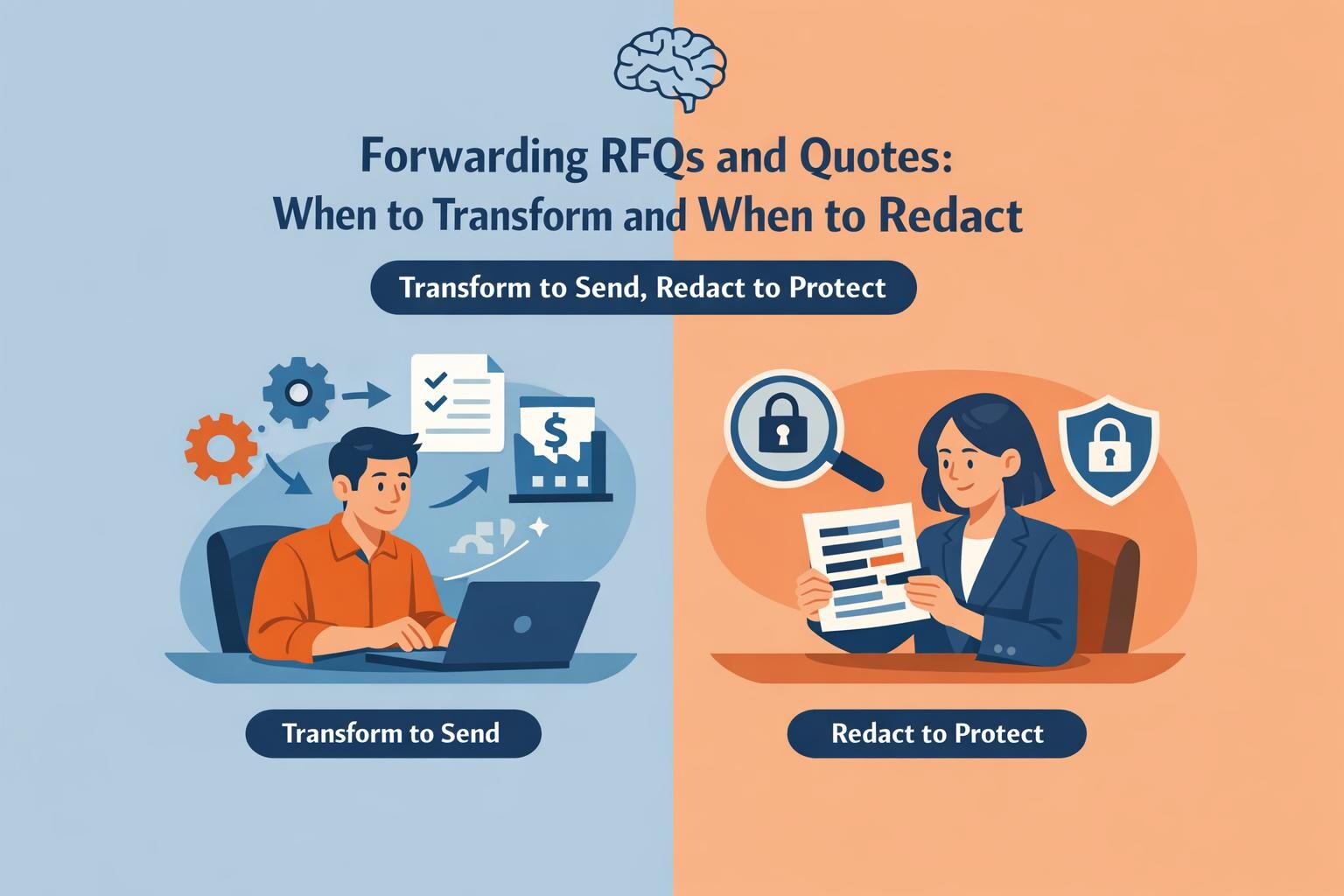
A distributor sits in the middle of a two-way flow. A customer sends you an RFQ, you forward it to suppliers, suppliers send back quotes, and you forward a quote back to the customer. At each hop the document needs two distinct kinds of processing: transformation to make it usable, and redaction to protect what must stay private.
Transformation reformats and restructures a document so the next party can act on it. Redaction removes or masks sensitive data before the document moves on. Confuse the two, or skip either one, and you risk slow quotes, leaked margins, or a customer who decides to buy directly from your supplier. This guide explains when to do each, in both directions.
What is the difference between transforming and redacting a document?
Transformation makes a document usable by the next party. It normalizes units, currencies, and part numbers, applies your template, and structures messy PDF or email content. Redaction makes a document safe to forward by removing or masking identities, cost basis, margin, and other private data.
The two operations often happen on the same document in the same step, which is why they get confused. When you forward a supplier's quote to your customer, you transform it onto your own template and redact the supplier's name and your cost basis at the same time. The two operations still answer different questions.
Transformation asks whether the reader can understand and act on the document. Redaction asks whether the reader should be allowed to see it. A clean, well-structured quote that still shows your margin is a transformation success and a redaction failure.
| Dimension | Transformation | Redaction |
|---|---|---|
| Purpose | Make the document usable and consistent | Make the document safe to forward |
| Acts on | Format, structure, units, language | Sensitive fields and identities |
| Typical examples | Normalize units, convert currency, apply template, translate | Hide supplier name, mask cost basis, remove margin and other bidders |
| Direction-neutral? | Mostly, both hops need it | No, what you hide depends on direction |
| Risk if skipped | Reader can't compare or act; slow cycles | Margin leak, disintermediation, cross-customer exposure |
A document can pass one test and fail the other, so check both before anything leaves your hands.
Why do forwarded RFQs and quotes need processing at all?
Forwarded RFQs and quotes need processing because the document that arrives is almost never the document that should go out. Formats clash, units differ, languages vary, and sensitive data rides along with the useful data. Every hop a document is forwarded without processing adds another round of manual rework.
As an intermediary, you handle two flows that pull in opposite directions. Inbound documents come in whatever shape the sender chose. Outbound documents must match what the receiver expects, and must protect the relationships you depend on.
Three problems make raw forwarding a mistake.
First, mismatched formats stall comparison. A customer BOM, three supplier PDFs, and an email quote will not line up until someone normalizes them. Passing the mess along just moves the work, and the errors, downstream.
Second, sensitive data travels by default. A supplier quote carries cost basis and the supplier's identity. A customer RFQ carries the customer's name, volume, and intent. Forward either untouched and you hand away leverage you cannot get back.
Third, the business depends on trust. Customers stay with a distributor because you absorb complexity and protect their position, and the processing layer is where that promise is kept or broken. We cover the operational side of this in detail in our look at where component distributors lose time and control.
When should you transform an RFQ before sending it to suppliers?
Transform an RFQ before sending it to suppliers whenever the customer's request is not yet in a shape your suppliers can quote against accurately. That usually means normalizing specifications, units of measure, and manufacturer part numbers, applying your own template, and translating language where needed. Clean inputs raise both response rate and quote accuracy.
A customer's RFQ reflects the customer's systems and habits rather than what your supplier base needs. Transforming it protects quote quality before a single supplier sees it.
Normalize specs, units, and part numbers
Restate quantities, units of measure, and tolerances in a consistent form. Cross-reference and correct manufacturer part numbers so suppliers quote the exact item. A mismatched MPN or an ambiguous unit produces quotes you cannot compare later. Disciplined quote normalization starts at the request rather than at the response.
Apply your own template and branding
Suppliers respond faster to a request that looks consistent and complete. Mapping the customer's content onto your standard RFQ template gives every supplier the same fields, the same deadline, and the same response format. Consistent RFQ templates directly improve response quality.
Translate where the supplier needs it
If your customer writes in one language and your supplier reads another, plan translation as part of the transformation. Sending a request in the supplier's working language reduces back-and-forth and misquotes. We cover this in automatic email translation for suppliers.
At this stage, transformation covers clarity and completeness only. What to hide from suppliers is a separate redaction question, covered later in this guide. For the wider request workflow, see our guide to RFQ automation.
What should you redact when forwarding a supplier quote to your customer?
Redact five things before a supplier quote reaches your customer: the supplier's identity, the cost basis, your margin, the prices of other bidders, and any internal notes. Anything that reveals where you sourced the item or what you paid for it must be masked.
The supplier quote that lands in your inbox is rich with information your customer should never see. Forwarding it raw is one of the most damaging mistakes an intermediary can make.
- Supplier identity. Name, logo, contact details, letterhead, and email headers. If the customer learns who quoted, they can go direct.
- Cost basis. The price the supplier charged you. This is the foundation of your margin and must never appear.
- Your margin. Any field, formula, or note that exposes your markup, even indirectly through a visible base price.
- Other bidders' prices. If you collected several quotes, none of the losing numbers belong in the customer's copy.
- Internal notes. Sales remarks, risk flags, negotiation room, and reminders left in the document by your team.
What remains after redaction is the customer-facing offer: the item, the quantity, the lead time, the delivered price under your name, and the terms you choose to present. You transform that onto your template and send it. For the comparison work behind choosing which quote to forward, see supplier quote comparison with AI.
What should you redact when forwarding a customer RFQ to suppliers?
Redact three things before a customer RFQ reaches your suppliers: the customer's identity, their volume and intent signals, and any competing suppliers visible on the thread. Suppliers who know exactly who the end customer is, and how badly they need the part, gain pricing power you would rather keep.
When you forward upstream, you protect the customer's position and your own role rather than the supplier's cost, so the fields differ.
- Customer identity. Company name, contact, and any branding in the original RFQ. A supplier who knows the end customer can court them directly or price to the customer's known budget.
- Volume and intent signals. Phrases like "urgent," "production down," or "annual contract" tell a supplier how much leverage they hold. Strip the urgency cues and keep only the firm requirement.
- Competing suppliers on the thread. Never let one supplier see who else you asked. Forwarded email chains and CC lists are the usual leak; send each request clean and separate.
What you keep is the quotable substance: the normalized spec, quantity, delivery target, and your response deadline. Sending individual, redacted requests also improves replies, since suppliers treat a clean direct request more seriously. Our piece on why RFQs don't get answered covers the response-rate side of this. Resellers bidding on government solicitations apply the same rule to the agency's identity, as described in sourcing supplier quotes for a government solicitation.
How does a two-way flow look from intake to delivery?
A two-way flow has four redaction-and-transformation gates: customer RFQ in, request out to suppliers, quotes in from suppliers, and quote out to the customer. At each gate you transform for usability and redact for protection. Mapping the gates explicitly is how intermediaries keep margin and identity safe as volume grows, the same structure behind reliable supplier quote management.
This example traces one buy in both directions, and its numbers are illustrative.
| Step | Direction | Transform | Redact |
|---|---|---|---|
| 1. Customer RFQ arrives | Customer to you | Read and structure the PDF or BOM | Nothing yet; this is your private input |
| 2. Send request to suppliers | You to suppliers | Normalize specs and units, fix MPNs, apply your template, translate if needed | Customer name, urgency and volume cues, other suppliers on the thread |
| 3. Supplier quotes arrive | Suppliers to you | Extract and normalize each quote to a like-for-like basis | Nothing yet; this is your private input |
| 4. Send chosen quote to customer | You to customer | Rebuild on your template under your brand | Supplier identity, cost basis, your margin, losing bids, internal notes |
Inbound steps (1 and 3) are pure transformation, because you are reading your own private documents. Outbound steps (2 and 4) carry both jobs, because something is leaving your control.
The cost basis at step 3 might be $3.10 per unit. The delivered price at step 4 might be $4.20 per unit under your name. The customer sees $4.20 and your template; they never see $3.10 or the supplier's logo.
What happens when redaction goes wrong?
When redaction goes wrong, four things follow: margin erosion, disintermediation, cross-customer price leakage, and broken NDAs. Each one is hard to reverse once the information is out. Because forwarded documents move fast and often, a single missed field can repeat across dozens of quotes before anyone notices, which is why the stakes justify a systematic approach.
Each failure maps to a specific leaked field.
Margin erosion
A visible cost basis tells the customer your markup. The next negotiation starts from your cost rather than your offer, and the margin you built disappears. One un-redacted base price can reset a whole account's pricing.
Disintermediation
If the supplier's identity slips through to the customer, or the customer's identity slips through to the supplier, the two parties can connect directly. You become a cost they route around. This is the existential risk of the intermediary model, and redaction is the main defense.
Cross-customer price leakage
Reuse a template without clearing the last customer's data and you can leak one customer's pricing to another. The harm compounds, because the second customer demands the first one's price and trust with both is damaged.
Compliance and NDA breaches
Many supplier and customer agreements forbid disclosing pricing or identity. A redaction slip can be a contract breach as well as a commercial risk. A clean audit trail of what was redacted, and when, protects you if a dispute arises. Clear supplier communication practices reduce these exposures further.
How do you transform and redact consistently at scale?
You transform and redact consistently at high volume by replacing memory and copy-paste with rules: field-level redaction policies, standard templates, and an audit trail that records every change. Manual handling fails as volume grows because attention does not scale. Rules keep processing fast and consistent as volume grows.
Consistency depends on the system rather than on individual effort. A buyer who reliably redacts on quote one will eventually miss a field on quote fifty, so the safe path needs to be the default.
Field-level rules and templates
Define, once, which fields are redacted in each direction and which template applies. The system then enforces it on every document, so protection does not depend on who handled the quote that day. This is where consistent quote comparison practices and standard templates pay off.
Where AI fits
AI handles the mechanical core in both directions. It extracts line items from messy PDFs and emails, normalizes units and currencies, applies automated field redaction by rule, and flags outliers, such as a base price that survived into a customer-facing copy. The human reviews and approves before anything sends.
Audit trail
Every transformation and every redaction should be logged: what changed, in which direction, and who approved the send. That record is your defense in an NDA dispute and your proof that the process held. The same audit discipline underpins reliable RFQ automation.
As in the rest of sourcing, automation handles the repetitive, error-prone work, and people keep judgment and accountability.
How do manual and automated processing compare?
Manual and automated processing differ most on consistency and risk. People get slower and sloppier under volume, while rules hold steady. An automated pipeline also applies redaction to every document, including the ones nobody remembered to check.
The differences shown in the table are illustrative examples.
| Dimension | Manual processing | Automated processing |
|---|---|---|
| Normalization of units and MPNs | Retyped by hand, error-prone | Extracted and converted automatically |
| Template application | Copy-paste per document | Applied by rule, consistent |
| Redaction in each direction | Depends on memory | Enforced by field-level policy |
| Outlier and leak detection | Easy to miss | Flagged for review |
| Speed per document | Slow, scales poorly | Fast, scales with volume |
| Audit trail | Often absent | Captured automatically |
The two approaches also fail differently. Manual processing fails silently, because a missed redaction looks exactly like a clean document until the customer or supplier acts on it. Automated processing fails loudly, because a rule either fires or flags. For an intermediary whose business depends on what stays hidden, a loud failure you can catch is better than a silent one you cannot.
FAQ
What is the difference between transforming and redacting a quote?
Transforming a quote makes it usable. You normalize units and currency, fix part numbers, apply your template, and translate if needed. Redacting a quote makes it safe to forward by removing the supplier's identity, cost basis, margin, and other bidders' prices. Both often happen at once, but one is about clarity and the other is about protection.
What should I redact before sending a supplier's quote to my customer?
Redact the supplier's identity, the cost basis you were charged, your margin, the prices of any other bidders, and internal notes left by your team. What remains is the customer-facing offer: item, quantity, lead time, delivered price under your name, and chosen terms. Forwarding a supplier quote raw exposes your markup and your sourcing.
What should I redact before sending a customer's RFQ to suppliers?
Redact the customer's identity, their volume and urgency signals, and any competing suppliers visible on the email thread. A supplier who knows the end customer can approach them directly or price to their known budget. Keep only the normalized specification, quantity, delivery target, and your response deadline so suppliers quote against firm requirements.
Why is forwarding documents raw so risky for a distributor?
Raw documents carry sensitive data by default. A supplier quote exposes cost basis and identity; a customer RFQ exposes who the buyer is and how urgently they need the part. Forward either untouched and you risk margin erosion, disintermediation where the two parties connect directly, and cross-customer price leakage. The information cannot be recalled once sent.
Is translation a form of transformation or redaction?
Translation is transformation. It changes the document's language so the next party can read and act on it, without removing any sensitive content. Redaction is a separate step, and even a perfectly translated quote still needs the supplier's identity and cost basis masked before it reaches a customer. Treat the two as distinct steps in the same forwarding workflow.
Can AI handle redaction automatically?
AI can apply field-level redaction by rule in both directions, mask defined fields, and flag a document where a sensitive value, such as a base cost, survived into a customer-facing copy. It also extracts and normalizes content for transformation. The human reviews and approves before sending, so judgment and accountability stay with people.
How do I stop a missed redaction from leaking margin?
Replace memory with rules. Define which fields are redacted in each direction, enforce them on every document with templates and automated checks, and keep an audit trail of what changed. Rule-driven processing fails loudly with a flag, rather than silently like a missed copy-paste, so leaks are caught before the document leaves your hands.
Key takeaways
- Transformation makes a forwarded document usable; redaction makes it safe to send. A document can pass one test and fail the other, so check both at every hop.
- When sending a customer RFQ to suppliers, transform the spec and redact the customer's identity, urgency, and competing suppliers.
- When sending a supplier quote to a customer, transform onto your template and redact supplier identity, cost basis, margin, other bidders, and internal notes.
- Redaction failures cause margin erosion, disintermediation, cross-customer price leakage, and NDA breaches, none of which can be reversed once sent.
- Consistency at high volume comes from field-level rules, standard templates, and an audit trail, with AI handling extraction, normalization, and automated redaction under human approval.
- An automated pipeline applies redaction to every document, including the ones nobody remembered to check.