
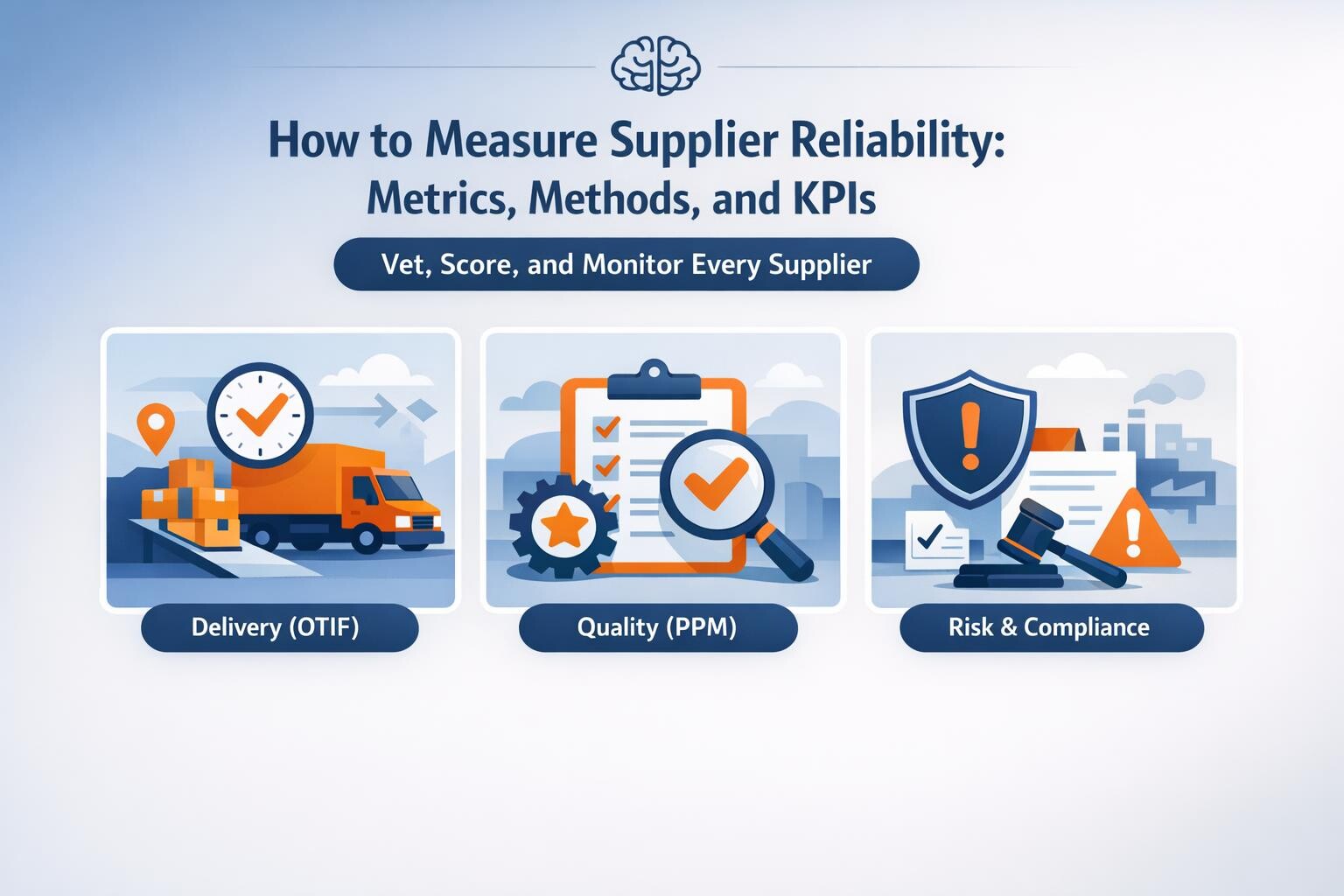
Supplier reliability is the consistency with which a vendor delivers what it promised: on time, in full, to spec, and at a stable price, order after order. It shows up as a pattern across deliveries, quality results, responsiveness, and the financial and operational health that sits behind them.
Most buyers can name their unreliable suppliers from memory. The harder task is proving it with data, before a late shipment stops a production line or a defect batch reaches a customer. The same blind spot shows up on the sell side, where the visibility problem behind win/loss leaves quoting teams guessing. Metrics make reliability something you can track, compare, and improve, which an impression held in memory does not.
This guide covers the metrics that measure reliability, how to vet a new supplier before you commit, how to build a scorecard, and how to monitor performance over time. It is a companion to our complete guide to managing supplier quotes, since the same data that wins an award should follow the supplier into the relationship. Scorecards are also the last phase of the cycle described in our practitioner's guide to strategic sourcing.
What is supplier reliability, and why does it matter?
Supplier reliability is the measurable consistency of a vendor's delivery, quality, and stability over time. It matters because unreliable supply is expensive, forcing buffer stock, expedited freight, and rework. World-class suppliers hold On-Time In-Full (OTIF) rates of 95 to 98%, with roughly 98% now the modern benchmark, according to SourceDay and Symestic.
Reliability determines how far the cost you actually pay drifts from the price you negotiated. A cheap part that arrives late, short, or defective carries hidden costs that do not appear on the quote, such as idle lines, emergency shipments, scrap, and lost customer trust.
Dependable supply also lets you run leaner, plan tighter, and commit to your own customers with confidence. Unreliable supply means every plan needs a buffer, and buffers cost money.
The stakes are rising across procurement broadly. 88% of procurement leaders have made supplier collaboration a higher priority in the past two years (Gartner via Exiger), and reliability measurement is the basis for that collaboration.
What metrics measure supplier reliability?
Supplier reliability is measured by a small set of operational metrics: OTIF, on-time delivery rate, fill rate, lead-time variance, defect rate in PPM (parts per million), and responsiveness. Together they capture delivery, quality, and consistency. OTIF is the headline measure, and world-class performance sits near 98%, per SourceDay.
Each metric misses something on its own. On-time delivery misses short shipments, and quality misses chronic lateness. A reliable supplier scores well across all of them, consistently, including in the months nobody is watching closely.
| Metric | What it measures | Formula | Benchmark |
|---|---|---|---|
| OTIF | Deliveries on time and complete | On-time and in-full POs / total POs | 95-98% (world-class) |
| On-time delivery rate | Deliveries arriving by promised date | On-time deliveries / total deliveries | 95%+ |
| Fill rate | Order quantity actually shipped | Units shipped / units ordered | 98%+ |
| Lead-time variance | Consistency of delivery timing | Actual lead time vs. quoted | Low and stable |
| Defect rate (PPM) | Quality of accepted goods | Defects / million units | <500 (precision); ~1,000 (F&B) |
| Responsiveness | Speed of quote and query replies | Avg. time to respond | Faster is better |
The PPM and benchmark figures above draw on LeanLinking and the OTIF sources noted earlier. A defect rate below 500 PPM is standard in automotive and precision manufacturing, while food and beverage typically runs near 1,000 PPM.
Why OTIF is stricter than on-time delivery
On-time delivery counts a shipment as a win if it arrives by the promised date. OTIF adds a second condition: it must also be complete. A delivery that lands on time but 10% short fails OTIF. That stricter bar is why OTIF is the metric large buyers enforce. Walmart's OTIF program raised the requirement from 75% in 2017 to 98% by 2020 and charges suppliers 3% of cost of goods sold for each OTIF failure, as documented by SourceDay.
Why lead-time variance matters as much as speed
A supplier with a steady four-week lead time is more reliable than one that swings between two and eight weeks, even if the second averages faster. Variance breaks planning, because you can buffer for a known lead time but not for one that moves. Track the spread as well as the average.
For a deeper look at evaluating suppliers on factors beyond headline numbers, see our field-tested quote comparison tips.
How do you build a supplier reliability scorecard?
A supplier reliability scorecard turns raw metrics into one weighted score so suppliers can be ranked and compared. A common, balanced split weights delivery (OTIF) at 40%, quality (PPM and non-conformance) at 30%, cost and commercial compliance at 20%, and soft metrics like responsiveness at 10%, according to LeanLinking. The weighting reflects what hurts most when it fails.
The scorecard combines several moving parts into a single, defensible judgment. Without weighting, every metric looks equally urgent. With weighting, a supplier's overall reliability becomes a number you can track quarter over quarter and discuss in a review.
| Criterion | Weight | Supplier A | Supplier B | Supplier C |
|---|---|---|---|---|
| Delivery (OTIF) | 40% | 5 | 4 | 3 |
| Quality (PPM) | 30% | 4 | 5 | 4 |
| Cost & compliance | 20% | 3 | 4 | 5 |
| Responsiveness | 10% | 4 | 3 | 4 |
| Weighted total | 100% | 4.20 | 4.30 | 3.70 |
The scores above are an illustrative example of the weights applied to three suppliers. Supplier B edges out Supplier A despite weaker delivery, because its quality and commercial scores carry weight. The scorecard reflects overall reliability rather than rewarding one strong metric.
Choosing your own weights
The 40/30/20/10 split is a sound default that you can adjust. A high-volume assembly line may push delivery weight higher. A regulated buyer may raise quality and compliance. Set the weights to match what actually disrupts your operation, document them, and apply them the same way to every supplier so the comparison stays fair.
Keeping the scorecard honest
A scorecard is only as good as the data feeding it. If OTIF is estimated from memory and PPM is guessed, the score means little. Capture each delivery and each quality result as it happens, so the quarterly number is a record rather than an estimate. We cover the data-capture habit in our guide to supplier communication.
How do you vet a new supplier's reliability before you buy?
You vet a new supplier's reliability before buying by checking the evidence you can gather without an order history: references, financial stability, certifications, a trial or sample order, and an audit where the spend justifies it. Early responsiveness also signals reliability. This vetting matters because predictive risk capability is rare. 93% of organizations remain at low maturity for predictive supplier risk management, per Deloitte 2025 third-party risk research. The document checks that come before any of this, confirming the entity, its owners, its permission to trade and its certificates, are covered in how to verify a supplier online.
A new supplier has no track record with you, so you assemble proxies for one. Each check closes part of the uncertainty gap before money changes hands.
References and financial checks
Ask for references from customers of similar size and product, then actually call them. Pair that with a financial check, because a supplier under financial distress is a delivery risk regardless of how good the quote looks. A vendor stretched on cash often stretches its lead times too.
Certifications and standards
Relevant certifications, ISO 9001 for quality management among them, show a supplier has documented processes rather than ad hoc ones. Certifications are not a guarantee of reliability, but their absence in a category that expects them is a flag worth probing.
Trial orders and audits
A sample or trial order tests reliability in practice. It shows the actual lead time, packaging, quality, and responsiveness when something goes wrong. For higher-spend or critical buys, an on-site or virtual audit verifies capacity and process before you commit volume.
Responsiveness as an early signal
How a supplier handles your RFQ is the first reliability data you ever get. Fast, complete, accurate quotes suggest an organized operation. Slow or sloppy responses during quoting rarely improve after the order lands. The most disciplined vendors run their own win/loss analysis for suppliers, which sharpens exactly the responsiveness you are measuring. Many response failures are operational, and we break down the causes in why RFQs don't get answered. For new overseas vendors, lead-time and schedule risk deserve extra scrutiny, which we cover in managing overseas suppliers.
How do you monitor supplier reliability over time?
You monitor supplier reliability over time by recording OTIF, fill rate, and defect data for every purchase order, then tracking the trend against set thresholds and reviewing it in regular business reviews. The shift from spot checks to continuous tracking is where most teams have room to grow, since 93% of organizations remain at low maturity for predictive risk (Deloitte 2025).
A single late delivery is noise, while a steady three-quarter decline in OTIF is a signal. Telling them apart requires capturing every order and watching the trend line rather than the last data point.
Track per PO, then watch the trend
Log on-time status, fill completeness, and any quality issue for each delivery as it happens. Capturing it at the moment takes seconds, while reconstructing it from memory at review time is impossible. Over a quarter, those entries become a reliable trend you can act on.
Set thresholds that trigger action
Decide in advance what counts as a problem. For example, OTIF dropping below 95% for two consecutive quarters, or defects rising above your category benchmark, should trigger a conversation. Thresholds turn passive monitoring into a process that prompts action rather than waiting for a crisis.
Run quarterly business reviews
For strategic suppliers, a quarterly business review puts the data on the table with the supplier. Share the scorecard, discuss the trend, and agree on improvement actions. Good suppliers want this feedback. The review also surfaces context that a metric alone would miss, such as a port strike or a raw-material shortage.
What are the warning signs of an unreliable supplier?
The warning signs of an unreliable supplier are mostly trends rather than single events: declining OTIF, rising defect rates, slowing RFQ and query responses, signs of financial distress, and your own growing dependence on a single source. These patterns usually appear well before a major failure. Catching them early is the main value of monitoring, especially since most teams still react rather than predict, per Deloitte 2025 third-party risk research.
Reliable suppliers rarely become unreliable overnight, and the signals accumulate over time.
- Declining OTIF or on-time delivery. A steady downward trend, even from a high base, predicts future misses.
- Rising defect rate. PPM creeping toward or past your benchmark signals slipping process control.
- Slower responses. Quotes and replies that used to take a day now take a week. Responsiveness often erodes first.
- Financial distress. Requests for faster payment, skipped shipments, or staff turnover can precede delivery failure.
- Single-source dependence. When one supplier becomes irreplaceable, its reliability problems become yours, with no fallback.
A buyer watching the trend catches the decline while there is still time to qualify an alternative or open a conversation. A buyer relying on memory finds out when a line goes down. Capturing the data makes the warning signs visible before they become emergencies.
How does supplier risk factor into reliability?
Supplier risk is the broader category that reliability sits inside. It includes the financial, geopolitical, and concentration risks that can turn a dependable supplier unreliable overnight. Exposure is now widespread. 90% of organizations have exposure to a high-risk geopolitical country or active conflict zone, according to Marsh Sentrisk data, which makes risk an unavoidable input to any reliability assessment.
Operational metrics tell you how a supplier has performed. Risk tells you how exposed that performance is to forces outside the supplier's control. A vendor with perfect OTIF in a region facing conflict or port disruption can become unreliable with little warning.
The main risk categories
Three risks bear most directly on reliability. With financial risk, a supplier in distress cuts corners or fails outright. Geopolitical risk, such as conflict, tariffs, and port disruption, interrupts even strong suppliers. Concentration risk, from depending on one source, removes your ability to recover when that source falters.
Why risk maturity is still low
Most organizations still manage risk reactively. Deloitte 2025 third-party risk research found 93% remain at low maturity for predictive risk management, and that 42% of risk leaders believe AI alone could cut third-party financial exposure by at least 20%, per the analysis published by JAGGAER.
Delivery risk is concrete and current. Ocean shipping on-time reliability ran about 64% in late 2025, meaning roughly one in three shipments arrived off schedule, per Sea-Intelligence Global Liner Performance (late 2025). For teams sourcing parts across many vendors, concentration and shipping risk compound, a problem we examine in electronic component distributor bottlenecks.
How can AI help measure supplier reliability?
AI helps measure supplier reliability by doing the data work that manual tracking neglects: capturing quote, PO, and delivery data automatically, calculating metrics like OTIF and PPM as orders close, flagging deviations, and surfacing early risk patterns. Gartner predicts 60% of supply chain disruptions will be resolved without human intervention by 2031.
The bottleneck in reliability measurement is data capture rather than the math. Metrics are simple to calculate but tedious to record consistently, order after order, which is exactly the work that gets skipped under time pressure.
Automatic data capture
AI reads quotes, purchase orders, confirmations, and delivery records from email and PDF, then files them as structured data. The OTIF and lead-time numbers a buyer would otherwise log by hand are captured as a byproduct of normal work.
Deviation flagging and predictive signals
Once data flows continuously, AI compares each delivery against the supplier's pattern and your thresholds, then flags deviations such as a slipping lead time, a fill-rate dip, or a slowing response. Over time those flags become predictive, pointing to which suppliers are trending toward trouble before they fail.
AI handles measurement and alerting, and the buyer keeps judgment, the supplier conversation, and the sourcing decision. A platform like Buyer24 captures the quote and order data automatically, but a person still decides what to do with a declining trend. For the underlying mechanics, see how AI compares supplier quotes and how RFQ automation feeds the same data pipeline.
Manual vs automated reliability tracking
Manual reliability tracking relies on spreadsheets and memory, so it is sporadic, backward-looking, and degrades as volume rises. Automated tracking captures every order as data and calculates metrics continuously, which is why early AI adopters report meaningful productivity and exposure gains. Deloitte 2025 research notes 42% of risk leaders believe AI alone could cut third-party financial exposure by at least 20%.
Both approaches use the same formulas, so the difference is consistency. A buyer can calculate OTIF perfectly and still track it badly, because no one has time to log every delivery by hand on a busy week.
| Dimension | Manual tracking | Automated tracking |
|---|---|---|
| Data capture | Logged by hand, often skipped | Captured automatically per order |
| Timeliness | Reviewed periodically, backward-looking | Continuous, near real-time |
| Consistency | Degrades under volume and time pressure | Steady regardless of volume |
| Deviation alerts | Noticed late, if at all | Flagged as they occur |
| Scorecard effort | Hours of assembly per cycle | Generated from captured data |
The figures and contrasts above describe typical patterns rather than a controlled study, so treat the specifics as an illustrative example. The lasting advantage is consistency, because manual quality fades on the fifth supplier of the day, while automated capture holds steady across the whole supply base. For the wider request-to-record picture, our supplier quote management guide shows where this data originates.
FAQ
What is supplier reliability?
Supplier reliability is the measurable consistency with which a vendor delivers on time, in full, to spec, and at a stable price, order after order. It also includes the financial and operational stability behind that performance. Reliability is a pattern across many deliveries rather than a single good shipment, which is why it is tracked with metrics like OTIF rather than judged anecdotally.
What is a good OTIF rate?
World-class suppliers hold OTIF rates of 95 to 98%, with roughly 98% now the modern benchmark, according to SourceDay and Symestic. OTIF counts a delivery as successful only if it arrives both on time and complete, so it is stricter than on-time delivery alone. Walmart's OTIF program enforces a 98% target and penalizes failures at 3% of cost of goods sold.
What metrics belong on a supplier scorecard?
A balanced scorecard weights delivery (OTIF) at 40%, quality (PPM and non-conformance) at 30%, cost and commercial compliance at 20%, and soft metrics like responsiveness at 10%, per LeanLinking. The exact weights should match what disrupts your operation most. Document them and apply the same weighting to every supplier so comparisons stay fair across your base.
What is a good PPM defect rate?
A defect rate below 500 parts per million is standard in automotive and precision manufacturing, while food and beverage typically runs near 1,000 PPM, according to LeanLinking. The right target depends on your category and the cost of a defect reaching production or a customer. Track PPM as a trend, since a rising rate signals slipping process control before a major quality failure.
How do you vet a new supplier with no order history?
Use proxies for a track record: call customer references of similar size, run a financial stability check, confirm relevant certifications such as ISO 9001, place a trial or sample order, and audit higher-spend suppliers. Treat early RFQ responsiveness as your first reliability data point, since slow or sloppy quoting rarely improves after the order is placed.
How often should you review supplier reliability?
Capture delivery and quality data for every purchase order continuously, then formally review the trend on a regular cadence. Strategic suppliers warrant quarterly business reviews where you share the scorecard and agree on actions. Set thresholds, such as OTIF below 95% for two quarters, that trigger a conversation so monitoring prompts action rather than waiting for a crisis.
Can AI predict supplier reliability problems?
AI can surface early warning patterns by tracking each delivery against a supplier's history and your thresholds, then flagging deviations like slipping lead times or fill-rate dips. Gartner predicts 60% of supply chain disruptions will be resolved without human intervention by 2031. Today, AI handles measurement and alerting while buyers keep judgment and the supplier conversation.
Why is supplier risk part of reliability measurement?
Risk is the broader exposure that can turn a dependable supplier unreliable: financial distress, geopolitical disruption, and single-source dependence. Marsh Sentrisk data shows 90% of organizations have exposure to a high-risk geopolitical country or conflict zone. Strong past metrics mean little if a supplier sits in a fragile region or is the only source you have, so reliability assessment must weigh risk too.
Key takeaways
- Supplier reliability is the measurable consistency of on-time, in-full, in-spec delivery plus the financial and operational stability behind it, tracked as a trend rather than judged from memory.
- The core metrics are OTIF, on-time delivery rate, fill rate, lead-time variance, defect rate in PPM, and responsiveness. World-class OTIF sits near 98% (SourceDay).
- A balanced scorecard weights delivery 40%, quality 30%, cost and compliance 20%, and soft metrics 10% (LeanLinking), with weights tuned to your operation.
- Vet new suppliers with references, financial checks, certifications, trial orders, and early responsiveness; monitor existing ones per PO against set thresholds and in quarterly reviews.
- Risk is part of reliability: 90% of organizations have exposure to a high-risk geopolitical country or conflict zone (Marsh Sentrisk data), and 93% remain at low maturity for predictive risk (Deloitte 2025).
- AI automates data capture and deviation flagging, with Gartner predicting 60% of supply chain disruptions resolved without human intervention by 2031; buyers keep judgment and the supplier conversation.