
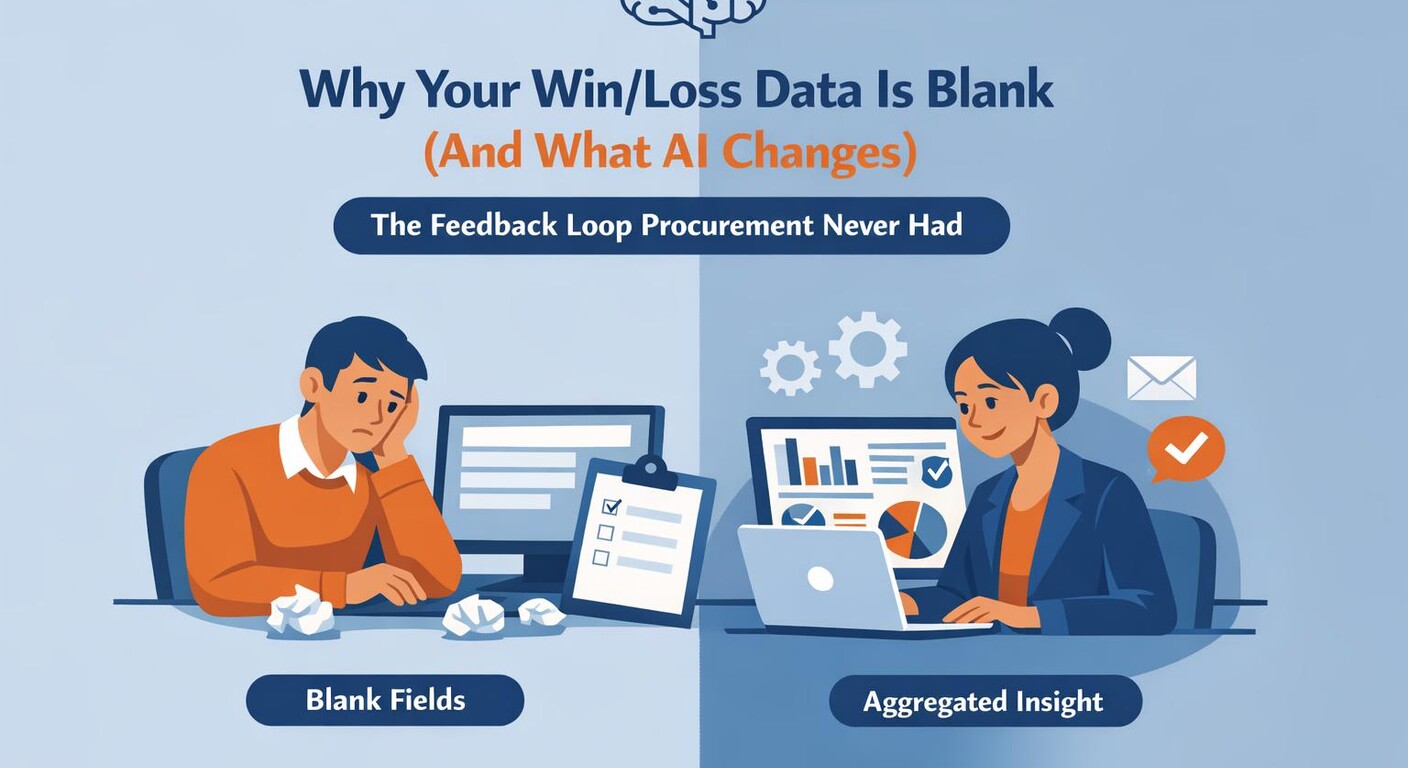
Win/loss is the dataset everyone claims to want and almost no one actually has. Ask any procurement or sales leader whether it matters why deals are won and lost, and you will get an emphatic yes. Yet between 80% and 95% of B2B lost-reason fields sit blank, according to crossnibble and Clozd.
The most valuable feedback in commercial work, the reason a quote landed or died, barely exists as data. This is because capturing it depends on a human logging an outcome they are busy, biased, or unmotivated to record.
Blank win/loss data is a design problem rather than a discipline problem. This post covers why it stays invisible, what AI changes by capturing outcomes passively, and why a two-sided view beats either party's internal system.
TL;DR: Win/loss stays invisible because it depends on people logging outcomes they are too busy, biased, or unmotivated to record, and 80% to 95% of B2B lost-reason fields are blank (crossnibble, Clozd). AI changes the economics by reading outcomes passively from the quote flow, and a two-sided network can show buyer and supplier the same picture, turning a blind spot into a feedback loop.
Why is win/loss the dataset everyone wants and no one has?
Win/loss is high value and low supply at the same time. Programs that study won and lost deals lift win rate by 10% to 20%, and 63% of companies running one report gains, rising to 84% once the program has run two or more years, per Clozd. Yet 80% to 95% of lost-reason fields are blank (crossnibble, Clozd).
The mismatch is strange until you look at where the data is supposed to come from. Win rate, pricing, product mix, all of it flows from one act: someone marking why a deal closed the way it did. When that act does not happen, the entire analysis has nothing to stand on. The analysis is straightforward; the input is missing.
So most teams operate on anecdote. They remember the loud losses and generalize from a handful of vivid cases. The quiet majority of outcomes, the quotes that simply went nowhere, never enter the record at all.
Key statistic: Win/loss programs lift win rate by 10% to 20% and 84% of mature programs report gains (Clozd), yet 80% to 95% of lost-reason fields sit blank (crossnibble, Clozd). The most valuable commercial dataset barely exists, which is why teams reason from memory instead of evidence.
For the mechanics of turning that quote history into a rate you can act on, see our guide to running win/loss analysis and the primer on what win/loss analysis involves.
Why do people never log why they lost?
People do not log losses because the work competes with everything else and usually loses. Already 32% of sales reps spend more than an hour a day on manual data entry, roughly 260 hours a year, per coffee.ai. Adding a loss-reason field to that pile is asking for time nobody has, on a task nobody enjoys.
Reps lose around 546 hours a year, about 27% of productive time, to data entry and chasing records, according to coffee.ai. When a system already eats a quarter of the week, the optional field at the end of a lost deal is the first thing to go. That is triage.
Motivation works against it too. Nobody rushes to document a loss they would rather forget. A won deal is worth logging because it looks good and triggers a commission. A lost deal is a small admission of defeat, filed after the fact, for a review that may never read it.
Which is why the only thing that reliably fills the field is force: a mandatory step, policed in review. Forced data is thin. People type "price" to close the ticket, because it is the fastest answer that ends the question. The record exists, but it does not tell the truth.
Key insight: Blank fields are a design outcome, not a character flaw. With reps already losing 546 hours a year to data entry (coffee.ai), any system that asks a human to log a loss will mostly fail or produce a lazy "price" that hides the real reason. Remove the ask, and the failure mode disappears.
We describe the same fragmentation on the supplier side in supplier quote management, where outcomes scatter across inboxes and never reach a single record.
How does visibility change behavior and management?
Visibility changes what a team can act on, and therefore how it manages. As colab91 puts it, what teams can see, they can manage, and what stays hidden, they respond to too late. The old adage holds in procurement too: what gets measured gets managed, per EDS International.
The shift is from anecdote to pattern. When outcomes are invisible, management runs on the loudest story in the room. When outcomes are visible, the same conversation runs on distribution: where you win, where you lose, and how those clusters move over time.
Visibility also changes the quality of decisions, not just their speed. Spend and outcome visibility changes what leaders decide, per Dynatos, because a decision made against a full picture differs from one made against a partial memory. You stop reacting to the exception and start managing the trend.
What the research shows: What teams can see, they manage; what stays hidden, they respond to too late (colab91), and what gets measured gets managed (EDS International). Visibility changes decision quality, not just speed (Dynatos). Win/loss visibility moves management from reacting to the loudest anecdote toward acting on the actual pattern.
This mirrors the buyer side, where teams measure supplier reliability from data captured automatically instead of impressions gathered after the fact.
What does invisibility do to judgment?
Invisibility does not just leave a blank; it lets memory fill the blank badly. Without a real-time record, teams reconstruct losses from recollection, and hindsight bias makes decision-makers overrate what they actually knew at the time, per BMT. The story you tell in the review is not the story that happened.
A deal dies; weeks later, at the monthly review, someone asks why, and the team assembles a tidy narrative that feels obvious in retrospect: of course we lost, the price was high, the timing was wrong. The account is confident and mostly invented, smoothed by knowing how things turned out.
In our experience, this is the quiet killer of win/loss programs. Teams genuinely believe they know why they lose, so they see no urgency in capturing it. But the reasons evaporate by the monthly review, replaced by a plausible reconstruction. A record made at the moment of the outcome preserves what was actually known; memory does not.
Evidence: Hindsight bias makes decision-makers overrate what they knew before an outcome, per BMT, so losses reconstructed weeks later at a review become confident fiction rather than fact. A record captured at the moment of the outcome is the only reliable defense, and it is exactly what a blank field fails to provide.
Can AI make win/loss visible without data entry?
Yes, and the shift is the whole point: AI captures outcomes passively from the quote flow instead of asking a human to type them. Every quote already moves through observable states, sent, revised, won, lost, gone quiet. AI reads those states as they happen. Nobody fills in a field, so the reason the field was always blank no longer applies.
This is why the design framing matters. A mandatory CRM field fights human incentives and mostly loses. Passive capture removes the fight. The data is a byproduct of work people already do, quoting and responding, rather than an extra chore bolted onto the end of a deal they would rather move on from.
Passive capture is also better at the losses humans hide. No-decision losses, where the buyer buys nothing at all, exceed losses to any single competitor by two to three times, per Clozd. Those are precisely the outcomes a person never logs, because there is no dramatic moment to record. A quote just stops getting replies. AI can flag that silence as a distinct outcome.
Speed becomes visible too. Responding within an hour makes a lead about seven times likelier to qualify, per Harvard Business Review, yet response time is another thing manual logging never captures. When capture is automatic, the timestamp is free, and the link between speed and outcome finally shows up in the data.
| Dimension | Manual CRM capture | AI passive capture |
|---|---|---|
| Who enters the data | A busy human, after the fact | Nobody, read from the flow |
| Completeness | 5% to 20% of losses recorded | Every resolved quote |
| Bias | "Price" typed to close the ticket | Actual outcome states |
| No-decision losses | Rarely captured at all | Flagged as silence |
| Response speed | Almost never recorded | Timestamped automatically |
Key takeaway: The design change is passive capture. AI reads outcomes from the quote flow, sent, revised, won, lost, no-decision, rather than asking a human to log them, which is why it catches the no-decision losses that outnumber any competitor two to three times (Clozd) and the response-speed signal humans never record.
This is the same redistribution of clerical work toward judgment that we trace in how AI reshapes procurement roles, pointed at the outcome data instead of the inbound quote.
Why does seeing both sides change the picture?
Because no single party can see the whole deal alone. A buyer sees only its own RFQs and the quotes that came back. A supplier sees only its own quotes and the ones it lost. Neither can compute the pattern that lives in the space between them: how your outcomes compare to everyone else facing the same market.
A network that sits between buyer and supplier can. It observes both sides of many deals, so it can show each participant an aggregated picture that neither internal CRM could ever hold. A supplier could see how its win rate against no-decision compares to peers. A buyer could see whether its RFQs draw fewer responses than the norm, a gap we examine in why RFQs don't get answered. The supplier's first step onto that network is simply being readable to the buyer's agent; see how to be found by AI buying agents.
This is the direction Buyer24 is building toward with two-sided win/loss visibility across its procurement network, so buyer and supplier could eventually see the same aggregated truth about where deals resolve. To be clear, this is roadmap, not a shipped feature, and any specific figure here would be an illustrative example rather than a measured result. It grows more useful as more quote and outcome data flows through one place.
The value is comparative. Average B2B win rates sit near 21% in 2024, slipping toward 19% in 2025, per Salesmotion. A figure like that means little in isolation and a great deal next to your own segment, and only a middle party can supply that comparison honestly, because it alone sees both sides.
Key insight: A buyer sees its RFQs; a supplier sees its quotes; only a party sitting between them can show each the aggregated pattern neither can compute alone. Against benchmarks like the ~21% average B2B win rate (Salesmotion), that shared view turns a private guess into a positioned fact for both sides of the deal.
What changes when win/loss becomes a feedback loop?
Win/loss stops being a quarterly autopsy and becomes a loop. Instead of assembling a post-mortem once a quarter from fading memory, the team captures outcomes continuously, sees the pattern as it forms, adjusts, and re-measures. Pricing, notably, is rarely the sole reason a deal is lost, per Satrix Solutions, so a live loop surfaces the non-price levers a memory-based review usually misses.
The operating rhythm is the difference. An autopsy tells you what already happened, too late to change it. A loop, capture, see, adjust, re-measure, lets you test whether last month's change actually moved the number. Management shifts from explaining the past to steering the present, which is what visibility was supposed to buy in the first place.
None of this requires more discipline from people already stretched thin. It requires removing the manual step that was breaking the loop all along. Once capture is passive and the picture is shared, the feedback loop runs on the work teams already do.
Key takeaway: A feedback loop replaces the quarterly autopsy: capture outcomes passively, see the pattern, adjust, and re-measure whether the change worked. Because price is rarely the sole loss reason (Satrix Solutions), a live loop keeps surfacing the non-price levers that a memory-based post-mortem reliably overlooks.
For the step-by-step mechanics of that loop, from calculating win rate to segmenting it, see the companion guide on win/loss analysis.
FAQ
Why are lost-reason fields usually blank?
Because logging a loss competes with everything else and loses. Between 80% and 95% of B2B lost-reason fields sit blank (crossnibble, Clozd), since reps already spend up to an hour a day on data entry (coffee.ai) and have little incentive to document a defeat. It is a design outcome, not a discipline failure.
Does win/loss analysis actually improve results?
Yes. Clozd reports that win/loss programs typically lift win rate by 10% to 20%, with 63% of companies seeing gains and 84% once a program has run two or more years. The constraint is almost never the analysis itself. It is capturing enough honest outcome data to analyze in the first place.
Can AI capture win/loss without manual entry?
Yes, through passive capture. Rather than asking a person to fill a field, AI reads outcomes directly from the quote flow, sent, revised, won, lost, or no-decision. That removes the human step that leaves fields blank and catches the response-speed signal, worth about a sevenfold qualification lift within an hour (Harvard Business Review), that manual logging never records.
What is a no-decision loss and why does it matter?
A no-decision loss is when the buyer chooses nothing at all, the quote simply goes quiet. It matters because these losses outnumber losses to any single competitor by two to three times (Clozd), yet humans almost never log them because there is no dramatic moment to record. AI can flag that silence as a distinct outcome. We unpack the full set of reasons in why suppliers lose quotes.
How does a two-sided view help both buyers and suppliers?
A buyer sees only its RFQs and a supplier only its quotes, so neither can benchmark against the wider market. A party sitting between them can show each an aggregated picture, your win rate versus peers, where you lose to no-decision versus price, against context like the ~21% average B2B win rate (Salesmotion). It improves the process on both sides.
Isn't this just better CRM discipline?
No. That is the contrarian point. More discipline still asks a stretched human to log a loss they would rather forget, so it fails the same way it always has. The fix is a design change: remove the human ask entirely with passive capture, and the reason the field was blank stops existing.
Key takeaways
- Win/loss is the dataset everyone wants and almost no one has: 80% to 95% of B2B lost-reason fields are blank (crossnibble, Clozd), even though programs lift win rate 10% to 20% (Clozd).
- Blank fields are a design problem, not a discipline problem. Reps lose about 546 hours a year to data entry (coffee.ai), so any system that asks a human to log a loss mostly fails.
- Visibility changes management: what teams can see they manage, what stays hidden they answer too late (colab91), and hindsight bias corrupts losses rebuilt from memory (BMT).
- AI makes win/loss visible without data entry by reading outcomes passively from the quote flow, catching the no-decision losses that outnumber any competitor two to three times (Clozd) and the response-speed signal (Harvard Business Review).
- A two-sided network shows buyer and supplier the same aggregated picture neither internal CRM can, useful against benchmarks like the ~21% average B2B win rate (Salesmotion).
- The payoff is a feedback loop, capture, see, adjust, re-measure, that surfaces the non-price levers a quarterly autopsy misses, since price is rarely the sole loss reason (Satrix Solutions).